Wednesday, October 4, 2017

Coober Pedy Outback


Coober Pedy does have more to offer than just opal mining. One possibility is to hitch a ride, for a fee of course, with the twice weekly mail run to outlying towns. The mailman has a medium size van which doubles as a taxi and tourist trip lasting about 12 hours through the real outback of the region. We will have to do that on another trip, but we talked to two ladies who had based their entire vacation on doing that ride and were not disappointed. The mailman does a good job of talking about the region as he drives the hundreds of miles from place to place.


We did do an afternoon tour into the outback with the same man who drove us to town from the airport. He is a busy guy as he also has a mine and is one of the people who guides the incoming planes to the proper resting spot. We were a bit concerned upon seeing that he would be our guide because he had been hard to understand and seemed very quiet. Fortunately, he turned out to be an excellent guide full of information and easy to talk to and understand.


We started with a tour of the town  including a stop at the Serbian Church and a visit to one of the museums. Linda and I had toured it the previous afternoon so she spent the tour time shopping for opals while I followed along on his tour. He shared a few things we had not heard the day before and told us that he had come to town to visit his uncle 20 years previous and had just stayed to become a miner. I’d say he is still looking for that big strike since he is doing all these other jobs in addition to the mine.


On our way out to our destination, Breakaways Conservation Park, he took us through one of the mining areas showing us clearly how dangerous it would be to tramp around the area on your own. Holes that are crumbling in from the edges mean the ground is very unstable and it would be easy to get too close. Apparently one very real danger is people with cameras backing into holes as they are framing that perfect shot. He also explained the noodling machine now being used by some miners to get at that 20% of opals that come up in the vacuuming process.


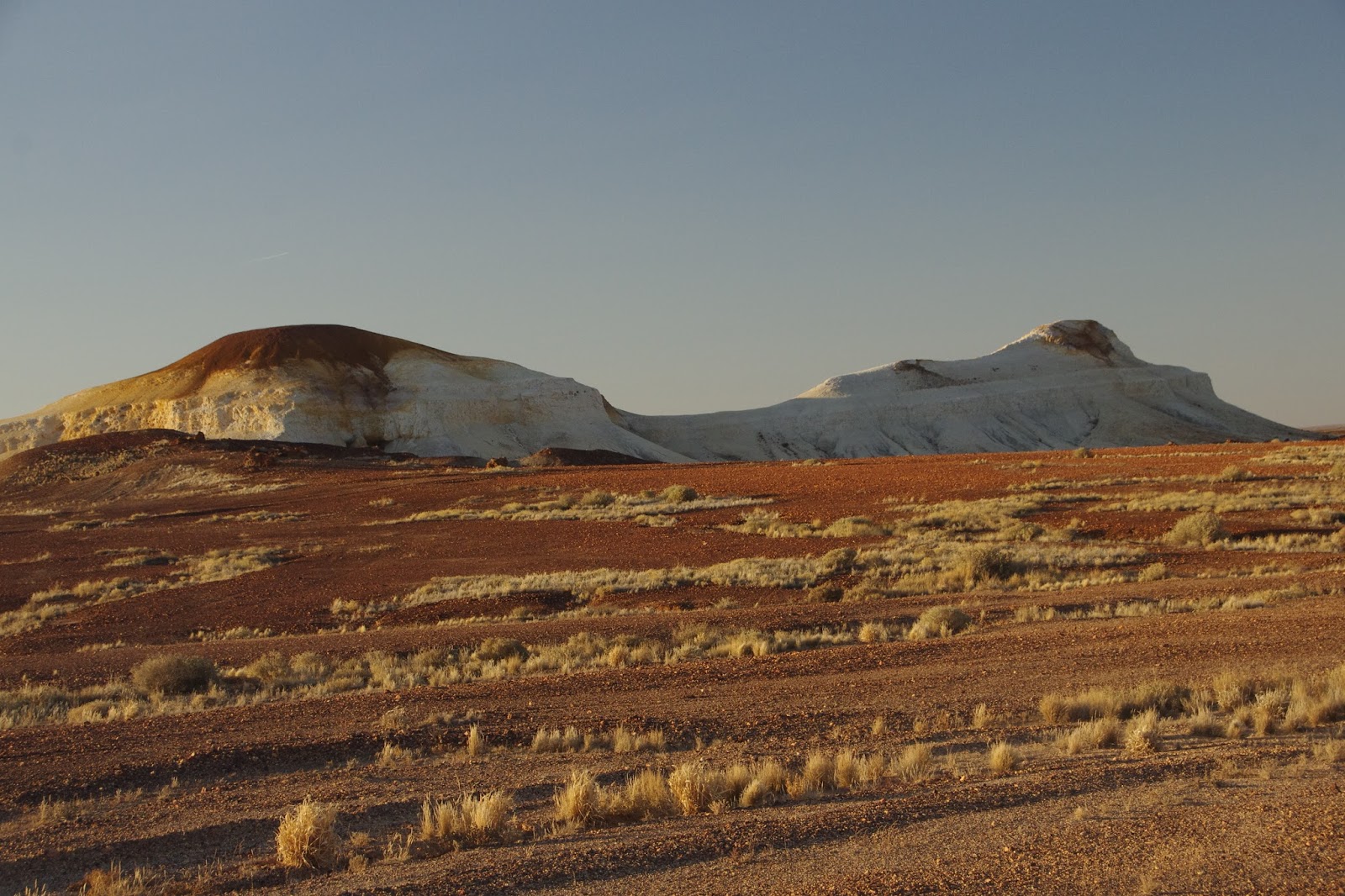
As we approached the Breakaways, we could see that they are appropriately named. They do appear to have simply broken away from the surrounding landscape. In reality, they are another example of hard stone harder that weathers more slowly the surrounding ground. Millions of years ago this was an inland sea so the area is also rife with fossils.


Wine and a platter of cheese and crackers
We spent about an hour in the fading light from our vantage point while our guide poured wine and we noshed on the cheese and meat plate he set out for us. Following our time there, we continued our drive through the park to the dingo fence. These wild dogs, native to Australia, wreak havoc on sheep and cattle so in the 1800s ranchers began fencing their land to keep the dingos out. In the 1880s, they decided with government help to build a longer fence that would serve the entire cattle/sheep region. It wasn’t until 1948 that it was finally completed, but now it runs 5600 kilometers enclosing parts of Queensland and South Australia and all of Victoria and New South Wales. Each local area is required now to keep the fence in good condition and repair any damage from large camels or kangaroos damaging it or other animals digging under it. Coober Pedy is responsible for about 400 kilometers of the fence. While it isn’t perfect and some still call for the complete extermination of the dingos, it works well enough to satisfy the ranchers.


Land beyond the dingo fence
We arrived back in town just before sunset, so we drove up to a panoramic hill for a few pictures there. After a short rest in our room, we crossed the street to a fabulous pizza place for dinner. I had one that had kangaroo sausage and cranberry paste big enough to finish off for breakfast the next day. The flavors melded wonderfully. I think it lived up to the hype that it is one of the best pizza places in South Australia.

And a few more pictures for your pleasure.


Don't bring your dirt to town


Monday, October 2, 2017

Coober Pedy Opal Mining


Opals - That is what Coober Pedy is all about - and now tourism, but the mining is what created the town and still is it major industry. Even today, town only exists because of opals. Without them there would be no tourism.


Will there be more behind here?
Opals may be in this seam
Opals were first discovered by the son of some men searching for gold. The boy was told to stay in camp while the men went off prospecting. A typical teenager when it comes to obeying Dad, the son did some exploring on his own. Dad was angry when they returned to camp to find him gone, but all was forgiven when he showed them what he discovered.
Lots of mining taking place here
Some of these mounds will be available for noodling
It may still be possible to find some opals above ground, but mining today required machinery and some luck. Once a claim is staked, the miner begins by drilling a nine-inch hole looking for evidence of opals. If he finds any evidence, the hole is widened to one meter and he begins working sideways in hopes of finding more opals. This work is done with a small caterpillar that has been lowered down the shaft. The cat is attached to a vacuum hose that sucks the rock out. This is a two-person job. One runs the cat while the other watches the rock fact hoping to see the opals appear. Once they find opals, the hard work begins as now they much use hand tools to pry out the opals. Otherwise the opals may be broken and disappear into the rock being sucked up to the surface.


Not much of a platform for working

In the old days all this work was done by hand. It would take two men two weeks to drill the shaft. Today that takes about one hour. And of course the work in the shafts is much easier, too. However, one downside to this method is that approximately 20% of the opals are sucked to the surface. This leads to a process called noodling where people, including non-miners, in some areas are able to sift through the rubble to try to find opals in this detritus. One lady tourist found a piece worth $5000 a couple of years ago doing just this. We spent about half an hour trying our hand at noodling joined by a small family. Let’s just say we did not have the luck she did. Today, some miners have developed a set of machinery to automate noodling using black light to illuminate the stones, but the majority of noodling is still done by individuals.


Pictures show the danger of these fragile shafts


All mining is dangerous work, but in Coober Pedy the danger is increased by the more than 250,000 mine shafts already dug and the crumbly nature of the rock. No one is allowed to be on any claim not their own which as much a safety measure as anything else. Signs all over town show the dangers of being near open shafts. Still, people fall down the shafts every year and have to be rescue if they survive the fall which isn’t likely. Miners are required to report any area they feel is dangerous. The area will be inspected and cordoned off if deemed too dangerous to work. Better to be alive and poor than the alternative.


Some mining is now done on the top - no tunneling

Seeing the machinery the miners use, much of it looks like it was made for a Mad Max movie, just made out of spare parts. They begin with an old truck or bus and add pieces to complete the job. Some probably look older than they are because of all the dust and there really is no point in washing them when they get dirty. Nevertheless, the machines work doing the job they are made for.


Noodling machine
Some of the most valuable opals are those formed as fossils. We saw a few of these on sale for several thousands of dollars. Some are complete shells and with the color of the opals, they make stunningly beautiful artifacts.


Opal mining is perhaps the only mining that has not been taken over by the large companies. There just isn’t any good way for them to industrialize the process, so it is still a place where any individual with some startup cash can have his or her own mine. Moreover, the law prohibits claims of over 165 square feet which have to be mined by you and/or your spouse. No third parties allowed. There is space for you if you a looking for some adventure.

Many who come to visit end up staying either because of the lure of the opals or just because it is a great small town. Linda saw a House Hunters episode filmed in Coober Pedy recently of a young family just looking for a nice place to raise kids.


Sunday, October 1, 2017

Coober Pedy

Coober Pedy Airport
Views of town

Coober Pedy is a small town about halfway between Adelaide and Alice Springs on the Stuart Highway. It has become a popular tourist attraction especially since the sealing of the road was completed in 1982 and a large tourism industry has built up since. The population is about 1500 with another 2000 in the general area so it is still a very small town. Coober Pedy takes pride in its multiculturalism with at least 48 nationalities amongst its residents.


Because of the heat (temperatures average over 100 degrees in the summer) most people prefer to live in ‘dugouts’ which are literally dug into the hillsides. The rocks maintain a fairly constant temperature in both summer and winter eliminating the need to air conditioning. Since the cost is about $10,000 per room, it is even economical to dig your house rather than build it once you have purchased the hillside. Rooms can be built to any size and made to feel homey in spite of the lack of windows. As our guide said, cutting out a ledge for knickknacks or books or even seating is an easy addition to the home. The walls are a beautiful red and black varnished to stop the dust that would otherwise be a big problem. Bathrooms and kitchens are placed close to the entrance to lower plumbing costs. Toilets require a septic tank, but some are able to simply use an old mine shaft in spite of the legal prohibitions against that practice.


Our hotel and museum
Our hotel lobby
Most of the hotels in town are also dugouts. Our hotel was one of these. We had been told we would be sleeping underground, but it felt like any other hotel room other than the fact that the walls were all obviously carved out of the hillside. Our hotel also included a museum, restaurant, bar, and shops all underground.
Another museum
At least four different museums have been created out of old mines to show off both lifestyles and mining techniques. The town also has at least 15 opal shops, many run by miners who advertise being direct to consumer without middleman markups. It’s hard to tell if this is actually true, but it is a good marketing ploy.


Catholic Church


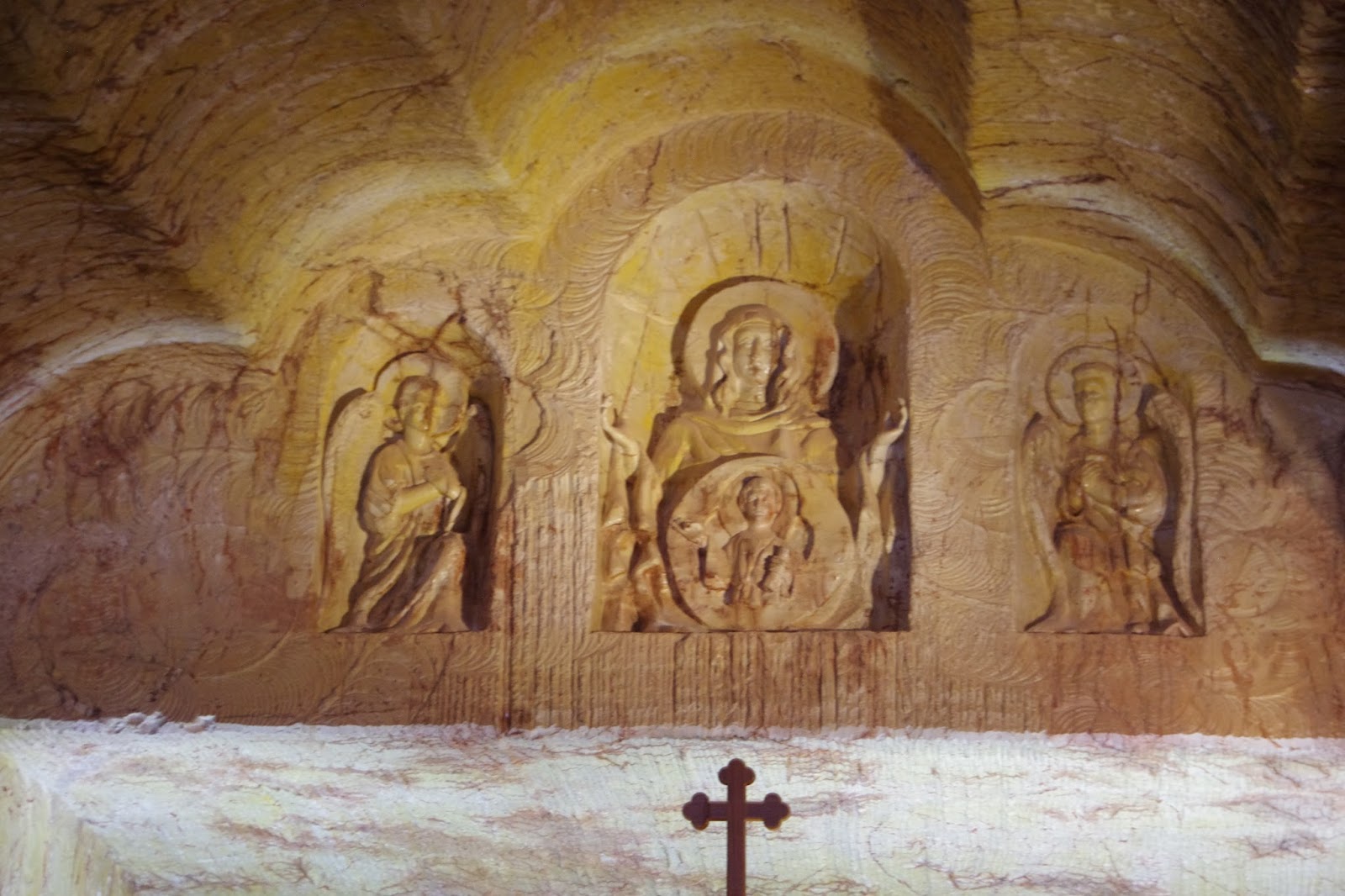
The town has several churches including a Catholic church on the main street, a Greek church and cemetery on a side street, and a large Serbian church away from downtown. The Serbian church was built with mining money when a successful Serbian miner left his money for the building of the church. It is much larger than the Catholic church and includes some excellent carving work and a separate large meeting room.
The Serbian Church exterior


One of the most intriguing parts of town is the golf course. Golfers carry their own grass mats as their is no grass. (Actually there are two spots of real grass in town. One is at the high school and the other is at the oval where they play Aussie Rules Football and cricket.) There are a few shrubs, but no tree or water hazards. No need for additional sand traps either. Greens are black, oiled sand which golfers must rake when they have finished putting. I played on similar ‘browns’ when I was in Ghana. There the putting was made easier by sloping the sand just around the holes. Because of the heat, most golf is played at night with night-glow balls. The club has a reciprocal agreement with St. Andrews in Scotland, the only club in the world with such an agreement. Our guide told us that some golfers join Coober Pedy without ever coming to down just to take advantage of that arrangement.

Warning to non-golfers


One of the 'greens'


From a tourist perspective, our travel agent told us we did not want to drive to either Coober Pedy or Uluru because of the distance and condition of the roads. While it is about 500 miles from Adelaide and another 500 miles to Uluru and that is more time than we wanted to spend on the road this trip, the road itself is sealed and it very good condition all the way to Darwin. If we had more time, driving would have been an excellent option allowing us to see much more of this wild country.

Additional scenes around town. Note the humor in some of them.


Space ship from a Vin Diesel movie
We thought it was left over from a Mad Max movie


The first tree in town, a metal sculpture
Photo of a dust storm.
Not while we were there.