Tuesday, September 26, 2017

Great Ocean Road 3

Six (or seven) Apostles
Our third day on the Great Ocean Road would be the most spectacular and weatherwise the most problematic. We enjoyed a few sunny moments, but it was mostly cloudy with a few torrential showers thrown in the the weather gods for our viewing pleasure. Even with the poor weather and at times lousy visibility this 25 mile section of the Great Ocean Road has to be easily one of the top two or three drives in the world.


Typical inland scenery
Our drive today did begin with about 50 miles of inland travel. We actually started with a coupld of miles along the coast until we left Apollo Bay and then touched the coast once more at Castle Cove.


Once we hit the coastline again, we never traveled more than five miles without stopping for a look at something magnificent. Often these stops were to look a sea stacks, but other times we looked and small bays and inlets and a couple of bridges created by the massive waves that travel north from Antarctica across the Southern Ocean. As the waves batter the beautiful orange sandstone, they eat away at the rock first creating small inlets which become bridges and stacks before finally being completely beaten down and disappearing. The makes the coast for extremely hazardous for ships and during the days of sail, shipwrecks were a common occurrence.


Gibson Steps
One special stop is Gibson Steps where you can walk down about 100 steps to the beach. Considering the weather we passed up this opportunity.
The Twelve get their own visitor center


Shortly after Gibson Steps are the Twelve Apostles, probably the most famous and most photographed of all the highlights along the Great Ocean Road. They have been called Sow and Pigs or the Pinnacles in the past and when first named there were thirteen although Wikipedia says there were only nine. We are sure that the ninth one fell in 2005. Of varying sizes, we could see that the days are numbered for a couple more of them, while at the same time, we could see spots where more are being created. It’s just a matter of geologic time so these may not happen in our lifetimes.


More of the Twelve Apostles


Shortly after the Twelve Apostles we stopped at Lord Ard Gorge named for the ship that wrecked here in 1878 with only two survivors. It could have been a great love story as the man who survived managed to pull the woman to shore with him. Unfortunately for the Cupid in all of us, she soon returned to England to be with what remained of her family while he stayed in Australia where he lived a long and successful life. Some of the dead are buried on the hill overlooking the Gorge.


Gorge pictures show new stacks being created


The ocean is relentless


Near to Lord Ard Gorge and its cemetery at the same stop is Mutton Bird Island. Mutton Bird is the local name for the Short-tailed Shearwaters who will be arriving in a few days from the Aleutians in the hundreds of thousands to breed all along the Aussie Coast. I did read that global warming is devastating their food in Alaska and there has been a large die-off. Scientists aren’t sure how many have died but thousands have been washing up on the shores of Alaska. Other seabirds are suffering a similar fate in Alaska as evidenced by the emaciated bodies washing up on shore.


Muttonbird Island


London Bridge is another famous stop because of its history. Formerly it consisted of two arches connected to the mainland. The span closest to the mainline collapsed on 1990 leaving just the outer arch. Fortunately no one was on the arch when it collapsed, but the couple beyond it had to be airlifted to safety.

All fall down
One of those torrential downpours caused us to bypass The Grotto for a bit as we headed to the end of the coastline at the Bay of Islands. It was still raining when we got there, but I still ventured out to the end of the trail through the stinging rain. I was glad I did because I had some of the best views of sea stacks close to the end of their lifespan and other spots where they are being created.

Bay of Islands


This stack won't last much longer
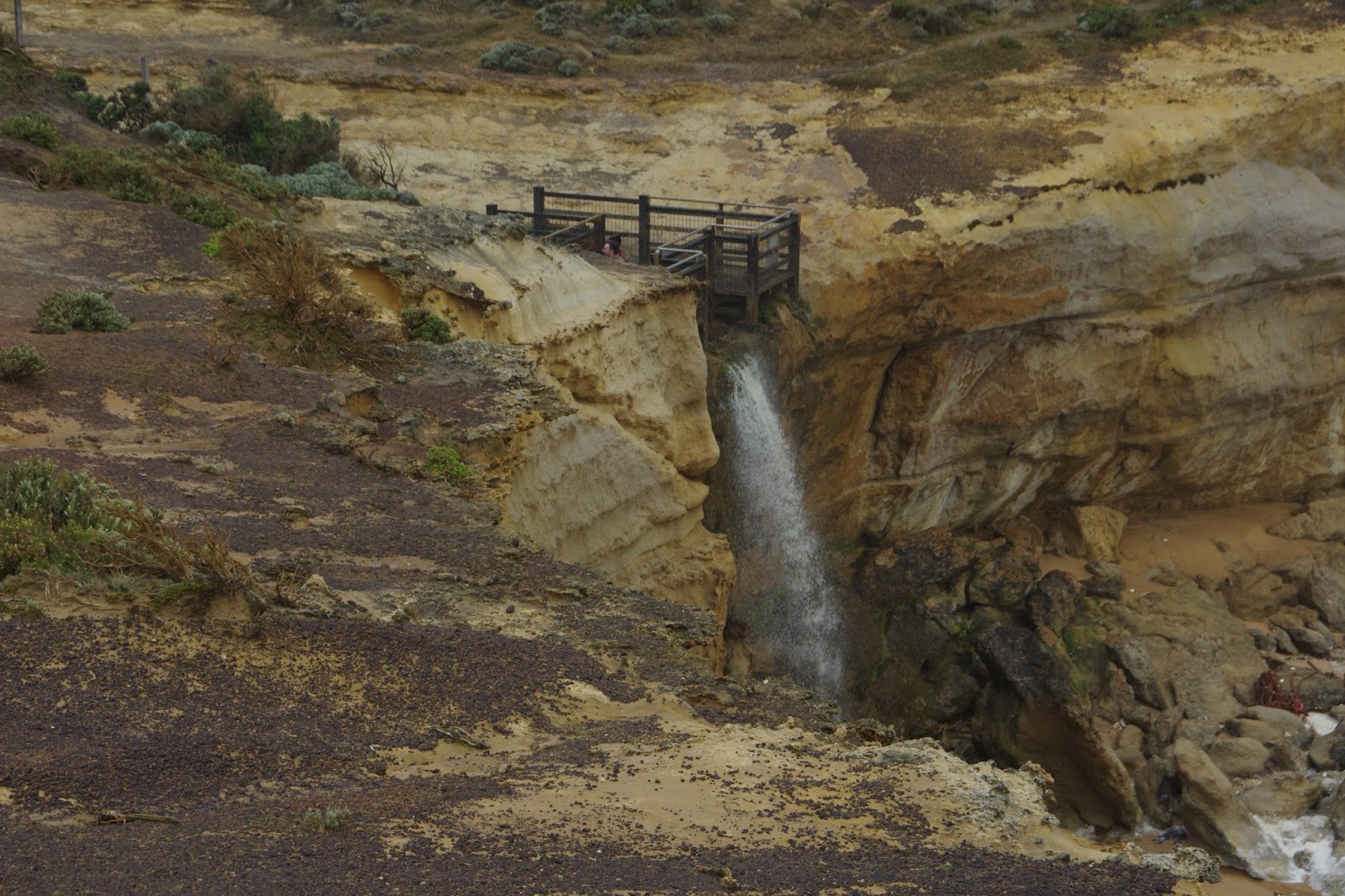
We then headed back to The Grotto for a look before we turned north to our next stop in Ballarat. I almost suggested that we had seen enough and might just as well pass The Grotto without stopping for a look. Fortunately, that fleeting thought fled before being implemented as this was a completely new look at the power of the ocean. The Grotto is an arch protecting a small pond created by the waves. Amazingly this pond is several feet above the level of the ocean. Two ladies we met there had come hoping to see the waves high enough to be splashing into the pond. However, even with the high winds, the tide wasn’t high enough for us to see this phenom
enon. It was still worth the short walk and the rain held off long enough for us to get a good look.

The Grotto


We made one stop on our way north to Ballarat at the Timboon Distillery. It had been recommended at the Information stop in Lorne as a good place to eat. We arrived at 4:30 just as it was closing. We did still get a tasting and a piece of caramel cake to tide us over until dinner in Ballarat two hours later. The folks there were fun and informative about the area and the liquor. We tried their whiskey, vodka, and limoncello. We would have purchased some, but we would too soon be on a plane to Cooper Pedy and its opal mines. We had dinner at the Daily Mail Hotel, one of the many pubs in Australia with hotel in the name but no rooms to let.

And some more pictures of this last day on the Great Ocean Road.


Monday, September 25, 2017

Great Ocean Road 2

The Great Ocean Road Memorial March

Honoring the men who built the road
Today our goal was Apollo Bay and Chris’s Beach Point Cabins and Restaurant recommend by the folks in Torquay. It took about five hours to travel those 60 miles giving us time to visit the lighthouse at Cape Otway. Obviously we made several stops along the way at places with names like Cathedral Rock, Cinema Point, Big Hill, and Artillery Bay.

This sign greets drivers after every view point.
Obviously they understand a lot of us are new at this.
Several miles beyond Aireys Inlet, we passed through the Great Ocean Road Memorial Arch at Eastern View. At one time this marked the official eastern end of the road although today that is officially at Torquay. Here we saw one of the many bronze plaques created to describe the history of the road. Unfortunately, some of them are worn down to the point that they are difficult to read. That is surprising since they are less than 20  years old.


One major stopping point is the town of Lorne and its Visitor Center. Australia does a much more extensive job of creating Visitor Centers than we do in the US where they tend to be few and far between and often only when one enters a state. And then they can be hard to find. The ones in our home town, Vancouver, and across the river in Portland are downtown making them difficult to find.


Views from Teddy's Point

The lady there recommended a visit to Erskine Falls and Teddy’s Point before leaving Lorne. We skipped the hour drive to Erskine Falls, but did venture up the hill to Teddy’s Point where we had some good views of the town and coastline. We stopped for a quick lunch at Wye River and then headed on a few more miles to one fo the best stops on the road, Kennett River, home to several wild koalas and lots of birds.


A short walk from the parking lot and restaurant into the forested camp area and we were getting some great views of koalas taking their day-long naps. A couple were slightly active and they had decided to pose nicely for the cameras allowing us to get some good pictures. We spent about half a hour there before heading on.
Eastern Rosella begging for scraps
Sulpher-crested Cockatoo
We passed through Apollo Bay without seeing our hotel and just figured we had missed it. From Apollo Bay the road turns inland through the Great Otway National Park. The lighthouse is a few miles off the main road through the rain forest. Again we passed up the climb even though the lighthouse park includes more displays and guides to talk about the park and the Aboriginals who lived there. Instead we walked up and down the coast a bit for some distant views. Typical weather for this time of year meant we had both a short heavy shower and sunshine during our half hour walk. This lighthouse is the first build on the Australian mainland built in 1848.


On the way back to Apollo Bay we made a quick stop at Mait’s Walk. There is a one-mile walk through the rainforest including information signs that would be good to do another timer.


Trusting Google we passed back through Apollo Bay to Skene Inlet where we started uphill with some trepidation. We had expected a hotel on the water. This would not be on the water but about five miles up the hillside to one of the most spectacular hotel and restaurant viewpoints anywhere. Our room had floor to ceiling windows and a deck overlooking the ocean below. The large restaurant shares the same view. The food was excellent. I started with some beautiful oysters from Coffin Bay further west on Australia’s south coast. For dinner I had barramundi and Linda a nice duck. The waiter told us you must have a booking to eat there during summer. We could see why.

View from our room