Thursday, November 16, 2017

Wanaka Nature


While Wanaka and Queenstown are separated by mountains, together they are the heart of New Zealand’s outdoor activities. Both towns have a beautiful lakeside setting and are filled with hotels, restaurants, and stores ready to fulfill every outdoors activity one can imagine. Queenstown is the larger of the two and has become quite a nightspot in its own right. It is also the jump-off point for tours to Milford and Doubtful Sounds, two of New Zealand’s western fjords. Wanaka, where we stayed is a bit more sedate, but still offers beautiful scenery, access to outdoor activities of all types, some good restaurants, and two unique movie theatres.


On the way to Queenstown, the highway travels between the shores of Lake Wakatipu which curves past Queenstown into the foothills of the Southern Alps and the Remarkables, a mountain range that rises directly from the shores of the lake. From Queenstown, we had a choice of roads to Wanaka. The main highway is easier but also longer than the route we chose over the mountains. Even with a stop at the Wet Jacket winery, the drive only took a couple of hours up and down the mountainside to Wanaka. The Cardona ski area sits about halfway between the two cities supplementing ones closer to each city. We heard the pub at Cardona is excellent, but will wait for another day on that.


Wanaka sits on Lake Wanaka only a few miles from Lake Hawea. If one follows the highway from here for about 100 miles over those Southern Alps you will reach Haast. From there another 300 miles or so follows the coastline before turning inland and back to the Marlborough wine country at the north end of South Island. That is a drive for another trip. Even with two weeks on this island we are only seeing a small part of its wonder and beauty.


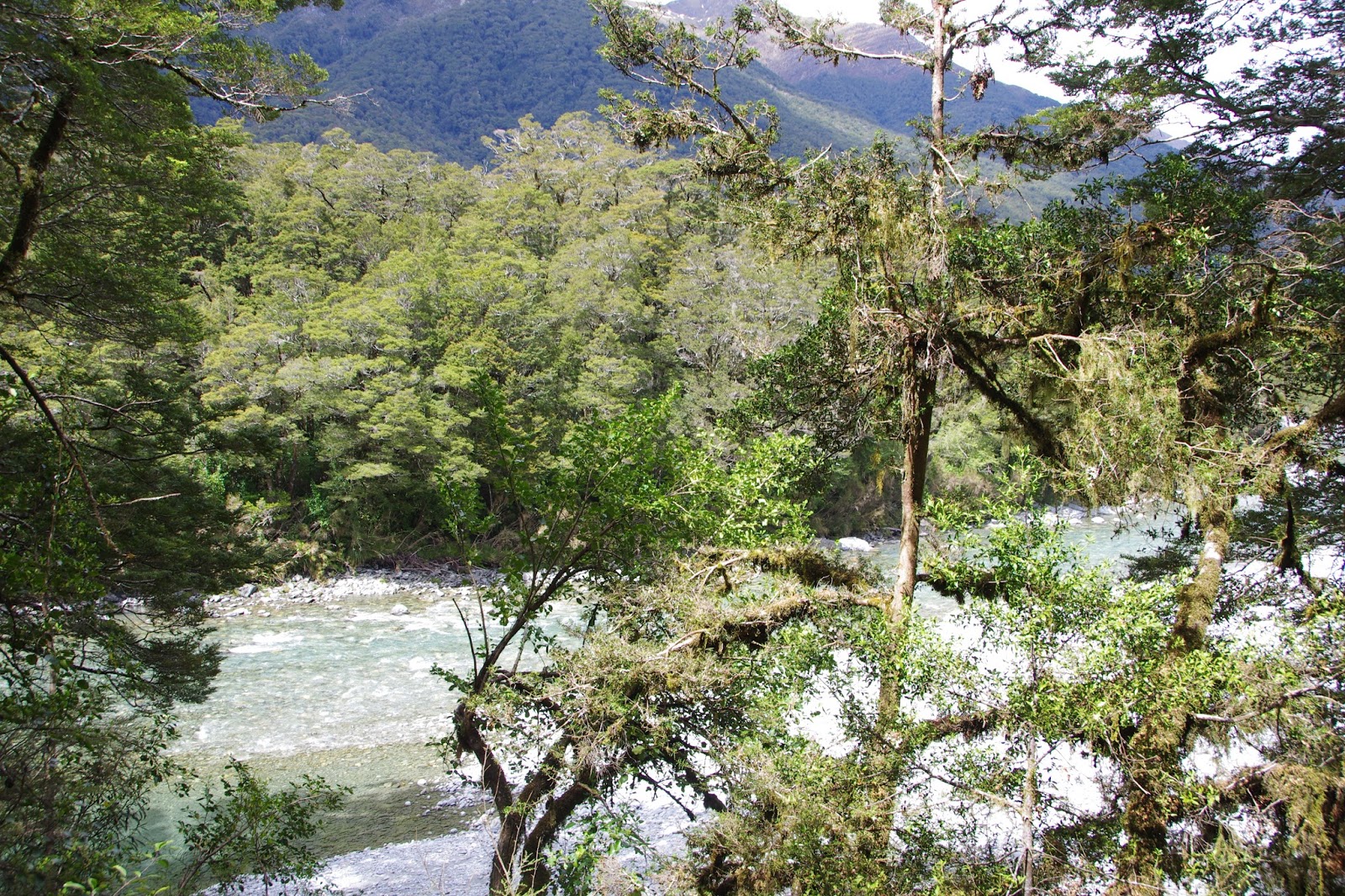
We did follow that road along both lake shores for about 40 miles as we headed to a short hike to see the Blue Pools. This hike is just a bit over a mile down and back to the confluence of the Makarora and one of its tributaries. The tributary floods yearly leaving gravel deposits and blue and turquoise pools of clear water for swimming and sunning on the rocks. Two suspension bridges offer excellent overhead views of the pools and a short trail takes hikers down to the pools. On a hot summer day, it’s hard to imagine a nicer spot to cool off after hiking in the nearby hills. We spent half an hour enjoying the scenery and watching a tomtit play in the trees before heading back up the hill to our car. Even though the weather was a bit cool, we saw a lot of hikers and several taking advantage of the swimming hole.


Tomtit


We stopped on our way back to town at a small cafe in the village of Makarora for a sandwich. This is one of those restaurants one finds in the mountains that caters to tourists, especially those on bus tours. One bus was there ahead of us finishing their meal. We watch one of the tourists finishing his five bowls of ice cream. He said he was having dessert so as not to spoil his afternoon tea (dinner). I don’t think any of his fellow passengers or the wait staff believed this explanation as we all marvelled at his ability to eat that much ice cream.

Lake  Wanaka

After lunch we headed out to Archangel for some wine tasting and then back to town to try out the Cinema Paradiso and compare it to the McMenamins theaters in the Portland area. Like McMenamins, Cinema Paradiso offers beer and wine and food for your enjoyment as you watch the movie from comfortable lounge chairs and sofas or the seat of an old car where you can reminisce about old-time drive in movie theaters. What makes this one unique is the halftime when the audience is invited to take a break with a fresh-baked cookie and some ice cream. I had a cookie but passed on the ice cream. Thor Ragnarok was only part of the fun. Wanaka offers another theater of distinction, Ruby’s Cinema and Bar. Ruby’s claims to harken back to the 1920s when attending a movie was an event. It also also offers alcohol in its sumptuous surroundings. We will have to try that one on another trip. There is so just so much to do and so little time.

While this isn't nature, it is seats from which to watch a movie.

We left the next morning for the long but continuously beautiful drive to Christchurch and our last stop in New Zealand. We were surprised to pass a number of salmon farms in the lakes and rivers along the way. These unusual freshwater salmon farms raise King Salmon originally imported from the Sacramento River in California. We stopped to look around at one before making a longer stop at the visitor center on Lake Pukaki where we had great views of Mt. Cook. The center had sashimi from one of the fish farms for sale so I bought a small package for lunch to eat on the shores of the lake. The cool mountain air and the beautiful views of Mt. Cook probably enhanced the flavor, but it was still some of the best salmon sashimi I have tasted. The cold glacial water must be working its magic on the fish.

Mt. Cook, New Zealand's Tallest Mountain


Fresh water salmon farm

David enjoying salmon sashimi for lunch


Also at the visitor center was a statue of a Himalayan Tahr, an animal I don’t remember hearing of. The Tahr were imported in the early 1900s in a successful attempt to induce world hunters to come to this area of New Zealand for some big game and spend some time visiting other parts of New Zealand in their travels. Beginning with the ‘liberation’ of eleven animals in 1904 and 1909, the herd grew to over 40,000 and damaging the ecosystem. A culling program reduced the herd to a size of 1000-2000 animals. Today, they are available for big game hunters and animals in excess of what is now recognized as a sustainable herd size of 10,000 are culled and sent to restaurants specializing in game meat. Listed as vulnerable in the Himalayas, New Zealand is today the only place in the world where they are available to thousands of local and international big game hunters contributing to the New Zealand economy and to the survival of these amazing animals.

Tahr, a successful import for hunting
Our last stop on this leg of our journey was the Church of the Good Shepherd on the shores of Lake Tekapo. This little stone church has to be one of the most photographed in the world. Not only is the setting one that might make you want to stay for Sunday service, Lake Tekapo is in the center of a UNESCO Dark Sky Reserve making it one of the best places to stargaze. Photographers of the night sky find the setting of the church just as alluring as do those of use who just have time to visit during the day. With that we drove the rest of the way non-stop to our hotel in Christchurch.


Tuesday, November 14, 2017

Wanaka Wine


We visited three wineries in the Wanaka area, each with its own story to share. The first was on our drive from Queenstown to Wanaka at the Wet Jacket winery. We don’t think any marketing advice went into this choice of name. The story is that the owner, who is an outdoorsy type, as is just about everyone in this part of New Zealand, was on his boat fishing in Milford Sound while he was trying to come up with a name for the winery. He happened to be in Wet Jacket Bay and decided that would be a good name. The bay was named by Captain James Cook when some of his crew returned from a bit of exploring having been drenched in the rain. I guess he didn’t have any people left to honor by naming a place after them so chose this one. Our winery owner liked the story since it tied the history with his own effort to create history with his wine.


We had a great afternoon, so we sat outside for our tasting joined by another couple from the US. The tasting room is in an old sheep shearing shed. The shearing area remains as it was along with some wool left over from when they stopped shearing sheep here 30 years ago. The focus here is on Pinot Noir and we bought a bottle. As we left, we stopped at the attached Whitestone cheese shop to buy some more of that excellent cheese from Oamaru.


The second winery we visited later that day involved a bit of a hike. After checking in to our condo, we had some time before dinner and the concierge suggested the ‘short’ walk to Rinnton Winery just up the street. After tasting we could walk back along the lake shore. The walk turned into a bit of a trek mostly uphill. The one kilometer turned out to be just to the winery road leaving us almost another kilometer up hill to the winery. Fifteen minutes turned into 40 and we arrived at ten to five with barely enough time to share a tasting while enjoying the view and watching them set up for a wedding one the field below. One of their wines is Osteiner, a seldom-grown German varietal. They are the only growers in New Zealand. The wine is similar to a Pinot Grigio with a smooth creamy texture and not much evidence of tannin. We liked it enough to buy a bottle even though that required carrying it back. The walk back was somewhat easier as it was mostly downhill. We stopped for several minutes to watch a pair of fantails flit around the trees hawking bugs. Their ability to fan their tails gives them excellent maneuverability as they chase the bugs for their dinner.


We visited our third winery the next day after a hike to see the Blue Pools (see separate post). Here the winemaker’s son shared their story of hope, love, and survival with appropriate pride. Stefania and Halina grew up in Warsaw, Poland before World War II without ever meeting. When the war came, they were sent to an Arkhangel’sk, Siberia labor camp as POWs. Released from there, they made their way through the Middle East to Kenya as refugees. They would finally meet when they both took advantage of the opportunity to help the war effort serving in in the WAAF England. There they met a pair of Polish officers, fell in love and fortunately survived the war to be married. One of the couples later moved to Dunedin, New Zealand, where their son Ian used his education to make money in the oil industry in Europe. He met and married Mary, the other child of these two couples. When they settled in New Zealand, they decided to start a winery in Central Otaga near Wanaka and chose Archangel as the name for his winery. The story continues today as the Ian and Mary’s son poured us wine and shared the story. Two of their Rieslings are named for Stefania and Halina each exhibiting some of the personal characteristics of the ladies.

Driving up to the winery reminded us of driving up to Brassfield Estate Winery in Clear Lake, California. The road climbs past dry farmland before arriving at a tasting room surrounded by interesting sculptures. The comparison continues after entering the tasting room to enjoy the excellent wines in this beautiful setting.


Monday, November 13, 2017

Ulva Island - Te Wharawhara


Like Tiritiri Matangi Island near Auckland, Ulva Island is an open sanctuary which means that anyone can visit this natural island. The seven minute boat ride is only $25, both cheaper and shorter than our 90 minute ride to Tiritiri. Guides can be had for another $70 so we decided to try it on our own. Our hotel shuttled us down to the taxi landing and we were off for our four hour visit to Ulva Island.

Blue Penguin on the water. Out only picture of this tiny creature.
Ulva has a series of trails for visitors and we are required to stay on those trails, so in a sense a guide is superfluous. The advantage is that they will recognize the bird calls, but we still have to actually see them and given that there are only about 15 birds that live on Ulva Island, they are relatively easy to identify once heard and found. We are pretty good at that so we opted to guide ourselves.
Trails are well maintained for easy walking
View from Post Office Beach
We had no more than landed when we were accosted by a weka. These chicken-like birds are not at all shy and will actually attack anything you have looking for food. If you stand still for a minute, they will give your shoes a try. As we stopped for a break on one bench, I had one peck at my hand. It was a hard peck, but the beak is too rounded to break the skin.


Weka attacking our pack
After this initial encounter with the weka we headed off on our first trail across the island to Boulder Beach. A short way up this trail we found a “Nature Trail” that wasn’t on the map. Only about 200 metres long, this trail has signs naming and describing the many trees on the island. We walked it both ways and had our first exciting bird sightings. Three Yellowheads entertained us for several minutes. Jeff, our hotel host, told us he had to visit the island several times before he saw his first Yellowhead. We also had some good views of the Kaka, one of New Zealand’s endemic parrots. This large bird is easily identified by its raucous calling across the forest. Several of them together almost drown out the other birds. They are also aggressive. Rhondda told us they will even come into our hotel room if we leave the door open for them. We also saw a group of six Brown Creepers feeding in the trees on this trail. These birds have an interesting breeding pattern. The dominant male and female mate and they are helped by several other birds caring for the chicks.
Kaka
Yellowhead
After about an hour we reached boulder beach where we met another weka. This one came running across the beach toward us as soon as we emerged from the forest. Even though we had no food to offer (and wouldn’t offer it if we did) he kept up with us as we crossed the beach to the trail to East End Beach. It was on this trail that we found the elusive Kiwi, New Zealand’s iconic national symbol. They actually have six different Kiwis, but this is one place where it is relatively easy to spot them. We were hoping since we had decided to pass on the $200 per person kiwi viewing tour after dark. The problem with finding them is that they are nocturnal and emerge from the their dens only after dark. They are noisy when feeding and tend to be unafraid, so seeing them isn’t supposed to be really difficult at night, but you still have to be in the right place at the right time. I had walked up to a spot near the hotel where they are often seen, but after standing in the wet grass until after midnight and watching the other people flashing their lights again and again, I gave up. So seeing this bird during the day on Ulva Island is a very rare treat. They do forage here during the day because the food here is more scarce than on the larger Stewart Island, but still less than one person in twenty will actually get to see one here. Jeff told us that the number has lately been closer to one in fifty.

Kiwi
Kiwi running down the trail
Kiwi entering its den
As often happens, Linda had walked ahead around a corner when I heard some rustling in the brush right beside the trail. I had hopes for a Kiwi, but expected that it was just another Weka. Then I saw the long beak of the Kiwi and hoped she would stick around long enough for me to call Linda. The bird came out onto the trail and rain about 30 meters along the trail in front of me before turning back into the forest. I caught up and called Linda thinking she might make it back in time to catch a glimpse. Fortunately, the Kiwi turned back towards the trail offering us some great views and giving Linda a chance to shoot a video. After watching for about five minutes more, our girl ducked into her den only a few feet from the trail. We suppose there are chicks in there. Perhaps if we had waited she would have reappeared, but who knows how long. So we headed on down the trail to the beach where we ate our sandwiches for lunch.

Saddleback. Note the red on the back.
On this trail to Sydney Cove we had our final good viewing of a special bird. South Island Saddlebacks are also a rare sight on this island. We had seen them on Tiritiri, but this one is genetically different even though they look the same. Overall we saw all the birds we wanted to see with one exception, the South Island Tomtit. It’s hard to complain though when we saw all those other birds including the elusive Kiwi without a guide to help us.

South Island Robin

Bellbird
On our return to Stewart Island, we began sharing our good fortune. Everyone we told seemed as excited as we were to have had such good looks at the Kiwi during the day. We do love being here in New Zealand with these wonderful people and the wilderness with its many birds.

Foliage is also interesting

A nurse log. Hemlock are the usual nurse logs in our Northwest forests.

This fern grows babies on its own leaves instead of casting spores into the winds.
Those that land right side up will grow up. The others die.