Showing posts with label Galapagos. Show all posts

Monday, February 10, 2014

Santa Cruz Highlands


A male yellow warbler providing an excellent view of his red crown

Our final day began with an early breakfast preceded by making sure our bags were packed and outside the room. Then we boarded the pangas for the final time for a trip to the Highlands of Santa Cruz Island. This was the most unusual experience we had on our trip as we were actually up about 1500 feet above sea level. One of the highlights of the Highlands is the giant tortoise. Unfortunately, they were not on our itinerary although I was able to see a couple of them resting on the road as we drove by. What we were able to see was the Scalesia Forest, a couple of pit craters, and a lava tube.


The Scalesia Forest is important to the ecology of the island as it traps water and supports several of the finch species along with the Vermilion Flycatcher and Yellow Warbler. The pit craters are volcanic in that they are collapsed magma chambers. 


The lava tube was at one time seven miles long and that is not an error. Today it is much less than that but still over 2000 meters. Unfortunately, some sections have collapsed, but it is still an amazing walk-through. It’s been many years since I have visited the Ape Caves on the south side of Mt. St. Helens, but as I remember that walk, we had to almost crawl through some sections. Here, we were in a tunnel large enough for those extra large trucks we pass on the freeway. Our van then returned us to the ferry ‘terminal’ where we boarded another boat to cross to our bus to the airport and our flight to Guayaquil. 


Ground Finch


Unlike other cruises we have taken, this is the only commercial establishment we saw.


Sunday, February 9, 2014

Punta Vicente Roca


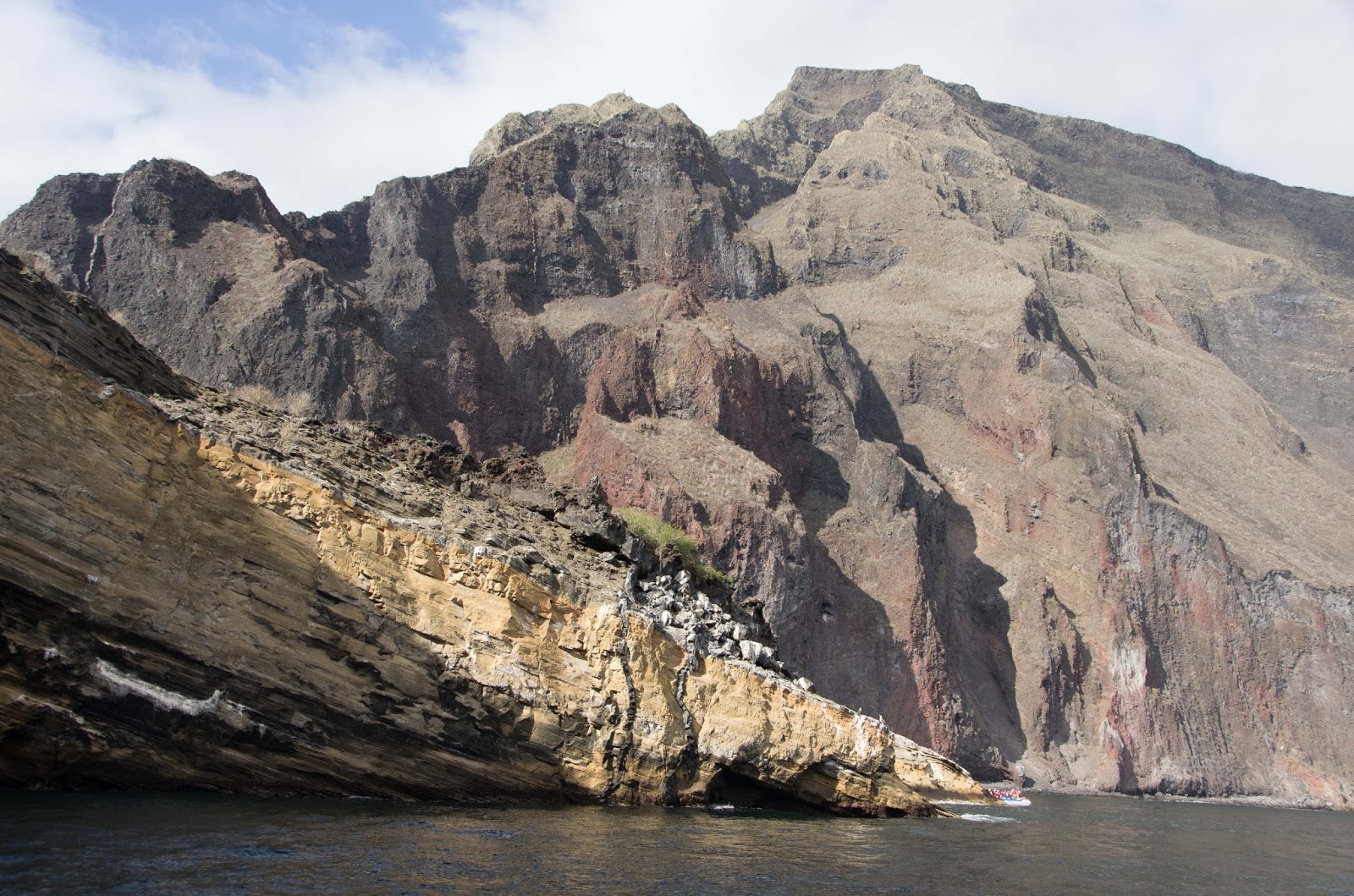
Our final day ended with another panga ride and some snorkeling along Vicente Roca Point on Isabela Island. The snorkeling was the best of the trip. They called it a deep-water snorkeling and I almost didn’t bother to go because of my very poor eyesight. I have prescription goggles, but we did not take them thinking that we wouldn’t be doing any snorkeling because the interest in the birds and iguanas would be paramount. That turned out to be wrong. The water wasn’t much more than about ten feet deep and we were close enough to shore that I was easily able to see most of what was there. We purchased an underwater camera that I also used figuring that anything I couldn’t see under the water, I could see later in the pictures. The most fun part of this day was the ten minutes I got to swim with a tortoise. Just as I was ready to look for the boat, another swimmer hollered and pointed to the tortoise. As a result, I was the last back on the panga for the ride back to the ship. 


Chocolate Chip Starfish
After a shower and a change of clothes, we went back out on the panga for our final shore ride of the trip. This turned out to be the most interesting as we saw two new birds and had some great views of the penguins, blue-footed boobies, and Magnificent frigatebirds.

Blue-footed Booby
Brown Noddy


Frigatebird
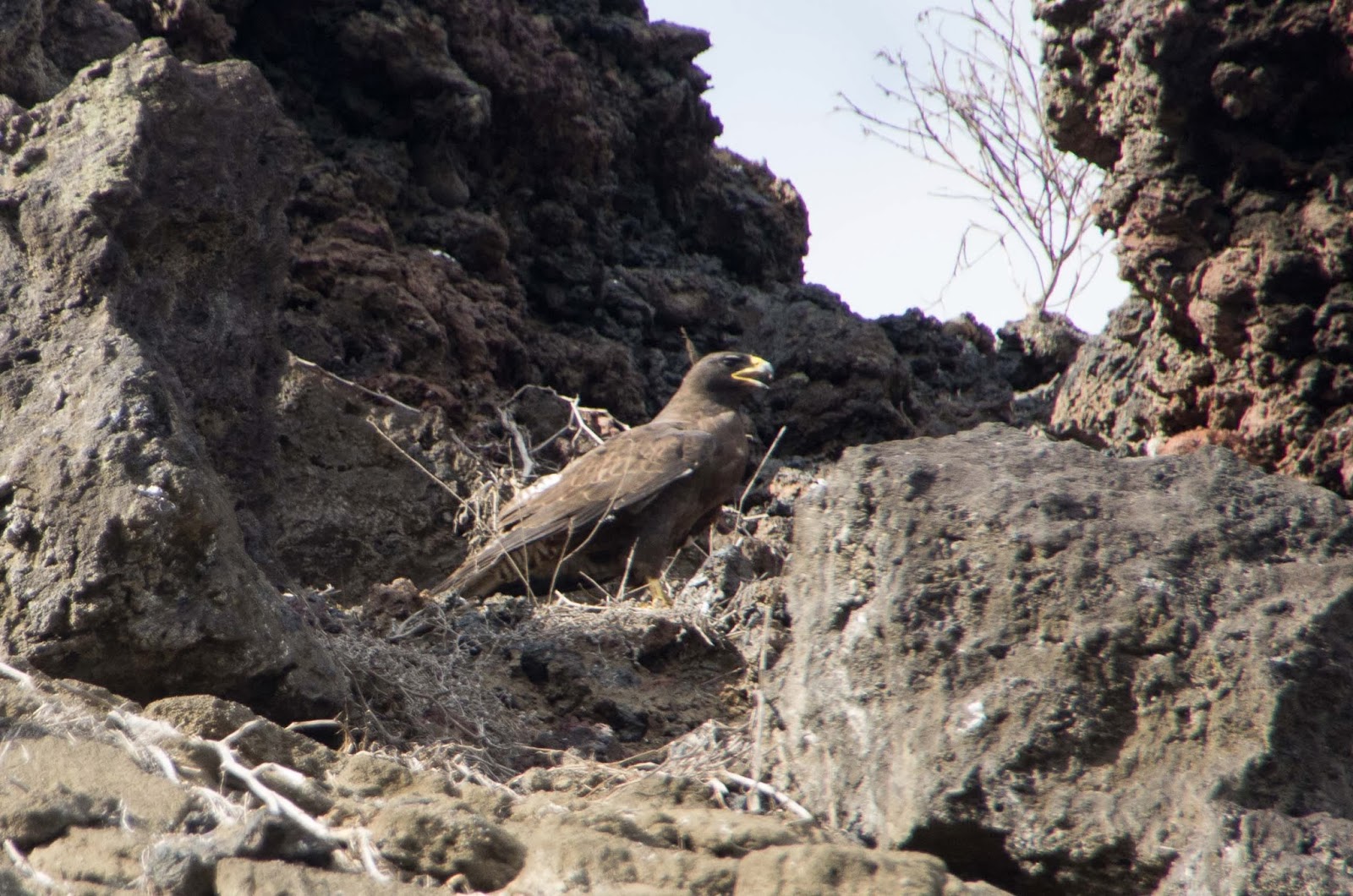
At the top of the cliffs we got to watch the Galapagos hawk eating his dinner. While the hawk was too far away for us to tell what he was eating, we were able to watch for about ten minutes before he walked up the cliff and flew away. 


Shortly after that we came upon some Nazca boobies. While they aren’t as interesting as the blue-footed variety, they are a more beautiful bird and live a similar lifestyle. 

Nazca Boobies


Saturday, February 8, 2014

Fernandina Island


Fernandina is the youngest and least vegetated of the islands. Because it is so young and also the furthest west it is also the most pristine island, probably in the world. This is one island in the group that has managed to stay free of any introduced species. The upwelling of the Cromwell current provides ample nutrients for the fauna that inhabit the island. 
Lava cactus beginning to colonize
Examining a whale skeleton
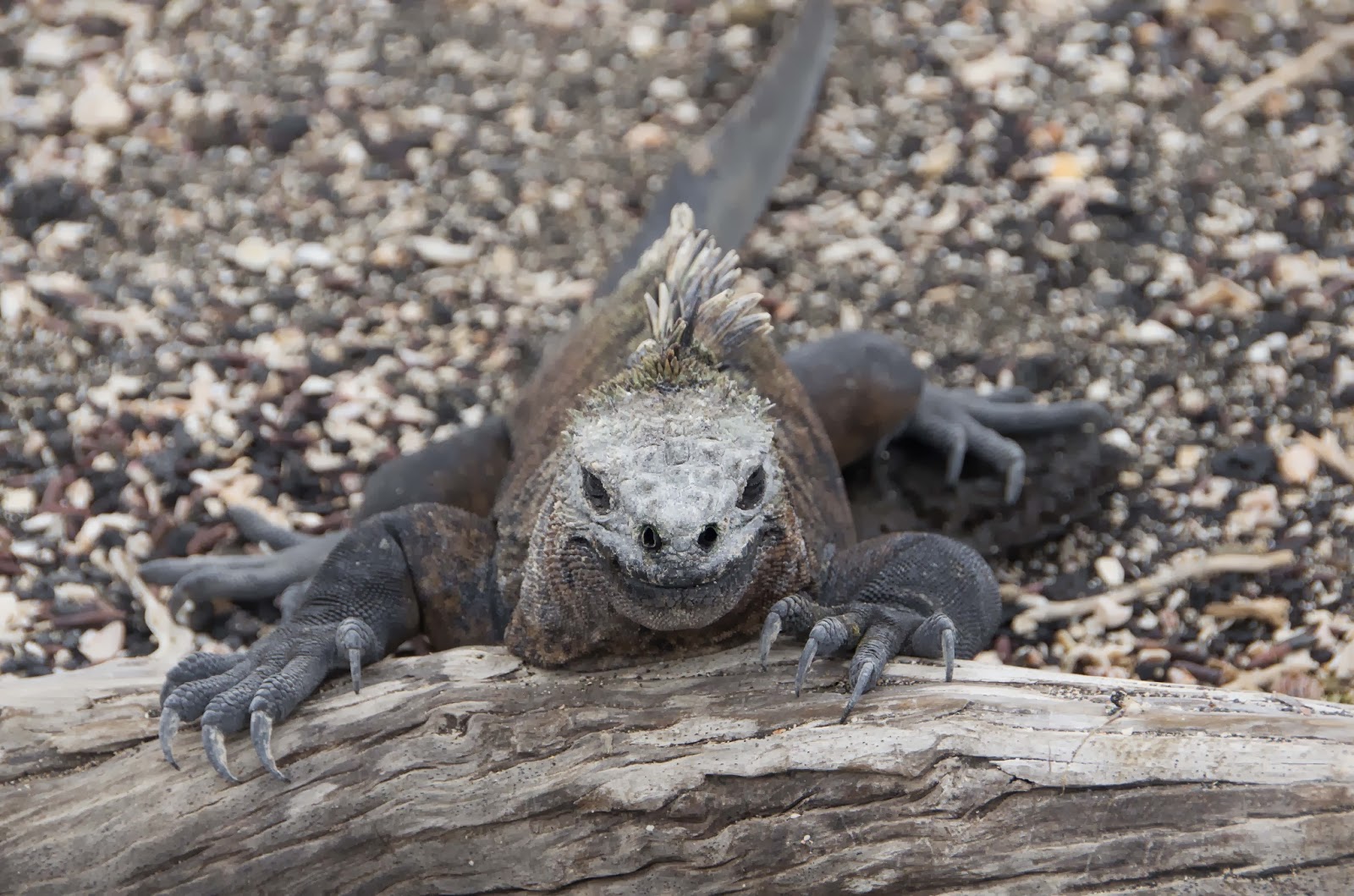
We left the pangas in a mango grove for our walk around Point Espinosa. After the short walk through the trees we spent the rest of the walk navigating the lava flows observing the largest group of marine iguanas along with several of the endemic birds of the islands. Of particular interest were the migrating shorebirds that are regularly seen here along the Washington and Oregon coasts: whimbrel, ruddy turnstone, willet, and semi-palmated plover. While it was a disappointingly cloudy morning, I was still able to get some good pictures of the iguanas and flightless cormorants. It was also my first chance to get a good look at the Galapagos Dove that I saw from a distance at the airport. 

It's easy to see why these are Flightless Cormorants


It is the fighting season

Galapagos Dove
We got some really good views of male iguanas beginning to compete as the breeding season begins. You can tell that they are ready to fight when they begin to bob their heads. While we saw a lot of this aggressive behavior, we didn’t see any actual fighting. We also witnessed a couple of the flightless cormorants fighting over territory by the shore. 

Too many to count


Friday, February 7, 2014

Tagus Cove


Tagus Cove is an historical site on the northwestern coast of Isabela Island. Darwin visited there in 1835 and the saltwater lake we hiked up to see is named after him. Whalers and pirates used the cove as a hideout because it is so well-protected by the surf. They also found it a good place to collect tortoises for food. The tortoises were popular because they could be kept alive without feed and very little care. Fresh meat was at a premium on those sailing ships without refrigeration. The sailors left their mark carving graffiti into the rocks, a practice that continued until the creation of the national park in 1960. 


We started our tour with a ride along the rocky coastline where we had good views of penguins, blue-footed boobies, brown noddies, and flightless cormorants. 

Sally Lightfoot crabs taking a break

Brown Noddy (a tern-like bird_
Hiking up to the Darwin Lake overlook
We then disembarked to hike up to the lake overlook. Along the way we were forced to clamber over rocks to avoid the sea lions who decided the stairs were a good place for them to rest. At the top, we had a good view of the lake and several mockingbirds and finches in the trees that would soon begin sprouting as the rains came.

A slight detour around the sea lions
Another detour. These sea lions liked resting on the stairs.

Darwin Lake - saltier than the ocean

Large ground finch