Showing posts with label South Africa. Show all posts

Saturday, December 27, 2014

Battlefields

Blood River

During our stay at the Spion Kop Lodge, we took advantage of our host Raymond Heron, an expert on South Africa’s wars, and asked him to take us on a tour of a couple of the battle sites. When we were here in 2012, he took us to the site of the Battle of Spion Kop which you can read about here. Spion Kop was one of the battles during the South African War which is better known as the Boer War.
This time we visited three battle sites from earlier wars between the Europeans and the Zulus which ended the Zulu threat to European efforts to take over the Zulu land. Coincidentally, these battles took place during the same period Americans were moving westward and doing the same thing to the Indians. In an even stronger coincidence perhaps, the Russians were expanding eastward to the Pacific Ocean at the same time.
The 1947 monument. This wagon is larger than life.
The Battle of Blood River was fought between 470 Voortrekkers led by Andries Pretorius, and 15,000–21,000 Zulu attackers on the bank of the Ncome River on 16 December 1838, in what is today KwaZulu-Natal, South Africa. The Zulu had developed a powerful attacking style emulating the horns of the cape buffalo. While the horns flanked the sides, the main body of the army attacked the front. with the enemy encircled one more portion of the army would sit with its back to the enemy until it was needed.

This and the next two photos show the 1971 monument with its 48 life-size bronze wagons.
At Blood River, the Boers negated the Zulu strategy by circling the 48 wagons where they were protected on one rear by the Ncome River and another by a dry riverbed. The front offered no cover for the attacking army. Before the battle, the Boers vowed that if God helped them win, they would build a church and honor the day forever as a holy day of God.

When the Zulus attacked, they were decimated by the Boers. As many as 3000 Zulus were killed while only three Boers suffered wounds. The Boers built their church in Pietermaritzburg and the holiday became known first as the Day of the Vow and then the Day of the Covenant. Today, December 16 is the Day of Reconciliation as the new South Africa tries to reconcile its racist, apartheid past with its non-racial future.


In 1947, the Afrikaners built a monument consisting of a larger than life granite wagon. Then in 1971, the monument was expanded to a life-size set of 48 bronze wagons staged in the laager formation including the three cannons deployed by the Boers. Then in 1998, the new government added a new monument and museum across the river. Ideally, the two monuments across the river from each other can provide symbols for reconciliation.

A Painting of the Reconciliation Ceremony
Our experience was ‘enhanced’ by a discussion by a young Afrikaner still living in the past. He made sure we understood he is not a racist, but he seemed mostly interested in making sure we understood that the Afrikaner is the superior race and was right to take the land. Change can be slow in coming. He was especially critical of the large mural in the new museum that he said misrepresented the battle. He would have been correct except for the fact that it is really showing the Reconciliation Ceremony that he should have attended. In the actual battle, the Zulus attacked from the field, not across the river and the Boers never left their kraal.

Isandlwana

The Battle of Isandlwana on January 22, 1879, was the first major encounter in the Anglo–Zulu War that the British instigated in its effort to unite South Africa under one rule. After creating a confederation in Canada in 1867, Britain decided to implement the same plan in South Africa. This would require defeating the independent Kingdom of Zululand. The British did not see this as a major obstacle given their overwhelming firepower and superior military training. Such was not to be the case however.

Isandlwana Peak
The war began when the Zulu rejected an ultimatum that would have destroyed the kingdom anyway. Among other things, it required a disbanding of the army and allowing missionaries total freedom within the kingdom. In early January, 1879, Lord Chelmsford began moving his troops in preparation for battle.
Upon reaching Isandlwana, Chelmsford divided his troops, taking the larger group and leaving a garrison at Isandlwana. The poorly led garrison neglected to create any defensive lines leaving itself open to attack as Chelmsford chased what turned out to be a feint by the Zulu.


On January 22, the Zulu army attacked using its buffalo formation easily surrounding the British force. The result was the worst defeat ever in a colonial war for the British. They lost approximately 1300 men of their force of 1800 including 52 officers.

Two of the British monuments. Many divisions have erected their own.
The Zulu memorial. This is a replica of the Zulu necklace.

The battlefield today includes four different monuments to the British dead and dozens of rock cairns painted white to mark the burial sites of British soldiers. A small museum and Zulu memorial are located nearby.

Rorke’s Drift

Isandlwana was immediately followed by a battle at Rorke’s Drift where 150 British soldiers held off an intense assault by 3000-4000 Zulu warriors while losing only 17 dead and 15 wounded. Rorke’s Drift had been designated for munitions storage. By the end of the battle, most of the ammunition the British had for the war had been depleted. Eleven Victoria’s Crosses were awarded, the most even awarded for a single battle in British history.

The hospital
 A drift is a river crossing. This one was named for its first owner James Rorke. At the time of the attack it was both a weapons depot and a hospital for wounded and sick soldiers. The awarding of the eleven Victoria’s Crosses has been criticized as an overreaction to the defeat at Isandlwana, but it is impossible to ignore the fact that this small group of soldiers, many of whom were sick and wounded managed to hold off the much larger Zulu force for over ten hours.


The two battles secured British public opinion in favor of the war. While the British would retreat for a time because of the losses inflicted here, they would invade Zululand a second time within weeks and finally secure victory in early July.


Thursday, October 16, 2014

Rhinoceros


Rhinoceros are perhaps the most endangered of the large animals in the world and the reason is they are being killed in huge numbers for an Asian market that believes the horn is an aphrodisiac and capable of curing cancer. Even more grotesquely, having rhino power or a horn to display has now become somewhat of a status symbol. I recently read of one Chinese girl of 19 who was given some rhino powder by her father. She uses it to avoid hangovers. All this in spite of the fact that you can get exactly the same ‘benefit’ by chewing your fingernails since it has exactly the same chemical composition.


With poverty at the level it is in Africa, the $1000 or so that a poacher can get for a single horn is great incentive. The counter argument that the game lodges employ hundreds of local people at a decent wage does help, but the dealers are the same folks who deal in drugs and human trafficking so it is dangerous to work to stop the poaching.


Our guide, Riaan, told us that many small game reserves have given up trying to keep rhinos because the cost of purchasing and protecting a rhino is too high. Buying a rhino legally for a game reserve can cost over $65,000. Even spending a lot of money of protection is no guarantee that the rhino will not be killed negating that large investment. One reserve we visited last year in Zambia had 24 full-time rangers guarding only eight rhinos.


Zulu Nyala is working on a different approach. Mr. Shaw, the owner, asks donations to purchase rhinos for the reserve.  He is installing the best protection system money can buy and hopes eventually to be able to have a surplus of rhinos to give them to smaller reserves. Then their only expense will be install a state of the art security system. This reserve recently had a stroke of good luck when one of the two rhinos they purchased turned out to be pregnant so they got three for the price of two. They sell small bracelets here as one fund-raiser and also accept donations. The best part of this scheme is that 100% of the money goes directly to purchasing more animals. There is no overhead which can comsume as much as 90% of some fund-raising schemes.

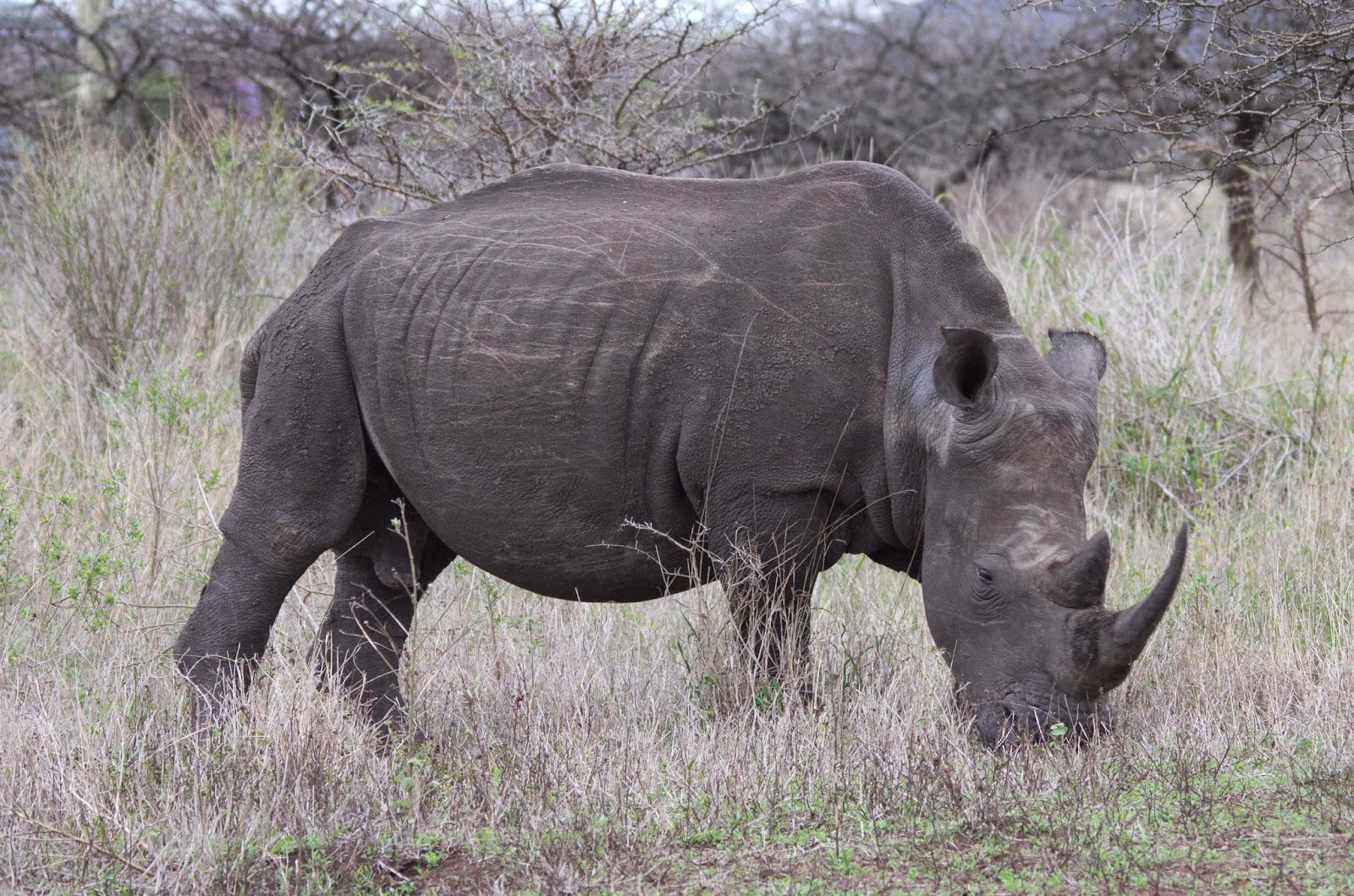
Black Rhino - All the others are white.
The Black Rhino is in front. You can see the differences clearly.
Rhinoceros come in two varieties: white and black. The name has nothing to do with the color. White rhinos are larger and graze the grasses along the ground. Black rhinos are smaller and browse the vegetation on trees and shrubs. Whites, therefore, have a wide mouth and longer neck to facilitate getting lots of grass. Blacks have a more pointed mouth capable of browsing the trees and shrubs. Blacks are more endangered only because they have been easier to kill and had smaller numbers to begin with. As long as they remain part of the cultural ignorance of Asians, they will remain endangered. We can only hope that knowledge will come before extinction.


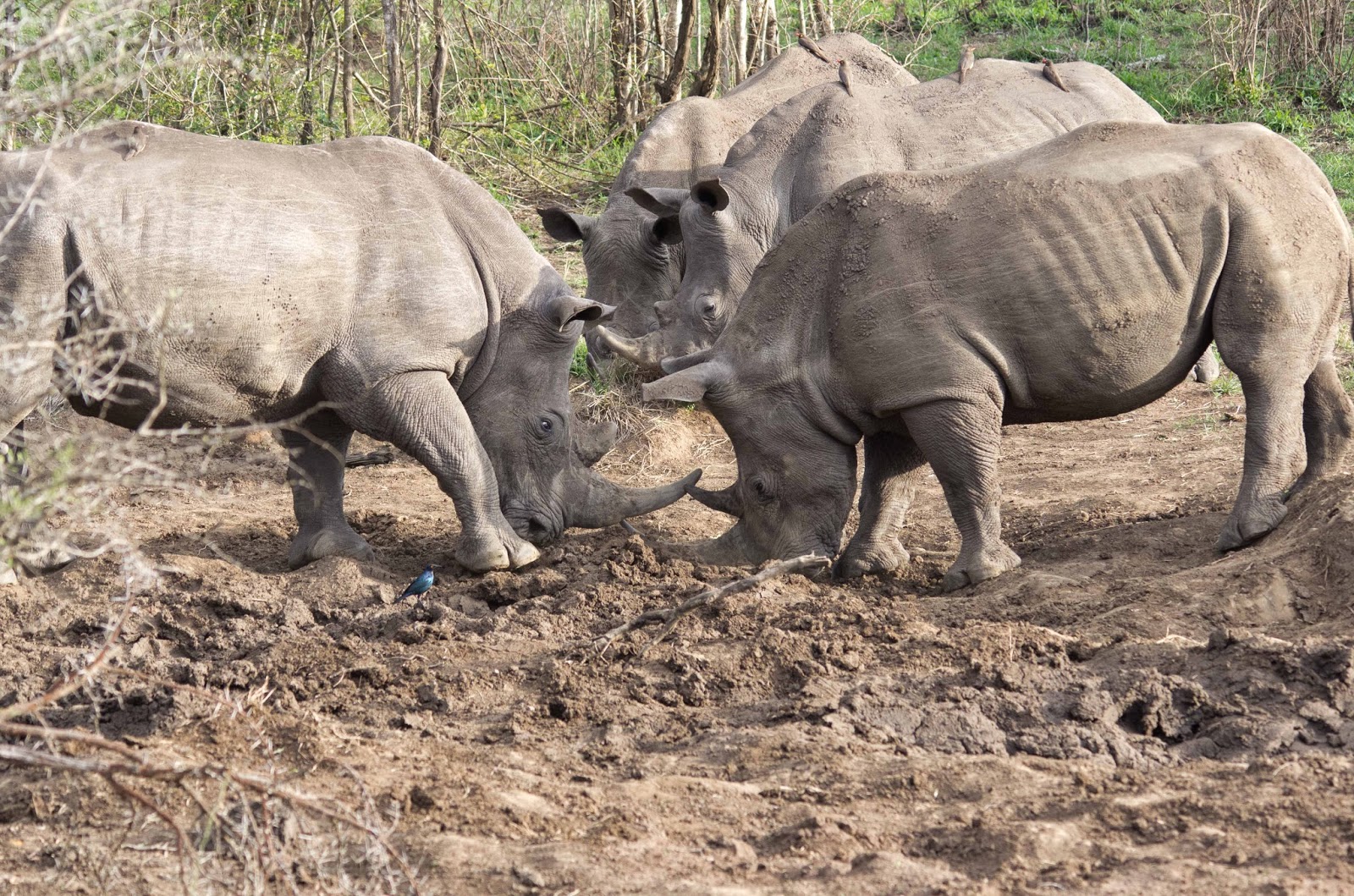
The rest of the pictures are of a group of five rhinos we encountered having fun play fighting. Even the youngster got into the act. 


Sunday, October 12, 2014

Hippopotamus


Hippopotamus are huge, sensitive animals. They are touted to be the most dangerous animal to humans in Africa even though they are only aggressive out of fear. They are one of the Big Five, so-called because hunters feared these five animals the most. The others are rhinoceros, lion, leopard, and buffalo. The others will seek out the hunter who wounds them, but the hippo seeks the safety of the water when wounded, so they are no real threat to hunters in the way the others are.


Hippos are dangerous because they are so big, fast in spite of their size and scare easily. They react when humans get too close and the move too fast for a human to escape. A couple of years ago, a resident of St. Lucia lost a leg to a hippo. His security light was out so he did not see the hippo when he entered his yard. When his wife discovered him some time later, the hippo was happily munching the grass a few feet from the man. The threat was gone so the hippo was no longer interested in the man he had attacked.


Hippos are also a danger to boaters who get too close As one approaches to closely, they open their mouths to show their teeth. Sometimes people think they are just yawning and so miss the warning. Before they know it the boat is capsized and they are swimming for their lives – if they can even swim.

Hippos spend the day in the water to protect their sensitive skin. They will dry out quickly in the sun and by the end of a single day will be covered in cuts from the sunburn. Once the sun sets they leave the water to graze. On land they will separate to graze. When they return to the water in the morning they will group up and enjoy each other’s company.


The pictures are from our first morning at Zulu Nyala. We watched them and the birds around the pond for about 30 minutes. Since they are resting the action probably happened when one hippo bumped or stepped on another in their sleep. Less than a minute after it started, they were again settled in to the water with only a small bit of the body showing. 


Friday, October 10, 2014

Table Mountain National Park


Monday, October 7, we got up early to ride the cable car up Table Mountain. We still arrived later than expected and had a two-hour wait in the heat for the ride up. Fortunately, today, the tablecloth did not get set and we were able to have great views even in the early afternoon. By the time we left, the fog had rolled in down below but not atop the mountain.


Rising 3566 feet above sea level, Table Mountain is a landmark for sailors from over 100 miles out to sea. The mountain rose out of the sea about 600 million years ago making it six times older than the Himalayas. Today, it is classified as one of the seven ‘new’ wonders of the world as voted by people online. I guess that means the Victoria Falls, which we will see in a couple of weeks is one of the ‘old’ wonders of the world. It makes for a good marketing tool anyway. Certainly, both Table Mountain and Victoria Falls are both worthy of a high placement on any list.


The tablecloth refers to the cloud cover that forms at the top and then flows down the mountain where it dissipates in the warmer temperatures. The legend is that an old pirate and the devil have been smoking ever since the pirate suggested a smoking competition to save his soul.

Most impressive about the mountain is the wide variety of plant species. The southern part of South Africa is one of six of the world’s plant kingdoms and the only one that exists solely within one country. The dominant plant type is the fynbos which includes over 8000 species, most of which are endemic to South Africa. Over 1500 of those species exist on Table Mountain giving it more plant diversity than any other place on earth. We only saw a few that were flowering, but it is still exciting to see that much diversity. I had hoped to see a couple of new birds, but none showed. Maybe next time.


South of Table Mountain the peninsula extends to the Cape of Good Hope, so named by Prince Henry as it indicated the possibility of the trade route to India and the Spice Islands. A 99 mile drive circumnavigates the peninsula and reaches right to the tip called Cape Point. Once we returned to the bottom of the mountain, we left to travel some of that 99 miles on our way to Cape Point and Simon’s Town where we would see the African penguins. With a bit of luck we would also see some of the resident baboons.


A young ostrich
Baboons playing in the road. We think they may have been a bit tipsy since they seemed totally oblivious to us.


The penguins are molting. Molting takes 21 days during which they stand in place with nothing to eat. Many birds are unable to fly while molting which obviously makes them more vulnerable to predators. The penguins have to make sure they have fattened up for the three weeks they will spend without food. 


Wednesday, October 8, 2014

Franschhoek Wine Train


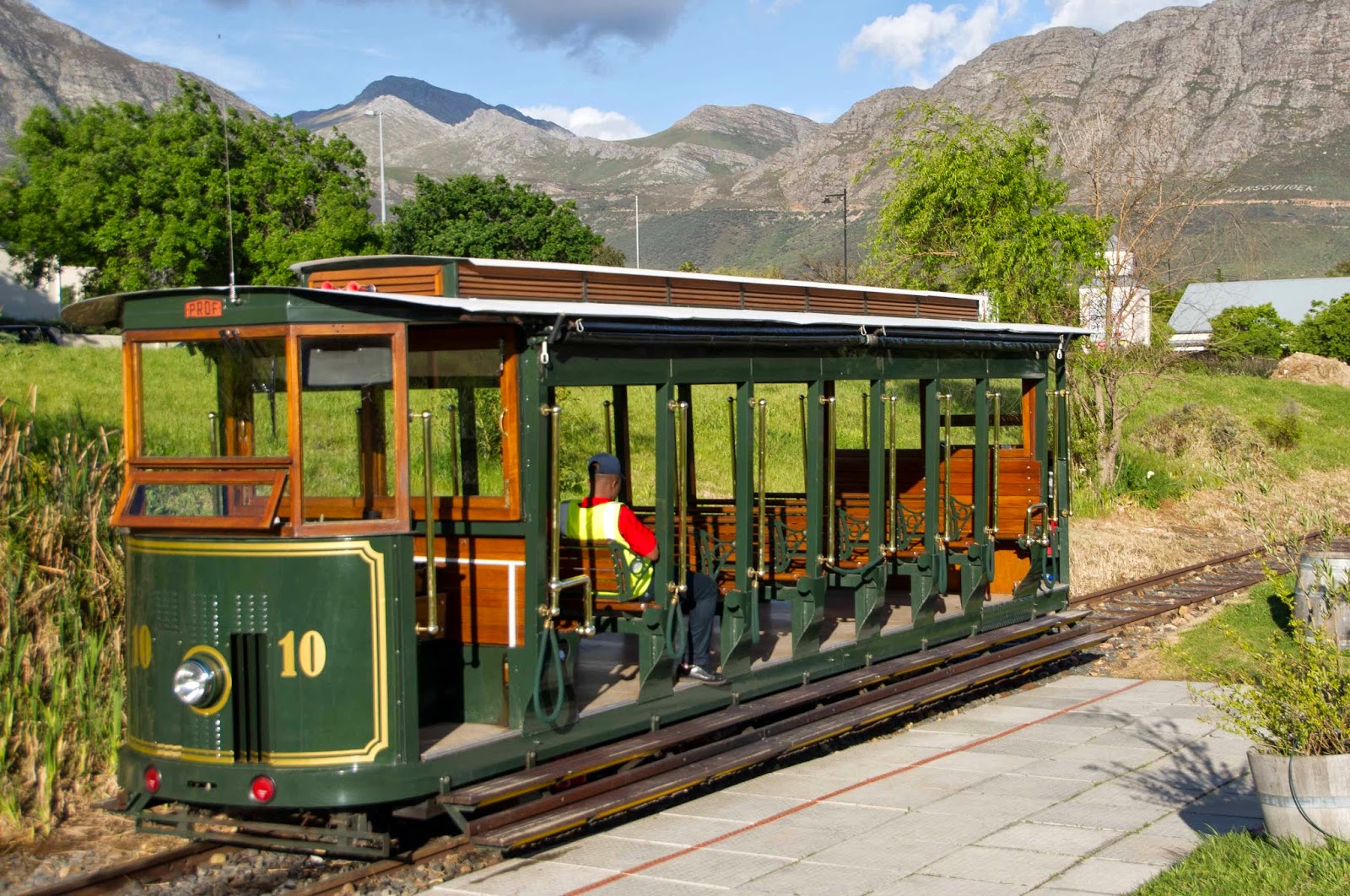
The Franschhoek Wine Tram is a new tourist experience in the wine country having started in 2012. Running on tracks first built in 1904 to replace the ox carts farmers used to get their goods to market, the tram carries passengers about two miles to two wineries. Passengers then ride a Tata bus made in India to the other wineries. Overall, it is a fun way to travel between several wineries especially since the only driving will be to get home after the ride is finished.


Passengers can get off at each of the wineries for one or two hours.  Some wineries offer free tasting. Others may have a discount on wine purchases. Several have lunch rooms or cheese platters so one can get some food to with which to enjoy the wine. Chocolate and olive tastings might also be available. One of the wineries even offers cooking classes. Since these are wineries, the food is usually excellent and the ambience couldn’t be better. A couple of them are up above town offering spectacular views of the valley below.


Mont Rochelle, now owned by Richard Branson (Virgin Air)
M
We started the trip with a group of about 30 Asian tourists who were already having a good time. They got off at the first stop so we skipped that one and continued on to the next one. Since there is only time to visit 5 of the 7 wineries, this seemed like a good plan. Later we met a lovely couple from Richard’s Bay and spent time with them at the last two wineries and then at the Stall and later at home to finish off the evening. We may be able to see them again when we spend a night at Richard’s Bay. We hope so as they were fun to spend time with.

Tasting with Sam and Sandra, our new friends
Some of the great artwork.


Leopard's Leap
The greeter at La Grande Provence


This is made of used tires. Quite impressive.