Sunday, March 31, 2013

Harlaxton Manor - Interior


Shortly after our arrival we were given a tour of the manor. You can imagine that it was fun reminiscing and trying to figure out how things had changed since we were there in 1969. As you can see from the pictures, the restoration work is of the highest quality. The biggest changes in the areas pictured here are the vibrancy of the colors and the time and effort that has gone into maintaining the cleanliness and beauty of the building. All of the elements were there in 1969, but the overall tone was much more dingy, shall we say. Probably the two biggest changes don’t show up here. First, the insulation weather-stripping mean that the building is warm and no longer drafty. Second, the layout of the student rooms has changed significantly. I could find no hint of the six-person room I lived in or the bathrooms we used down the hall somewhere.  

The old elevator remains as it was. Close both doors or it won't go anywhere.
Here we are marveling at the renovations.
The main cedar staircase
The railing above the top of the staircase is not accessible.
Imagine trying to keep this amazing stucco work clean. It's no wonder that many of these great old buildings fell into disrepair and are now open to the public to pay for their upkeep.
The great hall where we had our final banquet. I think this was a study area.
These are on the left in the picture above.
The upper wall and ceiling.
The entrance to the long gallery.
The Long Gallery. One of the two hidden staircases is in this room. They were used by servants. Sorry, no ghost stories here.
This fireplace is on the left side of the picture above.
One of the Conservatory windows. This room was perhaps in such disrepair that we did not have access.
I remember using these nooks as quiet study areas.
The library
The Gold Room. If you look carefully, you can see the cherub climbing down from the ceiling.
The Gold Room
The Gold Room Ceiling
Gold Room Detail
The ceiling in the state dining room.
Our bedroom this trip. On the top floor where the professors and families has exclusive access.

Saturday, March 30, 2013

Harlaxton Manor


Following out two nights at Cliveden, we traveled by bus to Harlaxton Manor near Grantham in Lincolnshire. Built by Gregory Gregory between 1835 and 1855, it was a catalyst for a renaissance of Elizabethan architecture. Gregory was a bit of an eccentric and building the manor was his life’s passion. Nowhere near as rich as one would expect looking at the manor, Gregory spent most of his yearly income building and decorating the manor. The manor stayed in the Gregory family until 1935 when it was abandoned. During that entire period, the manor was never occupied by a family. Abandoned in 1935, the manor deteriorated and was nearly demolished. 


Walking up the main drive
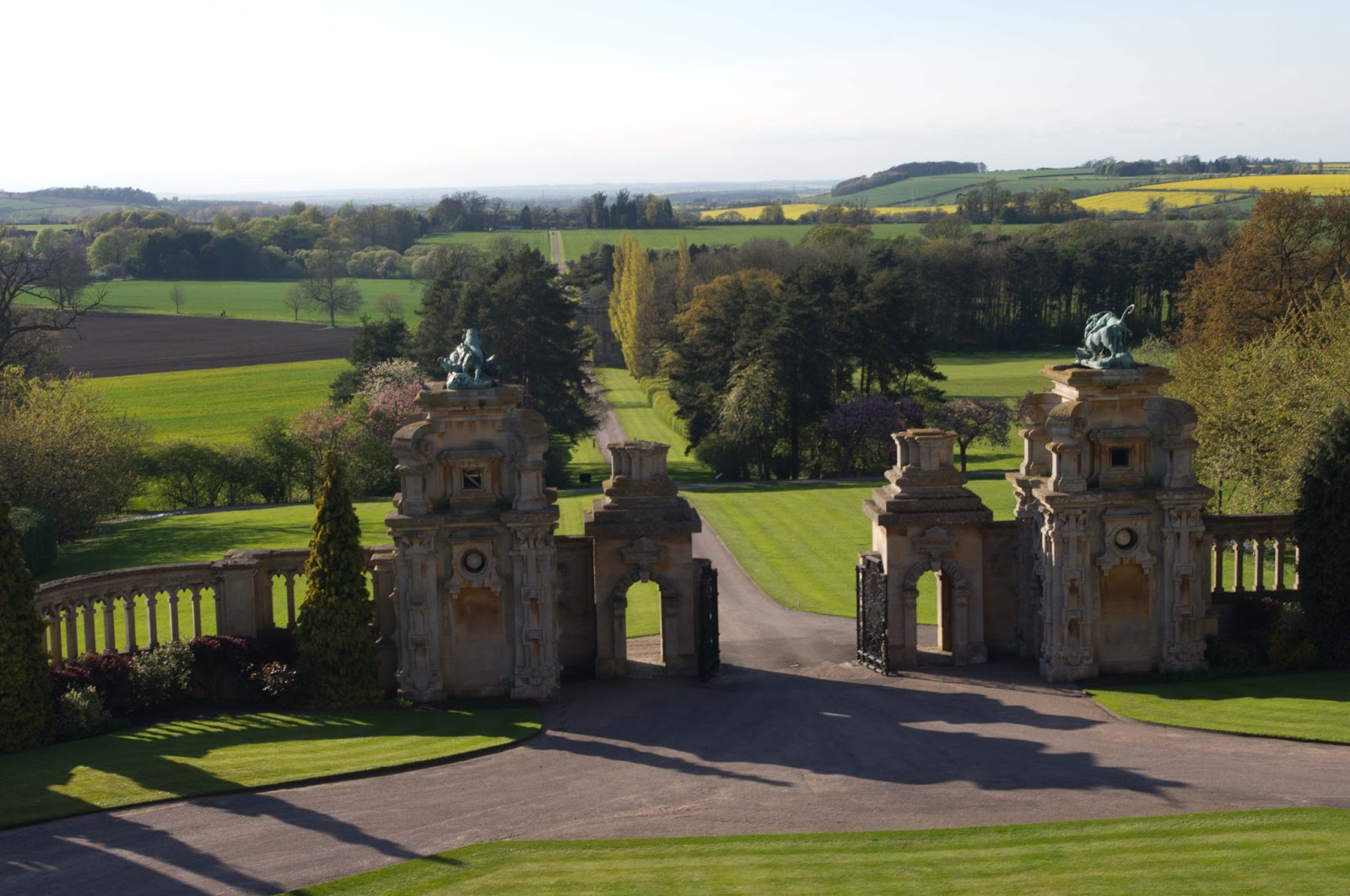
The entrance gate looking over the grounds
The entrance gate


Fortunately, Violet Van der Elst saw an advertisement in The Times and Country Life looking for someone to save this “labor of an age in piled stones.” Violet made her money selling beauty preparations and the first brushless shaving cream, Shavex, which she manufactured in her own kitchen. She spent over £250,000 restoring and redecorating the manor. A modern thinker, she stopped all field sports and hunting on the grounds to create a “sanctuary for the birds and wild creatures.” She was so opposed to capital punishment that she would not even allow mice to be killed in the house. Frequently arrested for protesting capital punishment, her money and activities were significant in the fight to put the practice to an end, something she lived to see.

The courtyard and circular driveway

In 1948, having dissipated her fortune, she sold the manor to the Society of Jesus who used it as a seminary until 1966 when they leased it to Stanford. 1966 was also the year that Van der Elst died penniless in a Kentish nursing home. Stanford in Britain stayed four years. We were fortunate to be in the group that ended the stay at Harlaxton and began the time at Cliveden. The University of Evansville (Indiana) took over the building and grounds in 1971 and spent the money Stanford was unwilling to spend updating and renovating the huge building.

The Conservatory at the back
Overlooking the grounds


Some of our group, remembering the drafty rooms and poor heating, chose to stay at the Angel and Royal Hotel in Grantham. They made a mistake as the renovations resulted in a place we hardly recognized. The only constant was the food served in the same old dining room that easily reminded us of our meals years ago. The exception was the excellent banquet in the state dining room our last night
.
Our arrival was much more pleasant than that cold and rainy night in December of 1969. The afternoon sun illuminated the manor for us shortly after we passed Grantham. Embarrassingly, we had to be told by our old professors that we were looking at Harlaxton. Our bus was too big to use the grand entrance. The main road is one straight mile with the manor elevated and behind a stunning entrance gate. 
No swimming in this pond
More of the grounds
 We grabbed our bags and entered through a side door, so missed the grand entrance and much of the beauty. One unchanged item is the elevator. It is still a cage with two doors, both of which must be fully closed or the call button does not work. It only took one open door and the walk up three levels for all of us to remember that small, but essential detail. After settling into our rooms, we were given a tour. Unlike at Cliveden, the renovations changed things enough that we were not always in agreement what had been where. I never did figure out where six of us had shared one sleeping room or where the bath and shower room we shared was located. Our room for the night was on the top floor which had been off-limits to all but the professors and their families during our stay. 
Renovations continue on the fountain


Wednesday, May 9, 2012

Reunion - Cliveden


Cliveden as we arrive. My room was in the two-story section on the right.

Cliveden from the rear towards the Thames.
Linda and I are in England for a 43rd anniversary reunion of my Stanford in Britain overseas campus group. Eighty of us spent six months travelling and studying here from January to June in 1969. We spent nine weeks at Harlaxton, then three weeks touring the continent followed by nine more weeks at Cliveden.  The reunion began with a night in London. We met for dinner at the Only Running Footman, a British pub with a noisy main floor and a nice restaurant upstairs recommended by one of our classmates who now lives in London. Unfortunately, he did not make it for the evening or any of the following events. The next morning we got on a bus to our hotel, The Compleat Angler, in Marley on the Thames. After checking in we spent the rest of the day at Cliveden.
We look a little different 43 years later.

Cliveden is a huge mansion built in the 18th century eventually owned by the Astor family. They say that every Prime Minister and King and Queen during the last two centuries stayed there at least once. Including Winston Churchill whose relationship with Lady Astor was so acrimonious it led to this exchange. Lady Astor: Winston, if you were my husband I would give you poison in your drink. Winston: Lady Astor, if I were your husband I would drink it.
The tower looks the same, but the gold leaf has been added.

By the time we arrived it was already part of the National Trust, a private organization that cares for historic sites in Britain. We were a bit of an anomaly and became part of the Wednesday tours. Some of the Trust staff never did come to appreciate the fact that we were there, but we tried to be on good behavior most of the time and especially when the tourists came through.
We had to stay out of this area when the tourists came through.

The Christine Keeler Memorial Couch is gone. It was big enough to serve as a double bed.
We did have a bit of trouble with the pool and the couch we designated “The Christine Keeler Memorial Couch.” Earlier in the 60s, the British government had been rocked by a scandal when John Profumo was discovered to have been having an affair with Christine and Mandy Rice Davies probably including nude bathing in the pool. An affair with young ‘professional women’ might have been ok, but it turned out that Keeler and Davies had also been ‘professional’ with Soviet spies. Profumo’s post as Defense Minister made this a major problem for the government.
The infamous pool. Rumor has it that some of us had a memorial skinny dip late one evening.

One of about twelve formal gardens that surround the estate on its 500+ acres. In the spring the rhodies added plenty of color.
Today, Cliveden is a 5-star hotel and still a part of the National Trust. We opted to save over $500 by staying at the Compleat Angler in nearby Marley. The estate has been spruced up a bit with things like gold leaf on the clock tower, but it felt very much the same as when we lived there. Those in the group who did spend the night said it seemed a bit run down considering the cost of the rooms. We did have fun trying to figure out where we had our classes and meals and where the bar and snooker room had been and most importantly, where we had slept. That was the easiest for me as I walked right in the correct door and it was very familiar.

My rooom was right around the corner.
Our big event at Cliveden this visit was the formal dinner. We had an excellent salmon fillet along with salad and dessert. The good wine flowed freely all night. We learned later that the wine had not been part of the pre-arranged price and were presented with a bill for 3500 pounds. Wow – 26 of us drank over $6000 worth of wine with one dinner. I wish I had known the wine was that good when we were drinking it. This is, however, the home of the $1000 sandwich (three different caviars help drive up the price). Fortunately, when the final bill was presented, Cliveden decided that it was part of the price and the charge was dropped. It was good wine, but …
The view out the back with the Thames barely in view. We did not play rugby on this field.

We did learn how to play snooker and billiards.

The best part of the dinner was sharing our memories. We all talked in some way about the broadening experience of spending that time of our lives overseas. We are all still traveling the world and at least three children are now living overseas. One is taking care of New York University students studying in Florence like we did.
Mute swan on the Thames. I just had to add one bird picture.

Monday, April 23, 2012

Hippos


Hippopotamus, the name itself is not one to engender fear. However, hippos cause more deaths in Africa than any other animal. Surprising given that the hippo is an herbivore. It’s not just that people don’t realize how dangerous they are, it is also because they are so much more aggressive and agile than people realize. Looking at them, you think they are just a big, fat, slow animal. In fact, they can run much faster than humans and are especially dangerous when they are in the water. Their speed has been estimated at between 18 and 30 mph.


Most or our sightings were hippos in the water, where they spend most of their time during the day. Their skin is ultrasensitive to sun. Too much time in the sun and they are sunburned with cracked skin much like what you see on dry lakebeds. Of course it is worse for the hippos since the cracks bring sores that are difficult to heal. Fortunately, they do naturally secrete a salve that medical researchers think might be used by humans as a healing salve.

Cattle egrets like hippos.
We saw a few hippos at Zulu Nyala. The family was safely watered down in a small pond the first time we saw them only allowing us a limited view of their eyes. The next time we saw them the pond had increased in size tenfold after the typhoon blew through dumping several inches of rain as it did.
Why we are careful walking to our tents. While they gather together in the water, they tend to feed alone at night.
 Our next view was quick. We were on a short 5-minute ride from the road to our first camp in Zambia. The ‘skipper’ wanted to get us to the camp and knew we would get many more views. That evening we went on our first boat safari and did see several more although the first one was only a quick glimpse. The guide explained that he had seen a baby somewhat separated from its mother and was concerned for our safety. Better safe than sorry. 


Over the next several days we would see many hippos in the water. On a couple of occasions, we saw bloats of 25 or more. Our guides were cautious about getting too close and only on a couple of occasions did we see their ‘you are getting too close’ behavior of opening the mouth to show us their dangerous teeth. Usually we were just able to watch them slowly rise to breathe and then retreat beneath the water.
The most interesting views were those few we had of the hippos on land. We were able to get much closer on land. For some reason, hippos are much less aggressive on land. Perhaps this is because they really only eat while on land. Just about every other part of their lives is conducted in the water from procreation to defecation. 
A group of hippos is called a bloat. This is a small one.

On land we could clearly see the effects that the sun has on their skin. The pictures tell the story better than I can, but notice the numerous scars and open sores.

Finally, an interesting story from Wikipedia - my favorite source of information.   ;-(  

It seems that Pablo Escobar of Colombian cartel fame had a bloat of four that he bought from a zoo in New Orleans. After Escobar was captured, no one wanted to deal with the hippos, so they expanded the size of the bloat to 16.  In 2009, two escaped and caused so much havoc among the farmers that one was killed by hunters. That is the end of the Wikipedia story, so we don’t know what happens next, but perhaps one day hippos will be one of the sites we expect to see on visits to South America. Seriously, I hope not, but it does show us again the havoc we humans can create for our environment when we try to play god.
Greetings for us as we arrive at Tubu Tree Camp