Showing posts with label Africa. Show all posts

Wednesday, January 30, 2019

East Africa Itinerary - 2019

We leave for East Africa on February 28. After a stopover in New York City, we travel through Dubai on our way to Nairobi, Kenya where we arrive on Sunday, March 3. We spend our first two nights at the Macushla House about 20 miles from the city center. While there we will have a half-day tour of Nairobi. We will also be visiting the Karen Blixen Museum. Karen was the author of "Out of Africa" made into a movie starring Robert Redford and Maryl Streep. We will probably also visit the nearby Giraffe Center and will certainly make a stop at the Daphne Sheldrick elephant orphanage. We have adopted one of the orphan elephants and are anxious to see him in person.

We will be stopping at three safari camps in Kenya
Then we move on to Tanzania and two more safari camps with a private guide. Part of this time will be a visit to the Ngorongoro Crater.
Before we leave Tanzania we will spend our last few days on Zanzibar. Zanzibar is a source of some of our spices and served as both a slave port and a staging site for many of the early European explorers.
Finally, we have a couple of days in Dubai before returning home to Vancouver.

I won't promise regular postings while we are traveling, but will be posting blog entries for the entire trip once we return.

Friday, October 24, 2014

Muchenje Game Lodge at Chobe National Park, Botswana


Zebra, Waterbuck, and Impala grazing together
View from our deck
Baobab Tree
I haven’t been as regular as I’d hoped  in keeping up with this blog. We are in Johannesburg now and headed off to our next stop at SpionKop where we will spend the next five days. We had a fabulous time at Muchenje with Robert and Joy as our hosts and David as our guide. Robert and Joy had great stories to tell about knowing Jane Goodall and Dion Fossey. They are also good friends with Peter Allison who wrote the marvelous book, Walk Don’t Run, about his adventures as a game guide. Since we have all read his books, it was a real treat to learn more about him.

We ate lunch with the Elephants our first day
Then waited for them to cross the road on our way back to camp
Of course, the real treat at Chobe is the animals. The park is about 11,000 square km. It was set aside in the 1930s and became Botswana’s first national park in 1968. Botswana has the largest number of elephants of any nation; over 70,000 of them live in Chobe along with lions, leopards and thousands of different species of antelope. It may be hard to believe, but by our fourth day we would drive through a herd of 100 elephants without stopping as we were in search of other animals or birds.
She is wishing that those zebra hadn't seen them


Just resting in the middle of the day

We saw 29 lions. This was the only male.
The camp sits at the top of a slope overlooking the Chobe River so we awoke each morning to a view of the expanse of Africa and its animals. Since the river is the border Botswana and Namibia, we were also able to watch Namibian fishermen working their nets. Zebra, waterbuck and vast numbers of birds usually had made it across the river to graze enhancing the view.

Tough times for the baboons as they wait for the rain.
The short neck leads to adaptive behavior.  They are not praying.
We saw one elusive leopard - a first for Rintas and Briggs.
The Chobe bushbuck is the only one with spots. This was a very rare sighting.
Slender Mongoose
Banded Mongoose
An unusual scene of a buffalo in the water feeding.
Spotted hyena at dusk
A beautiful Waterbuck


Kudu
Rather than write more, I am just going to show some of the better pictures. Enjoy.

African Fish Eagle
Tawny Eagle
African Jacana - also known as the Jesus bird as it seems to walk on water over the lily pads
Brown-headed Tchagra
Crimson-breasted Bee-eater
Blue Waxbill
Kori Bustard - Botswana's National Bird
Lilac-breasted roller - runner up for the title of national bird
Marabou stork - one of the "Ugly Five"
Yellow-billed Stork
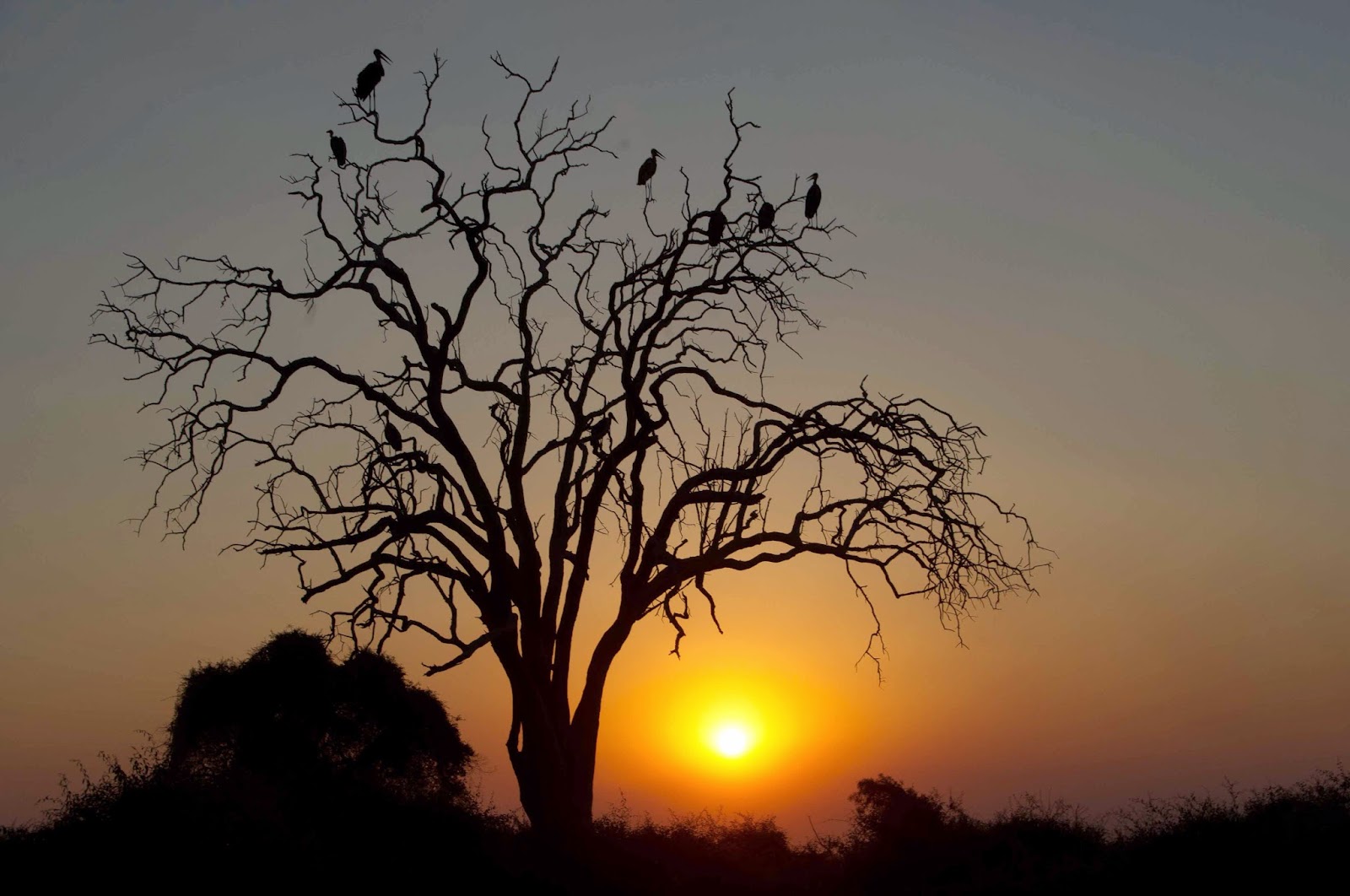
Sunsets here are absolutely amazing.


Monday, September 22, 2014

Arrival in Franschhoek

Here is the itinerary for our Africa trip.


We left Johannesburg with our driver at 8:00 am for our 10:00 am flight to Cape Town. Thinking that the company would know how early was necessary we accepted that time as normal. Turned out that we were too late to get seats on the plane. Since we did not have assigned seats yet, we needed to take care of that earlier and since it was a full flight, we were bumped to the next one an hour later. That was fine, but then we hit another glitch when picking up our rental car. Budget wanted a printed voucher and we only had an itinerary. Our agent had said that everything was electronic and that would be fine, but it seems that Budget did not get the memo about going paperless. Fortunately, we had an off-hours number for our agent locally and were able to get a voucher emailed so we could get the car. Otherwise, we would have been paying again for the car and having to get reimbursement – a hassle at best.
The view from our veranda.
Additionally, Linda’s new credit card wouldn’t work for Budget even though it has an electronic chip to enable its use all over the world. Her new card is not embossed, the number is simply printed on card and Budget has to use the imprint to get the credit card number onto the contract. I was shocked because Visa and MasterCard both have said that using a swipe machine is no longer acceptable. Those manual machines put the entire number on paper making the number much easier to steal. One would think that a major world company like Budget would have a computer system that did not require the number on a sheet of paper. So even though they had a record of the reservation and we had a valid credit card, they could not process the rental normally. Because the rental was in Linda’s name they needed her card. Fortunately, the agent was a problem solver who worked to make certain we got the car we needed. He used my card for the rental because it still has the embossing and them made explanatory notes all over the rental agreement and in the computer. He also made certain that I do not count as an additional driver raising the rental fee. Then, before assigning us a car, he asked to see how much luggage we have and gave us a VW Jetta because it has the largest trunk and was large enough to take all of our luggage – barely. We have slimmed down our packing considerably, but four people for seven and ten weeks still need a lot of stuff. I have one small backpack just for camera, lenses, binoculars and computer. So, even though it took three times as long as it should have, we left with all of our luggage in the trunk where it belongs and no worries about payments.

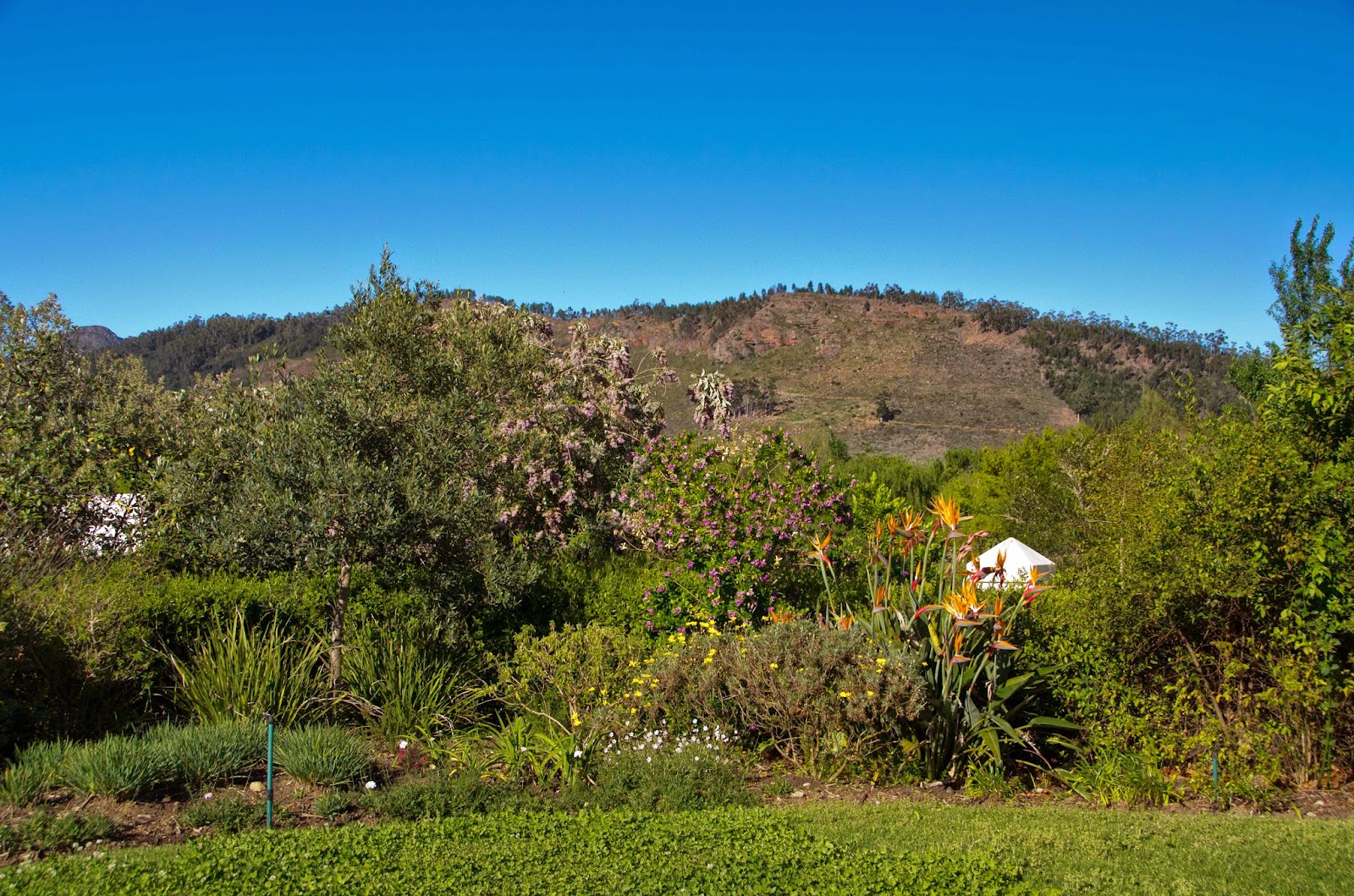
Franschhoek is nearly surrounded by these mountains.
We are staying in a lovely home in Franschhoek in a gated community, La Petite Provence. Franschhoek was settled by French Hugonots fleeing the religious discrimination they were facing in France. Streams gurgle past the rear of the house and across the street in the front. A large field and several small vineyards dot the complex making it a lovely place to walk in the morning or evening. A patio in the back offers a great venue for coffee and bird watching to start the day while those slower to get started shower and ....

One of the streams running through the property
The only trouble we had upon arriving was getting me to listen carefully enough to Linda as she explained how to turn off the alarm system. We have a fob with three buttons. The red one opens the garage after you remove the padlock; the green one is for an emergency, and the blue one turns the alarm on and off. To my amazement, since my listening skills have deteriorated, there is no delay before the alarm begins screaming that you have improperly entered the property. Linda quickly explained – again – that I had to push the blue button and the screaming stopped. No more than a minute later the security team was there to make sure everything was ok. That was comforting even as it was a bit embarrassing. It was even more embarrassing to have the same thing happen the next day because we weren’t sure if the system was on or off. The other challenge has been dealing with the fact that every door has a different skeleton key for its lock. That is seven different keys. Fortunately they are well-labeled.

Helmeted Guineahens have the run of the place.
The other negative is that there is NO internet service at the house, but we have found a nice solution to that problem. Once we were settled in, we drove the short distance to town to do a bit of grocery shopping and find a nice place for a casual meal. We settled on “The Stall” – less than a mile from our house. The food was outstanding. I had a burger with gouda, grilled onions and cranberry, a surprisingly good mix. Linda had a regular cheeseburger. Jim had some excellent fried Patagonian calamari. Marcia had a penne pasta with chicken in a white pesto sauce. They also have what look like fantastic wood fired pizzas. Most importantly, we had a great time talking with the owner drinking some of the excellent local wine at about $5 per bottle. Really. The wine here is very good and really inexpensive. Since they also have free wireless, we have decided that we will drop in for coffee in the morning or wine in the evening to catch up on all those must-do things that computers have imposed on our lives. Lisa, the owner, said that they officially open at noon, but since the pizza oven requires 90 minutes to warm up, the rest of their menu is available and since they make everything fresh, we can get just about anything we want. The owners live at Le Petite Provence where we are staying, so we will probably be seeing them here well.


Monday, April 23, 2012

Hippos


Hippopotamus, the name itself is not one to engender fear. However, hippos cause more deaths in Africa than any other animal. Surprising given that the hippo is an herbivore. It’s not just that people don’t realize how dangerous they are, it is also because they are so much more aggressive and agile than people realize. Looking at them, you think they are just a big, fat, slow animal. In fact, they can run much faster than humans and are especially dangerous when they are in the water. Their speed has been estimated at between 18 and 30 mph.


Most or our sightings were hippos in the water, where they spend most of their time during the day. Their skin is ultrasensitive to sun. Too much time in the sun and they are sunburned with cracked skin much like what you see on dry lakebeds. Of course it is worse for the hippos since the cracks bring sores that are difficult to heal. Fortunately, they do naturally secrete a salve that medical researchers think might be used by humans as a healing salve.

Cattle egrets like hippos.
We saw a few hippos at Zulu Nyala. The family was safely watered down in a small pond the first time we saw them only allowing us a limited view of their eyes. The next time we saw them the pond had increased in size tenfold after the typhoon blew through dumping several inches of rain as it did.
Why we are careful walking to our tents. While they gather together in the water, they tend to feed alone at night.
 Our next view was quick. We were on a short 5-minute ride from the road to our first camp in Zambia. The ‘skipper’ wanted to get us to the camp and knew we would get many more views. That evening we went on our first boat safari and did see several more although the first one was only a quick glimpse. The guide explained that he had seen a baby somewhat separated from its mother and was concerned for our safety. Better safe than sorry. 


Over the next several days we would see many hippos in the water. On a couple of occasions, we saw bloats of 25 or more. Our guides were cautious about getting too close and only on a couple of occasions did we see their ‘you are getting too close’ behavior of opening the mouth to show us their dangerous teeth. Usually we were just able to watch them slowly rise to breathe and then retreat beneath the water.
The most interesting views were those few we had of the hippos on land. We were able to get much closer on land. For some reason, hippos are much less aggressive on land. Perhaps this is because they really only eat while on land. Just about every other part of their lives is conducted in the water from procreation to defecation. 
A group of hippos is called a bloat. This is a small one.

On land we could clearly see the effects that the sun has on their skin. The pictures tell the story better than I can, but notice the numerous scars and open sores.

Finally, an interesting story from Wikipedia - my favorite source of information.   ;-(  

It seems that Pablo Escobar of Colombian cartel fame had a bloat of four that he bought from a zoo in New Orleans. After Escobar was captured, no one wanted to deal with the hippos, so they expanded the size of the bloat to 16.  In 2009, two escaped and caused so much havoc among the farmers that one was killed by hunters. That is the end of the Wikipedia story, so we don’t know what happens next, but perhaps one day hippos will be one of the sites we expect to see on visits to South America. Seriously, I hope not, but it does show us again the havoc we humans can create for our environment when we try to play god.
Greetings for us as we arrive at Tubu Tree Camp