Showing posts with label Safari. Show all posts

Wednesday, January 30, 2019

East Africa Itinerary - 2019

We leave for East Africa on February 28. After a stopover in New York City, we travel through Dubai on our way to Nairobi, Kenya where we arrive on Sunday, March 3. We spend our first two nights at the Macushla House about 20 miles from the city center. While there we will have a half-day tour of Nairobi. We will also be visiting the Karen Blixen Museum. Karen was the author of "Out of Africa" made into a movie starring Robert Redford and Maryl Streep. We will probably also visit the nearby Giraffe Center and will certainly make a stop at the Daphne Sheldrick elephant orphanage. We have adopted one of the orphan elephants and are anxious to see him in person.

We will be stopping at three safari camps in Kenya
Then we move on to Tanzania and two more safari camps with a private guide. Part of this time will be a visit to the Ngorongoro Crater.
Before we leave Tanzania we will spend our last few days on Zanzibar. Zanzibar is a source of some of our spices and served as both a slave port and a staging site for many of the early European explorers.
Finally, we have a couple of days in Dubai before returning home to Vancouver.

I won't promise regular postings while we are traveling, but will be posting blog entries for the entire trip once we return.

Friday, October 24, 2014

Muchenje Game Lodge at Chobe National Park, Botswana


Zebra, Waterbuck, and Impala grazing together
View from our deck
Baobab Tree
I haven’t been as regular as I’d hoped  in keeping up with this blog. We are in Johannesburg now and headed off to our next stop at SpionKop where we will spend the next five days. We had a fabulous time at Muchenje with Robert and Joy as our hosts and David as our guide. Robert and Joy had great stories to tell about knowing Jane Goodall and Dion Fossey. They are also good friends with Peter Allison who wrote the marvelous book, Walk Don’t Run, about his adventures as a game guide. Since we have all read his books, it was a real treat to learn more about him.

We ate lunch with the Elephants our first day
Then waited for them to cross the road on our way back to camp
Of course, the real treat at Chobe is the animals. The park is about 11,000 square km. It was set aside in the 1930s and became Botswana’s first national park in 1968. Botswana has the largest number of elephants of any nation; over 70,000 of them live in Chobe along with lions, leopards and thousands of different species of antelope. It may be hard to believe, but by our fourth day we would drive through a herd of 100 elephants without stopping as we were in search of other animals or birds.
She is wishing that those zebra hadn't seen them


Just resting in the middle of the day

We saw 29 lions. This was the only male.
The camp sits at the top of a slope overlooking the Chobe River so we awoke each morning to a view of the expanse of Africa and its animals. Since the river is the border Botswana and Namibia, we were also able to watch Namibian fishermen working their nets. Zebra, waterbuck and vast numbers of birds usually had made it across the river to graze enhancing the view.

Tough times for the baboons as they wait for the rain.
The short neck leads to adaptive behavior.  They are not praying.
We saw one elusive leopard - a first for Rintas and Briggs.
The Chobe bushbuck is the only one with spots. This was a very rare sighting.
Slender Mongoose
Banded Mongoose
An unusual scene of a buffalo in the water feeding.
Spotted hyena at dusk
A beautiful Waterbuck


Kudu
Rather than write more, I am just going to show some of the better pictures. Enjoy.

African Fish Eagle
Tawny Eagle
African Jacana - also known as the Jesus bird as it seems to walk on water over the lily pads
Brown-headed Tchagra
Crimson-breasted Bee-eater
Blue Waxbill
Kori Bustard - Botswana's National Bird
Lilac-breasted roller - runner up for the title of national bird
Marabou stork - one of the "Ugly Five"
Yellow-billed Stork
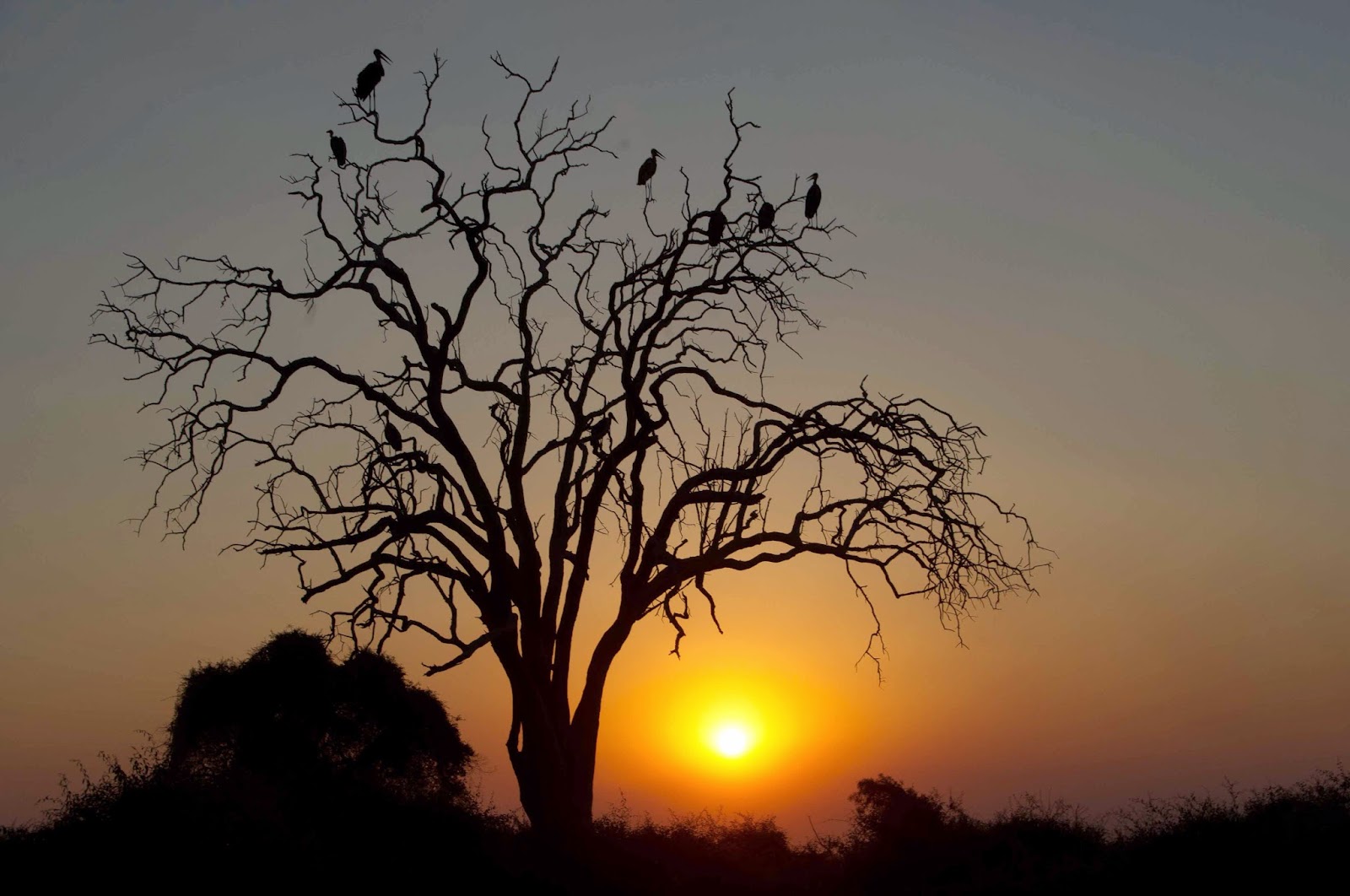
Sunsets here are absolutely amazing.


Wednesday, April 18, 2012

Finally a Leopard


I did not realize this when we began the trip, but there is an official Big Five when it comes to viewing animals in Africa. Hunters designated them as the most dangerous animals to hunt. They are elephant, buffalo, lion, a rhinoceros, and leopard. Sometimes you hear of the Big Seven by adding the second rhinoceros and the cheetah. There is also a Wee Five which include things like the rhinoceros beetle and the leopard tortoise.

We saw three of the five easily at Zulu Nyala. The first evening we started with the elephant and quickly added the buffalo and white rhinoceros. We added the lion on an extra excursion to Phinda Reserve in what was one of the the highlights of the trip. (I’ll share more of that when I get some pictures from Jim to show just how close we were. We also added the Black Rhinoceros on that safari, getting up close and personal with a family of three.

We continued to see more of these animals as we traveled to Spion Kop in the Drakensburg Mountains, Toka Leya in Zambia and Chilwero on the Chobe River in Botswana. I asked Raymond at Spion Kop if he worried at all about leopards attacking his cattle. He said that they are not a danger because even the calves are too big for the leopard to get excited about. Leopards like to drag their kills into a tree where they can eat at their leisure without competition.

But even though they were advertised everywhere, the leopard remained elusive until we got to Tubu Tree, our last stop on the trip.

Tubu Tree is a small camp with only five tents for guests, so we were really able to feel alone as we rode around the reserve. The down side of that is that with only two other vehicles out there, the sightings were harder to come by.

Nevertheless, we met up with a magnificent female leopard on our first day there. Another vehicle made the spotting so we quickly headed off in that direction. I fully expected that this animal would be gone by the time we arrived, but she was still walking down the road as we arrived. She acted completely as if we were not there, walking right by the Land Rover within a couple of feet. After she passed, our driver took off in chase. After doing this twice, the guide said we needed to leave her be for the evening.

We were amazed at her beauty and strength, but mostly we were amazed at how little she seemed to care about us. She was almost close enough to touch on two occasions as she walked by and did not do much more than glance at us.

The pictures are a bit dark as they were taken in the late evening and it was a bit cloudy, but they clearly show her power and elegance. Linda also managed to take a video with her iPhone.

Wednesday, March 7, 2012

Emdonene


This afternoon we took an excursion to the Emdonene, popular because guests get to spend time interacting directly with some of the cats and have a picture taken up close and personal with a cheetah. When discussing the possible excursions for today, this one did not top my list, but Linda wanted to go, so we did. And what an experience it was. Not only did we get to pet the cheetah, we learned a lot about an organization doing great things for the servals, caracals, cheetahs, and African wild cats they breed here. It was fun and well worth the time. Caring for these animals is expensive, so they charge people to visit and have their picture taken with the cheetahs and get in the pen with some of the other cats.
Our Picture
Jim and Marcia
First, we made one of those obligatory tour stops at a cultural shop for ten minutes. Tour companies seem to  have a constitutional duty to connect with these shops to help us support the local economy. At least at this one there was no pressure and we were able to pass on the buying opportunities without feeling guilty. It helped that one lady bought two sets of place mats and another bought a table cloth. If we weren’t already over our weight allowance for the end of our trip we might have looked more seriously at the items they had for sale. Quality here at Ilala Weavers was higher than at a lot of these places.
A Carical Eating the Chicken He Didn't Jump For
Carical Getting a Drink
We arrived a bit late and had to join a group in progress. Bernie, the director, had just begun talking about the caracals. This center takes in animals that are not able to survive in the wild. Some were pets, some were injured in the wild or by hunters. One of the caracals came because the chicken farmer who caught her killing his chickens decided Emdoneni was a better fate. Caracals (look like our bobcats) are especially dangerous to farmers because they will wantonly kill an entire flock and only eat one. The cats here have been trained to jump for their food. At least that is what we were told. We did not see much jumping. Perhaps they have figured out that the food comes whether they jump or not. 
Caracal Jumping For the Chicken
In addition to caring for these animals, they breed them and train the babies to live in the wild so they can be placed in game reserves to improve the species chances of survival in the wild. The cats are weaned as soon as possible and then begin their training. The first step is a dead chicken instead of their regular food. The naturalist said it may take as much as three days before the cats get hungry enough to eat this different food. Then they throw in a live chicken that has been hurt enough to be easy to catch. This may take longer, but the animal finally gets the idea. Finally, in a larger pen, the animal gets a healthy chicken. It may take 5 or 6 days, but the animal finally gets hungry enough and smart enough to catch the chicken. Over the next few weeks, the animal perfects its skill and is soon ready to be released into the wild. For our entertainment and picture opportunities, she had them jump as she threw chicken parts over the fence. Unfortunately for us, only one jumped once. Always smiling our guide moved us on to the cheetahs.
Cheetah Posing For Us
Bernie Showing Her Photography Skills
Bernie spent quite a bit of time talking about the cheetahs and going over the rules for us as we entered the pen to get an up close and personal interaction and picture with the cats. She explained how they are able to run so fast, but only for very short distances. They have a backwards claw that is perfect for hamstringing the prey if they are not able to catch them directly. One of her big concerns is legal hunting in Namibia. She said that if they don’t stop that hunt, cheetahs will be extinct in less than 40 years. Meanwhile they will do what they can.
Bernie Discussing the Cheetahs
The two cats we would interact with were a bit feisty, but gentle and purred a lot during their ordeal with us. Once inside the pen we each had a chance to sit with the cheetah while she took our picture with our own cameras. She said she is a good photographer and she is. Taking 30 pictures kept her busily moving around the marginally uncooperative animals. As one side gets hot, they turn over to cool off. So Bernie would scoot around to the other side of the animal. Because they were doing this more than normal, she explained that the cats were playing with her.  
Serval Eying the Photographers
Next were the servals. These beautiful cats are on the endangered species list because their pelts make beautiful coats. However, it takes 19 animals to make one coat. While their pelts are also used in official Zulu ceremonies, that is too small a take to matter. They are beautiful animals, and it is easy to see why people would want the pelts, but it is also easy to see why we need to change some or our attitudes around the world if our grandchildren are going to have these opportunities. After Bernie talked about the servals we were able to get in the pen with them for some close-up pictures. No petting however, as these cats are a bit too skittish for that. 
African Wild Cat
The final cat we saw was the African wild cat. While they look exactly like our house cats these are easily identifiable by several markings. The tails always end in black. They have a rust color on the back of their ears. They also have an orange front collar and full black circles around their front legs. These cats are threatened by interbreeding. These are the ancestors of our domestic cats. So many of our domestic cats have escaped or been released that some have entered into the wild here. As they interbreed with these wild cats, the wild cats will lose their unique identity – another sad story to share with our grandchildren.