Showing posts with label Norway. Show all posts

Tuesday, October 23, 2018

Searching for an Ancestral Past

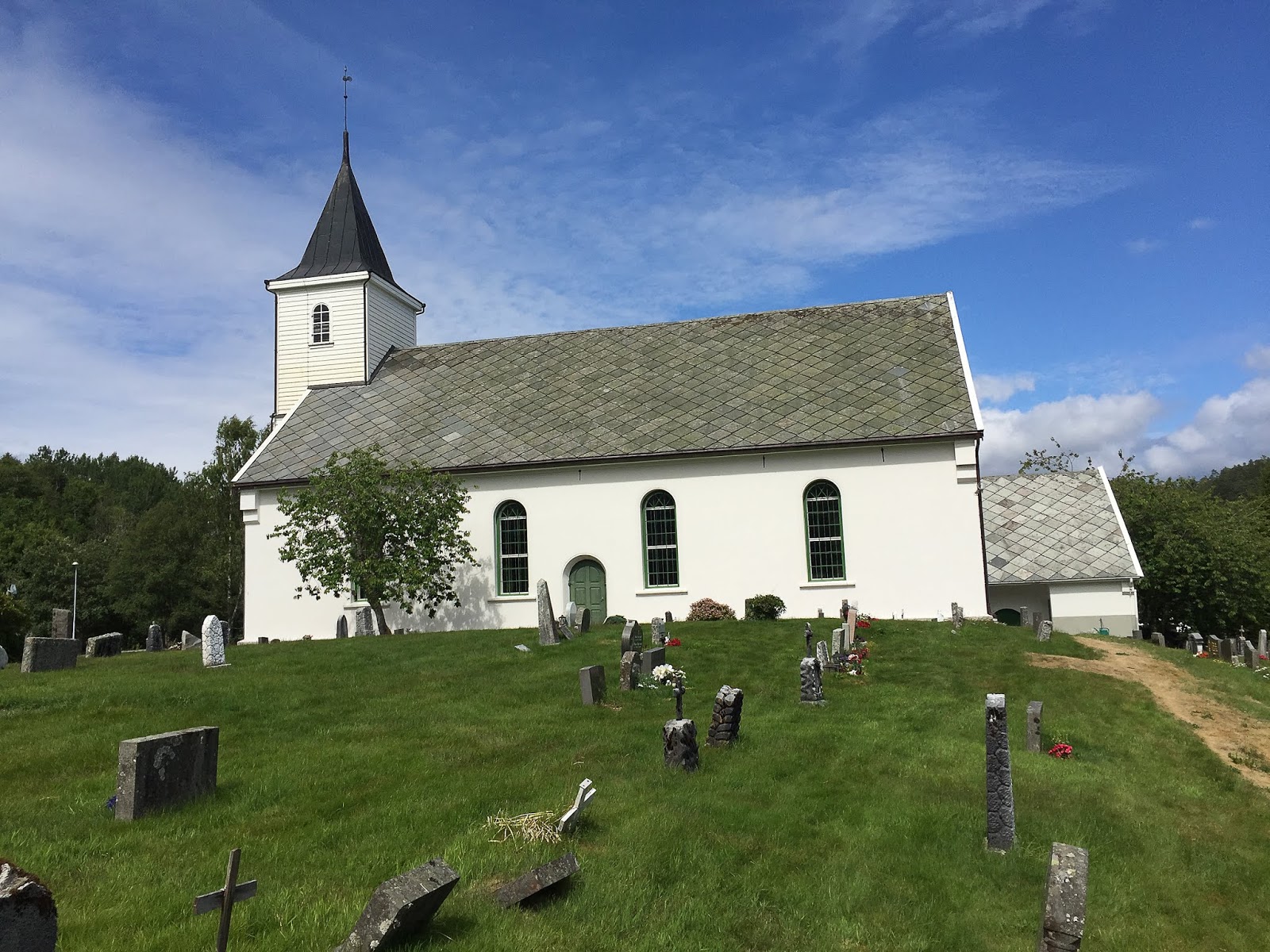
The Myking Church
While the Hurtigruten Ferry was the catalyst for this trip, it has been much more about finding ancestral roots. Linda and I started in Norway before the ferry ride looking for places her family had lived in the wilds around Bergen. We were fairly successful with some help from Ancestry.com, Linda’s cousin Jerry and his wife Joni, and the kindness of our Airbnb host who set us up with her father who remembered the names of places where people lived. With that we were able to get a good look at a few of those locations before heading off to our ferry cruise on the Hurtigruten. We left information with him and another stranger we met nearby with hopes that they will get back to us with more information.

The extent of farmland in Fjordland
Naevda Farm
A water world
The land is good for sheep
We also took a drive to Vik where we had tours of two churches connected to Cherie’s family. We took some pictures and hope to join them when they head that way in the next few years.

The Hove Stone Church
Hove Gravestones
Then after some time exploring southern Finland, we took the ferry to Åland Island. Cherie had made contact with someone living on property that her aunt had corresponded with. Fortunately, the woman living there today responded to Cherie’s letter and invited us to visit her. Cherie learned a lot about her family and left documents with Carlita who promised to translate them. Her husband also set us up to meet relatives of my brother-in-law Roy through an address he still had. That was the most exciting part of the trip. When we arrived at that address, we were met by two families anxious to meet us and although they were disappointed we were not the actual relatives. Even so, they entertained us with pictures and memories. We left with promises to continue the communication and visit again. We finished our stay in Åland with a visit to the Emigrant Institute where we spent a lively afternoon with the two women in charge. Among other things we learned that many of the papers Cherie had saved when her sister passed are rare and have real historical value beyond what they will teach her about her family. We also learned a lot about the context of emigration from Åland Islands which helped us understand more about the emigration of our ancestors.

Fun with paper at Carita's winter home
Roy's family
At the Åland Emigrant Institute
Then after a few days in Stockholm, Linda and I headed off to Vetlanda, a small city of about 10,000 where my grandmother was born. We already had a lot of details about the family here because she and a few others of her generation had written about the family as their contribution to the American Bicentennial in 1976. We don’t have any names or addresses of current relatives living in Sweden, so we did not expect any kind of a reunion as we had experienced on Åland Island, but we did want to explore the area and see what we could of the land where they had lived. With one possible exception, the only buildings remaining from that time are churches and even some of the have been replaced in the intervening years. The possible exception is a root cellar. The pictures look like it could be the same, but there isn’t a lot of difference among root cellars, so we can’t be sure. We did have a good time driving around the area, visiting two marvelous Emigrant Museums in Göteborg and Växjö, and looking at the amazing variety of churches the Swedes have built. There have been times on previous trips to Europe when we did tire of visiting churches and cathedrals, but on this trip, the only times a church disappointed us was when they were closed and we could not get inside. Outside and in, the amazing variety and beauty of even the smallest of these churches continues to amaze as the number we have visited approaches 20.

Vetlanda Lutheran Church
The stone fence
Root cellar - perhaps used by my ancestors
Linda pointed out that it is a bit ironic that on this trip, the person who learned the most about their past and was able to make actual personal connections is the person who wasn’t even there. Nevertheless, we were all excited with what we did learn and we all are leaving Scandinavia with the promise to return and spend more time in this stunningly beautiful region of the world.

Tuesday, September 11, 2018

Hurtigruten Day 6 - Kirkenes


We landed in Kirkenes at 9:30 in the morning to finish our Hurtigruten journey. We were about half an hour late due to the bus breakdown on our birding outing. A shuttle delivered us to our hotel where we were three hours early for our rooms. After storing our luggage, we decided to walk up to the local museum. The walk turned out to be harder than expected because it was an uphill climb of about a mile. No problem as we had lots of time.


The museum tells the story of this transborder region of the north. Until 1825, there were no borders here and the majority of the population was the Sami who regularly herded their reindeer across the region. But in 1825, they were forced to choose a nationality among Finnish, Russian, or Norwegian. The majority chose Russia and a minority decided on Norway. But it was a difficult adjustment for them as they were no longer able to move about freely as they had. Still crossing those borders was easy at first. Things would get more difficult. Norway worked hard to get more Norwegians to live in the region by paying people to move north. It was a tough life with little infrastructure and many returned south. A big population boom came in 1905 when iron ore deposits were discovered. The mine and processing plant brought about 3000 people to fill the jobs.

The museum

Two world wars and other border conflicts made life difficult for all the inhabitants. World War II was especially difficult as the Germans occupied the territory. They feared an Allied invasion and wanted to cut off Allied materiel support for the Soviet Union through the port of Murmansk. Kirkenes was one of the two most heavily bombed cities of the war, the other being Malta. Most of the town was destroyed by those Soviet bombing raids. Many of the residents left town for the duration. Much of this story is told through personal accounts and pictures. A monument commemorates the date the Soviets finally liberated Kirkenes in 1944.


The end of the war brought major border changes and the Soviets took a large chunk of Finland. Finland had collaborated with Germany during the war and the Soviets wanted the territory to put more distance between Norway, a part of NATO in the new Cold War, and Murmansk, their only open ice free port. Crossing the border was now much more difficult as well and both nations guard their border with tenacity.

Several of these panels of old photographs graces the square

A few locals hanging out in the public square
With the end of the Cold War and the development of the European Union, the borders have opened considerably. The crossing between Norway and Finland is totally open and the Russian border is now relatively easy to cross. Russians come to Kirkenes regularly to purchase things they can’t get at home and Norwegians cross into Russia to buy gasoline at one-third the price. Still, the border is closely guarded by both Norway and Russia. Russia has even created a military zone up to one kilometer wide along the border.


This has brought a new kind of prosperity to Kirkenes and its hinterland. The mining operation closed early in this century, but tourism has risen exponentially both in summer and winter. Kirkenes actually gets more visitors in winter when people come to see the Northern lights, take dog sled rides, and stay in the snow hotel. Kirkenes is the only place in Nordland that can guarantee snow during the winter. It gets cold and stays that way from November to April with the average temperature often below freezing. Kirkenes also enjoys the Russian need for ship repair. About 90% of the repair work done in Kirkenes comes from Russia. There is talk or reopening the mine, but that is controversial now with a heightened concern for the environment.

I should have known it was too cheap to be real.
Look at the alcohol content on the label.
We stayed two nights in Kirkenes so we could experience a part of life here in the far north so close to Russia. We chose to take a tour that would put us on the Pasvik River which serves as the border between Norway and Russia. Our guide exemplifies the new Kirkenes as she moved here from Germany 17 years ago with the intent of staying only a short time. She loved the place so much she decided to stay, got married, has a family, and is in the process of taking over the tour company as its present owner and founder retires.

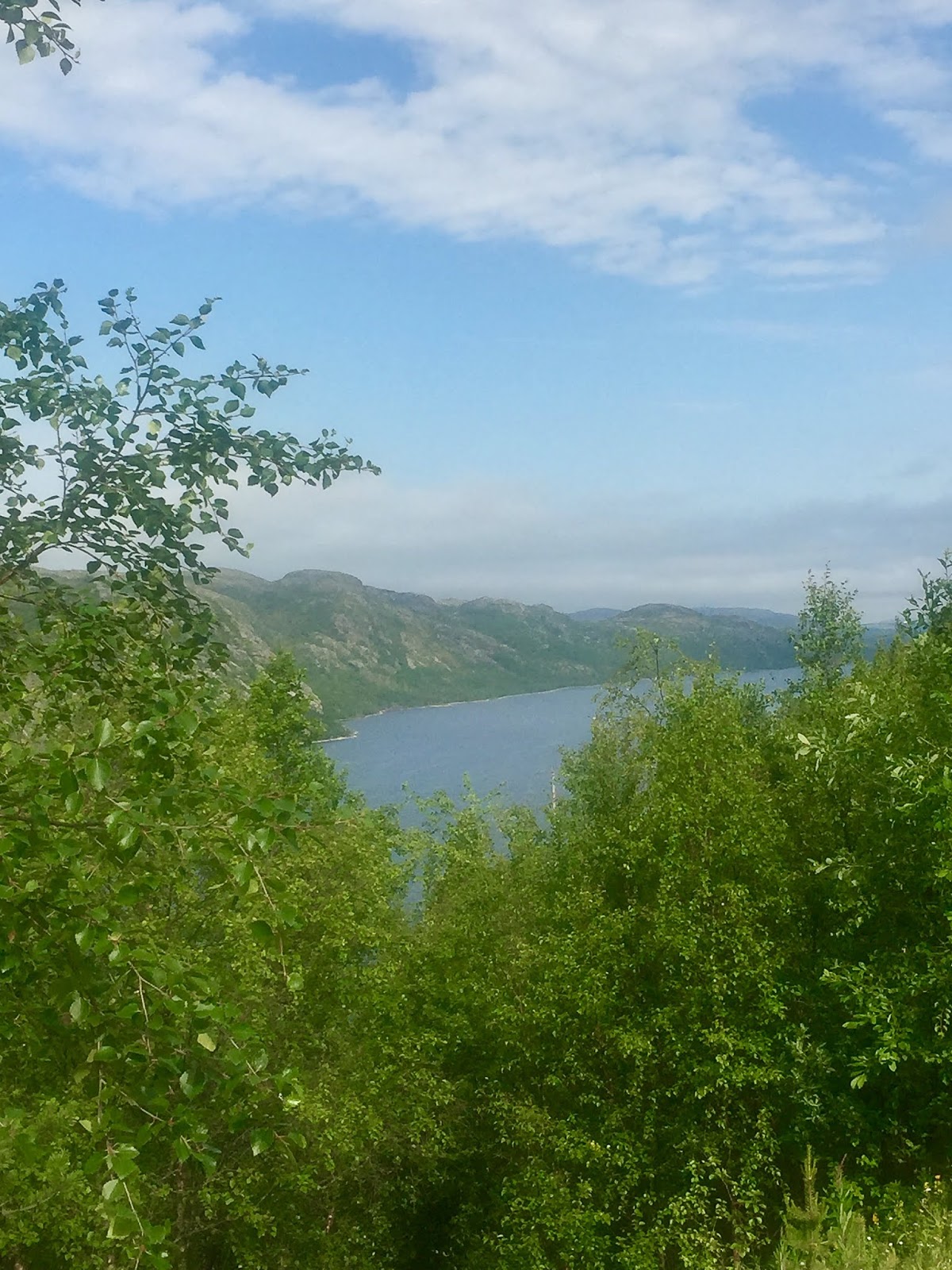
One of the lakes in the area
We drove to the river with a couple of scenic stops along the way. Fellow guests included a guy who had gotten into trouble the day before at the border. On a different tour he had hiked about six kilometers to the Three Borders monument where Russia, Finland, and Norway meet. While there he laid his jacket over the chain marking the border while taking a picture. This put part of his jacket in Russian territory creating an international incident. The fine for this could reach into the thousands of dollars, but he thinks he will not be punished. Still, we learned how seriously the Norwegians take border security.

A natural area created by the park headquarters.

Our first stop was at the National Park Visitor Center with nice displays about the flora and fauna of the area.


We were on the river for an hour. We saw a few birds, but most interesting was the difference between the Russian and Norwegian sides of the river. The Russian side is empty except for a few watch towers. Meanwhile, the Norwegians build right down to the river so they can fully enjoy their access. Most often the saunas are built closest to the river so the users can finish with a dip in the river.

Norwegian homes next to the river
The sauna at the riverside

An unusual site according to our guide was the Russian Zodiac floating the river, its occupants fishing. It looked like they had some success. Our river guide said he had caught a six kilogram trout the evening before. At the end of our ride, we were served lunch at a rustic resort built to serve those wanting a sled dog ride in the winter. The have a restaurant where we were served lunch in a building reminiscent of Northwest Coast Indian longhouses. We sat on benches on either side of the building with a fire pit between us. Instead of a simple hole for the smoke, the roof is constructed so that one side of the roof extends over the other side allowing the smoke a passage to the sky without letting in any rain or snow. Our tasty meal of moose burgers in gravy accompanied by lingonberries, carrots, and new potatoes followed by a cloudberry flan more than satisfied our hunger.

Russian soldiers fishing
We did NOT cross the line marked by these poles.
Notice that there is no evidence of civilization by the river
After lunch we were taken across the street to meet the 45 sled dogs. These friendly animals have a lazy summer as they wait for their fun pulling sleds for guests during the winter. The ride is highly recommended, as the snow-covered landscape is beautiful and might be lit by the Aurora Borealis. No more than eight guests share a single tour, so the isolation adds to the joy of the ride. I was a bit later getting to the dogs as i was sidetracked by the bird feeding station. It’s just fun watching the little guys flit in and out of the area as they fill up for the winter and fight over the access. I saw greenfinches, redpolls, and tree sparrows among the crowd. The dogs were fun, too as they begged to be petted and pampered.

Waiting at the dock for lunch


On the way back we stopped at ‘96 Height’, a watch tower abandoned by the Norwegian military several years ago. They had been using it to watch the Soviet, now Russian, military camp across the river until the trees grew too tall and they had to move it some distance upstream. Today, it is open to the public with a small restaurant and great views of the area for only 30 kroner, about $3.50. None of us chose to make the climb. The location is 96 meters above sea level, thus the name.

Midnight Sun
We went back to our hotel for the rest of the afternoon and watched the World Cup Finals. We only got to watch the first part of the game and missed all the goals. A lightning storm travel through the area which seems like a good culprit we can blame for knocking out the cable system in town. Later, we ventured out to dinner at an excellent Chinese restaurant in town. Tomorrow we head to Helsinki to begin the Finnish portion of this trip.

A few wild reindeer on our way to the airport

Sunday, September 9, 2018

Hurtigruten Day 5 - Honningsvåg

Honningsvåg, Note the snow fences
We landed at Honningsvåg about 11:15 for our next excursion, just before our normal lunch time. I had an early breakfast, made a sandwich to take on the excursion, and a small bit for an early lunch. The others decided they would travel to North Cape, the northernmost point in Europe. They had a good bus ride and short walk to the site. It was a bit foggy, but they beat the main crowds of the day to enjoy the views and the experience. Four large cruise ships arrived at Honningsvåg on this day including the world’s fourth largest making it the busiest day of the year for Honningsvåg.

Reindeer swim this channel twice a year

One of the lakes as we crossed the island
The world's fourth largest cruise ship
Honningsvåg is on the island of Mageroya which is now connected to the mainland by a 6.8 km tunnel. Norwegians do love their tunnels. Fishing and whaling used to be the mainstays of the economy. Fishing is still important, but tourism is now the mainstay. The airport welcomes 19,000 passengers per year and multiple cruise ships enter the harbor daily during the summer. An exciting thing to see here would be when the caribou herds swim to the island, a distance of some 1.8 kilometers.


A few cod on the drying rack
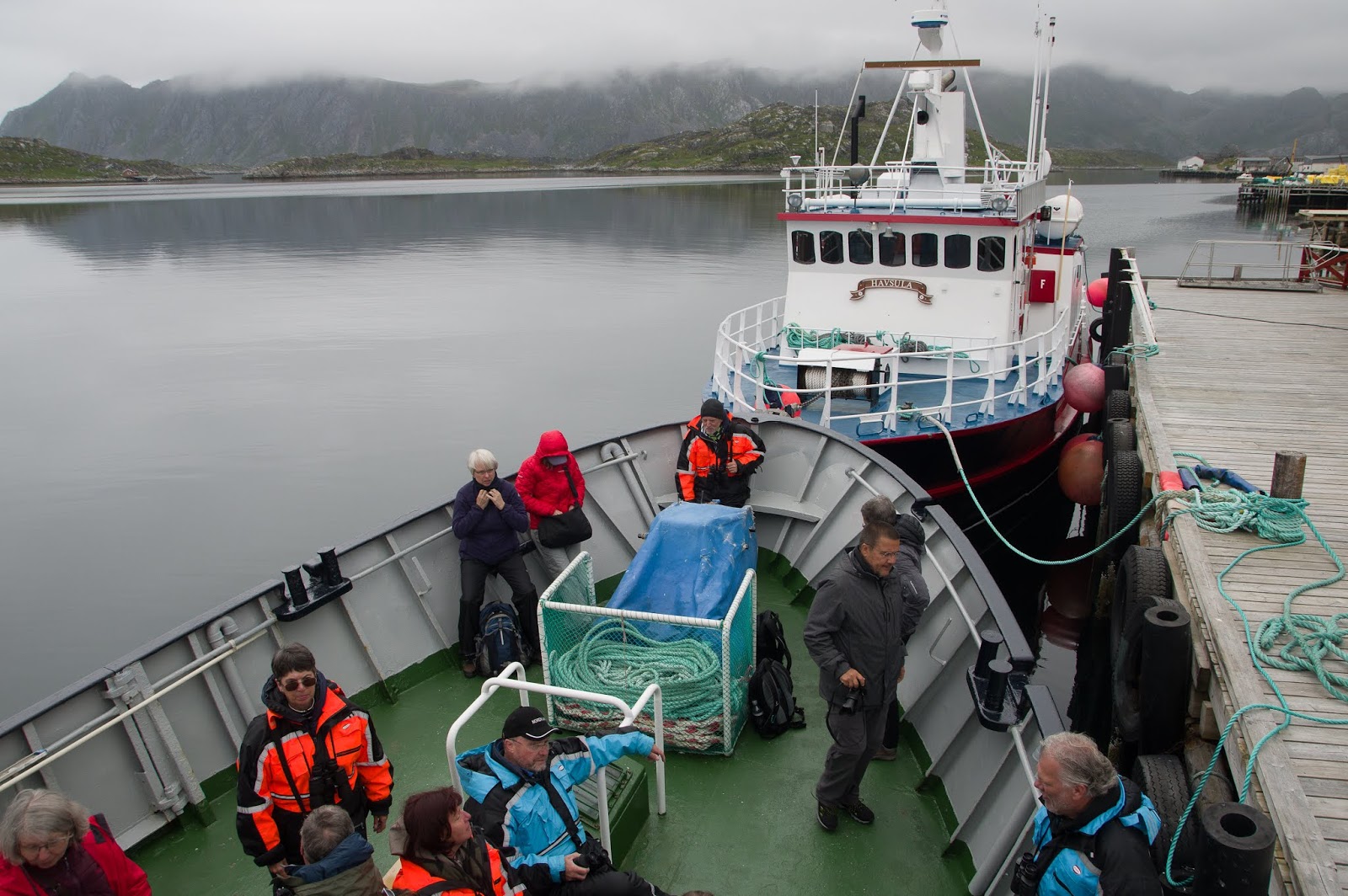
Preparing to leave the dock
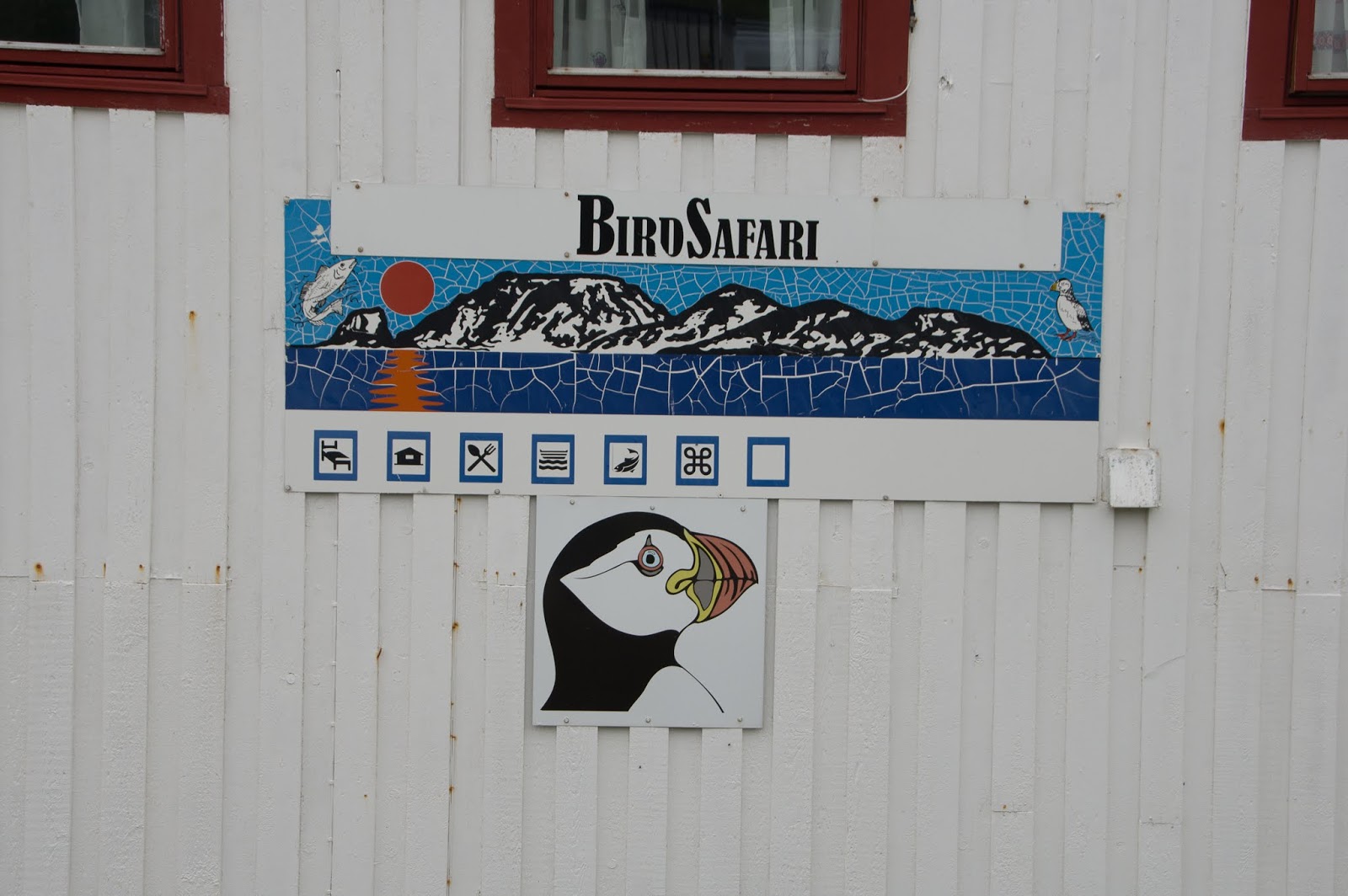
I opted for the bird safari and was not disappointed. We drove across the island to the small fishing village of Gjesvær where we boarded our safari boat out to the bird colonies on the small island of Gjesværstappan. As we left the harbor and crossed the channel, the number of birds increased until we were literally surrounded by thousands of swimming and flying puffins and guillemots. Nearly 1 million puffins nest here. Since raiding the nests for eggs and killing the birds for eating was outlawed about 50 years ago, the population has increased. Puffin eggs and meat were so popular, the locals bred a special dog for the purposes. These puffin hounds were small enough to enter the deep holes the puffins dig for their burrows. They also had an extra claw to help them climb the steep cliffs. Finally, they were short of teeth to they did not harm the meat of the birds as they pulled them out of the nests.

Mostly Atlantic puffins
Puffin taking off

One would think they are out of danger now. Unfortunately, the capelin and herring they eat and feed their chicks are decreasing to overfishing and a warming climate. Without enough of these small fish to feed the young, the babies die before they can care for themselves threatening the future of the species.

Razorbills


Mostly razorbills
After some time amongst the puffins and razorbills and watching the gulls and eagles fly around looking for easy pickings, we sailed just a short distance to see other bird colonies. The northern gannet colony of 3000 began with a single pair about 20 years ago. I’m not sure why they came here, but they do seem to have found a good spot. These are beautiful white and gold birds who dive into the water in search of fish. Puffins and guillemots, on the other hand dive from a floating position. They are built for swimming and can reach a depth of 80 meters. Unlike the gannets, the puffins and guillemots are not elegant flyers.

Puffins are ungainly in the air
Northern Gannets
A bit further on we would pass nesting sites of black-legged kittiwakes, shags, cormorants, and razorbills. Along the way we saw at least 15 white-tailed eagles either flying or perching on the cliffs. Eagles will eat just about anything they can find, but there are so many birds here they subsist just fine on a bird diet. The big excitement for me however, was seeing the Great Skua, my first, chasing a puffin. Skuas are thieves. This one wasn’t chasing the puffin to eat her, but to get her to drop her to drop her catch so the Skua could eat it. I think it was successful because it dropped quickly down to the water after the puffin left the scene.

Common Murres

Black-legged Kittiwakes

Great Cormorants
We learned that we had actually reached the most northerly point in Europe rather than those who were driven to North Cape. The problem is that there is not easy access to this true north point, so North Cape gets the distinction for touristic purposes.

Gjesvær: The Bird Safari Harbor


Unfortunately, we had to leave all too soon to get back to our ship. Alas, it was not to be. While we were gone, something went wrong with the air system on the bus. Since everything on the bus, including the brakes, depends on air pressure, we had to wait for a replacement. Fortunately, because this was a Hurtigruten tour, the ship had to wait for us. That is one advantage of ship-sponsored tours. When something goes wrong, they will wait for you. If you are on your own, you could be left on your own to reach the next port or whatever at your own expense. We were so close to the end of our voyage that we never did catch up, arriving at Kirkenes, our final port, 30 minutes late.

Sami and reindeer in traditional dresss
John and Cherie at North Cape

I need Linda to write about these discs.