Showing posts with label Switzerland. Show all posts

Wednesday, December 23, 2015

Basel


St. George killing the dragon from a distance
We were in Basel to begin our tour down the Rhine River to Amsterdam. Basel sits at the uppermost navigable point on the river and at the intersection of France, Germany and Switzerland. One resident told us that the best financial arrangement is to live in Germany, shop in France, and work in Switzerland. Our arrangement here in Vancouver is to live in Washington with no income tax and shop in Oregon with no sales tax. Of course it is never really that simple. Anything delivered or licensed will still get the Washington sales tax and if you want to live in Washington and work in Oregon, you will pay the income tax AND fight the traffic. 

Christmas markets are about socializing with friends

We took maximum advantage of our time in Basel with a tour of the Rathaus (town hall), a visit to the Munster, three hours in the cultural museum (Basel calls itself the cultural capital of Switzerland with its 30+ museums), and a walking tour of the city after checking in the our cruise ship. Or course, we also had a splendid fondue dinner and spent a couple of hours wandering the Christmas market.


We were fortunate to arrive on Thursday when we could take advantage of the weekly evening tour of the Rathaus. The guide told us it would be in German, but we agreed that just seeing the place would satisfy us. As it turned out the other two couples were fluent in English and offered to listen in English so we could get the full tour. Very nice of them. The Rathaus was built in 1503. The new bishop refused to grant Basel a constitution, so the city showed him its power by building this beautiful new city hall. The city had become the eleventh member of the Swiss Confederation in 1501 and would end its Catholic connection in 1529 when the city became Protestant. 


The inner courtyard of the Rathaus
Justice in the center

The inside and outside of the building were built and decorated to educate and impress. One of the large paintings inside shows Solomon’s decision to cut the baby in half to settle the dispute over its motherhood. Another shows the evils of justice only for the rich. The most interesting artifact is the statue of justice that adorns a wall of the inner courtyard. It had been a statue of Mary. Taken from a church, the builders saved money by simply adding the scales of justice and neglected to provide a blindfold or remove the crown. 


Solomon's justice


The original document when Basel joined the Confederation

The Munster is a  fine example of the late-Romanesque/early-Gothic style. The façade includes an interesting statue of St. George slaying the dragon. The two towers are different, not because they were constructed at different times, but because one of them housed a city guard for many years when Basel was in danger. Erasmus, the Dutch philosopher who lived in Basel for much of his life is buried here. 


The cultural museum had an interesting display of decorated Sicilian carts which were used until only a few years ago. I imagine they are still used in some places today. They also had a fascinating display of early anthropoligists who had traveled to then remote parts of the world study cultures. Photographs and artifacts showed both their findings and their lifestyles as the lived in these remote places. 


Sicilian carts

A beautiful stringed instrument in the musuem


Fountain designed by iron sculptor Jean Tinguey

Clean fresh water spout. I wish we had some fountains like this.
This ferry uses the river current for power. Note the cable stretched across the river. The cable from the ferry slides along as the river current pushes the ferry across the river.

The three kings banged the staffs on the floor whenever a donation was made. It was a steady din as people walked by.
Not sure who this is, but I liked the colorful statue on the pedestal.

Tuesday, December 22, 2015

Lucerne Excursions


While we stayed in Lucerne, we visited the tourist information office – always a good idea when entering a new town. They provided a map and booklet for Lucerne and recommended that we purchase a Tell-Pass which would pay for all our trips on the trains, boats, buses, and chairlifts in the area for as many days as we chose. At 100 Swiss francs apiece, it was expensive, but we used so much that our trips ended up about half price. We visited two different towns by train, rode the chair lift up to Mt. Pilatus, and took a three-hour tour of Lake Lucerne.


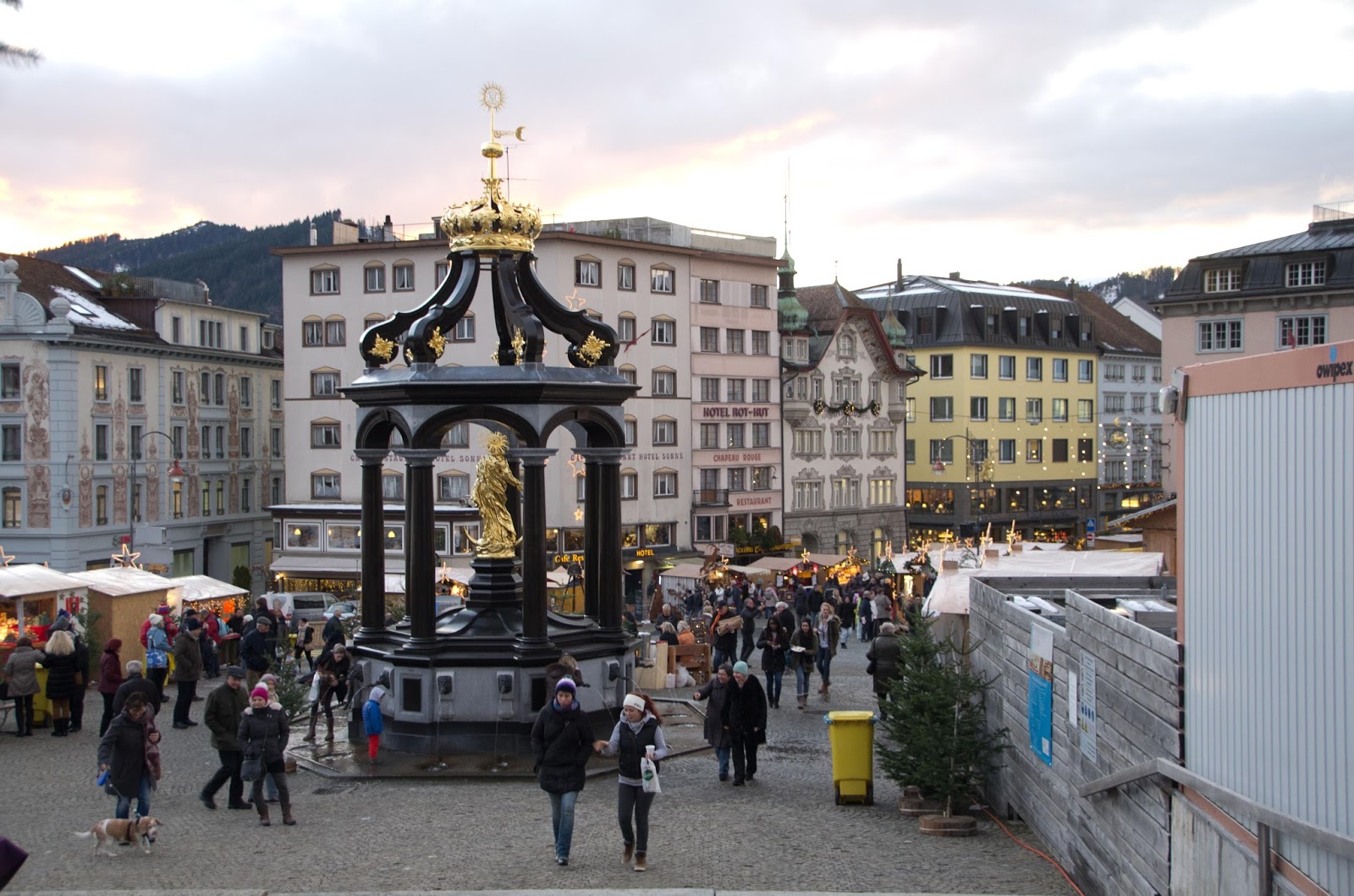
Our first visit was to Einseideln where we visited a beautiful still-active Benedictine monastery built in the early 18th century and meandered through our first Christmas market. On the train ride to Einseideln, we were treated to splendid views of lakeside villages and farms and passed a ski jump used for Olympic training. 

 
The monastery had its beginnings in the story of Meinrad, a Benedictine monk who desired the life of a hermit in the forest. He was killed for his non-existent treasure 861. The killers were followed back to Zurich by his two tame ravens. They were identified and hanged for the crime. In 934, the ‘recluses of the forest’ were convinced to form a Benedictine community out of which grew the monastery. Today, the monastery belies its rustic origins with its stunning interior where pictures are not allowed. 


The walk from the train to the monastery heads right though the Christmas market lining the street so we got to visit it twice and were enticed to make a few purchases.


Catholic and Protestant Churches sharing space
The next day we visited Interlaken, two hours by train in the opposite direction. The ride is even more beautiful even on a cloudy day. Interlaken is a small tourist town made famous as an international meeting place before World War I. it is also the center for a wide variety of summer and winter mountain activities. The nearby Jungfrau and Eiger mountains draw mountain climbers world wide. Our big disappointment was that so much of this activity is oriented towards  the summer. The funicular next to the train station was closed for the winter, much to our surprise. We did see a number of hang gliders landing in the field in the center of town. We also visited the most starkly decorated Catholic church we would see anywhere. We were surprised to discover that it is a cathedral. 


A very small dog park for only one purpose

One of the many hotels in Interlaken
We wandered through town, had a nice fondue for lunch, purchased a new winter coat for Linda who was sadly underdressed for the cold weather and enjoyed the return train ride to Lucerne. 


The next day we ascended Mt. Pilatus, another mountain for summer activities. The amazing views from the mountaintop were worth the trip, but we were surprised to find only one short walk carved into the mountainside to protect it from the snow available for ‘hiking’. We were entertained by two Alphorns which provided a fitting musical accompaniment to the views. We were again disappointed that the funicular we hoped to ride down to the lake for a boat ride back to town was also closed for the winter .


Upon our return to town we bought sandwiches for a quick lunch and hopped on one of the boats for a three-hour cruise of the lake. The boat was really a people ferry making a round trip. Locals and tourists joined us for parts of the ride. This was the most beautiful of our three days in Lucerne so we had great views of the towns and mountains and we circumnavigated the lake. 


Someday we will return to this beautiful spot during the spring or fall when we can enjoy more of the mountain activities. 


Monday, December 21, 2015

Lucerne


Lucerne is a lovely small city in the middle of Switzerland. We spent four nights there on our way to Basel where we would get on the Viking Kvasir for our cruise down the Rhine to Amsterdam. Not only is it a fun city on its own, it is the center of a recreational area that offers just about any kind of summer or winter activity you could ask for.  


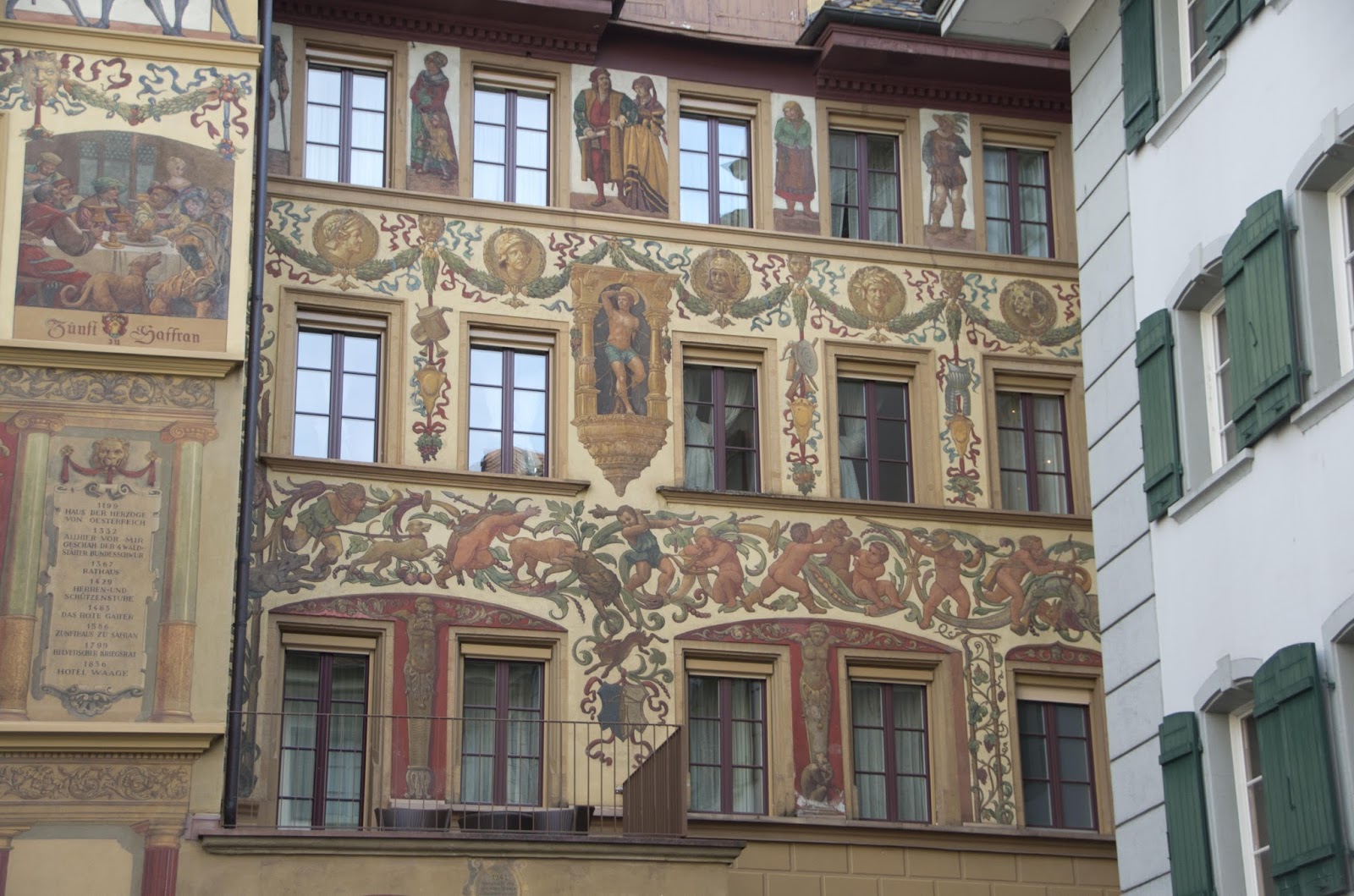
The city straddles the Reuss River where it enters Lake Lucerne in the midst Alps. We were particularly fascinated by the painted buildings. It seems that the thing to do is paint interesting pictures on the sides of buildings to make them more attractive. We certainly approve. Actually, most buildings aren’t painted, but that just makes those that are more interesting.


Swans, ducks and gulls have made a home of the river no doubt attracted by the tourists and locals who provide plenty of bread.

 Lucerne sports the most photographed bridge in Switzerland, a covered bridge crossing the bay. The Chapel Bridge was built in the 14th century as part of the city’s fortifications. Today it still functions as a walking bridge joining the two parts of the city. The small tower, added as a chapel in 1568 today houses a souvenir shop. Inside the bridge itself, 17th century paintings of scenes from Lucerne’s and Switzerland’s history adorn the ceiling area. At one time 110 of these paintings covered both sides of the triangular boards beneath the roof. Unfortunately, most are gone today including several that were lost in a fire a few years ago. The charred beams still show evidence of the fire.  Still, those that remain add to the interest of a walk across the bridge. 


Lucerne’s other famous site is the Dying Lion of Lucerne. Carved from the rock face, it commemorates the heroism of the Swiss soldiers who died attempting to protect the Tuileries Palace during the French Revolution. Mark Twain called it “the saddest and most moving piece of rock in the world”.


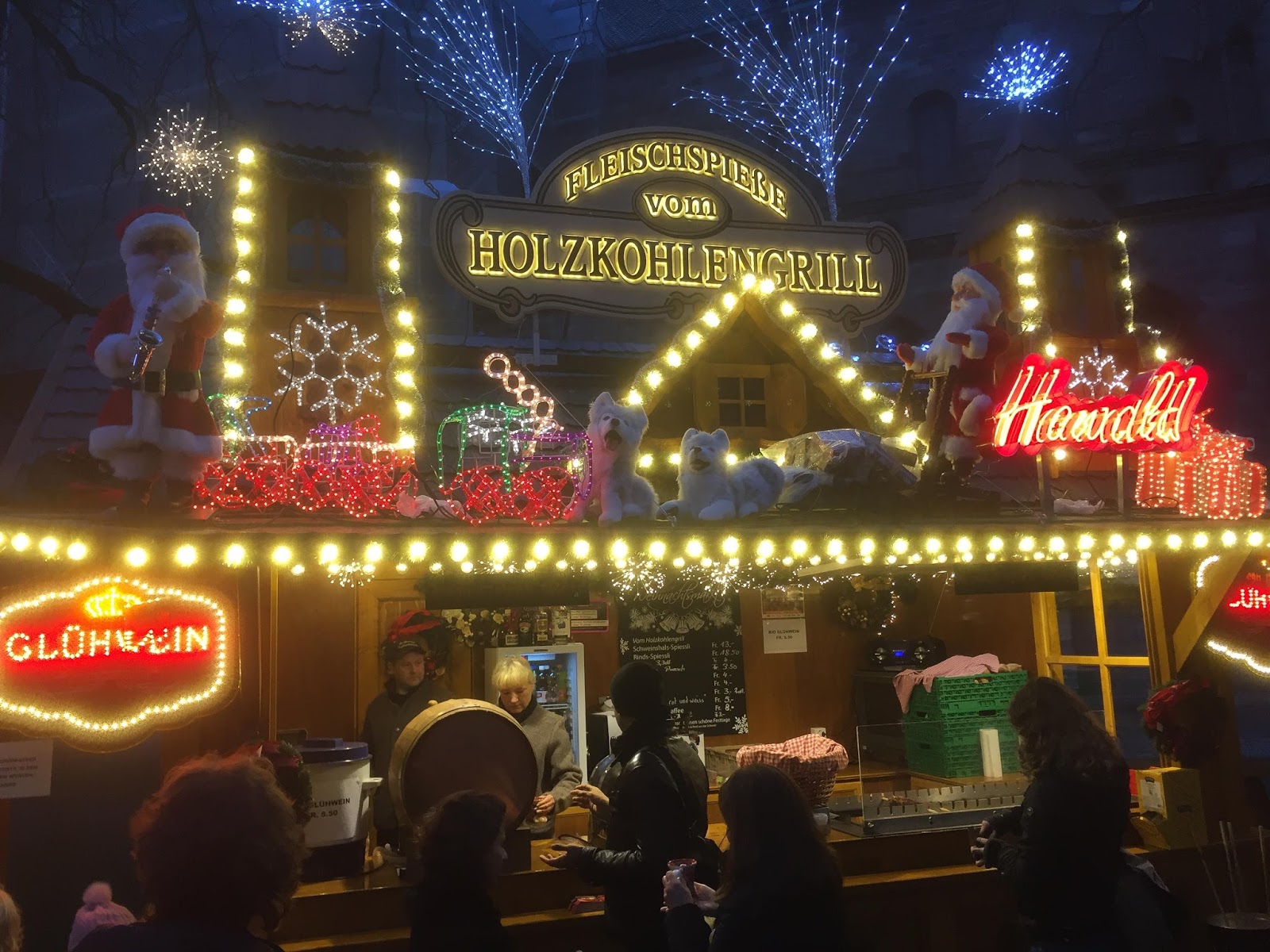
We are quickly learning that Christmas is a major undertaking here in Europe. Streets and buildings are decorated. One building uses its windows as an advent calendar. Each day the shutter opens to reveal a new Christmas scene. Many towns also have their own Christmas market. The shops are not housed in tents; the wood constructions ensures a sturdiness in the winter weather and adds to the Christmas look. Gluwein (milled wine) is served throughout and each town offers its own collectible mug. The presence of food and gluwein make the markets a wonderful strolling area for families along with the tourists.