Showing posts with label ZuluNyala. Show all posts

Sunday, October 12, 2014

Hippopotamus


Hippopotamus are huge, sensitive animals. They are touted to be the most dangerous animal to humans in Africa even though they are only aggressive out of fear. They are one of the Big Five, so-called because hunters feared these five animals the most. The others are rhinoceros, lion, leopard, and buffalo. The others will seek out the hunter who wounds them, but the hippo seeks the safety of the water when wounded, so they are no real threat to hunters in the way the others are.


Hippos are dangerous because they are so big, fast in spite of their size and scare easily. They react when humans get too close and the move too fast for a human to escape. A couple of years ago, a resident of St. Lucia lost a leg to a hippo. His security light was out so he did not see the hippo when he entered his yard. When his wife discovered him some time later, the hippo was happily munching the grass a few feet from the man. The threat was gone so the hippo was no longer interested in the man he had attacked.


Hippos are also a danger to boaters who get too close As one approaches to closely, they open their mouths to show their teeth. Sometimes people think they are just yawning and so miss the warning. Before they know it the boat is capsized and they are swimming for their lives – if they can even swim.

Hippos spend the day in the water to protect their sensitive skin. They will dry out quickly in the sun and by the end of a single day will be covered in cuts from the sunburn. Once the sun sets they leave the water to graze. On land they will separate to graze. When they return to the water in the morning they will group up and enjoy each other’s company.


The pictures are from our first morning at Zulu Nyala. We watched them and the birds around the pond for about 30 minutes. Since they are resting the action probably happened when one hippo bumped or stepped on another in their sleep. Less than a minute after it started, they were again settled in to the water with only a small bit of the body showing. 


Monday, March 5, 2012

Cheetahs - Up Close and Personal


The weather has turned bad. We are experiencing a cyclone of unknown proportions other than we are to expect somewhere between 30 and 50 centimeters of rain over the next 36 hours. Hopefully it will subside by Monday so we can visit Phinda, the neighboring game park. Phinda is 60,000 hectares as opposed to the 3000 of Zulu Nyala, so we have a much better chance of seeing leopards and a good chance to see lions. There are no lions here on Zulu Nyala’s smaller range. 
Cheetah At Emdonene (More on this Later)
Marking Territory
We did get out this morning just before the rains began. And what a morning it was. First we had some great views of Cape Buffalo (more on that in a separate posting). And we finished with a nursing rhinoceros. More on rhinos later, too. The real highlight was the three cheetahs we spent about an hour with. 
Phinda Refuge Cheetah
Phinda Cheetah
Phinda Cheetah
Cheetahs are the world’s fastest land animal reaching speeds up to 140 kph in short bursts. They have huge lungs and nostrils so they can get enough air, but if they run too far they will overheat and perhaps die. The only cats with non-retractable claws that help them run, they also are the only cats with a rear-facing claw they use to cut the leg tendons of their prey if they aren’t able to catch them. When they do catch their prey, they jump on the back and use their strength to cut off the air supply suffocating the animal. Unfortunately for cheetahs, they are the prey to almost every other large animal in the neighborhood.


Playful Brothers
Two of the cheetahs belong to Zulu Nyala. The other belongs to Phinda. There used to be three brothers on the Phinda side, but two have been killed by the Zulu Nyala pair, who are also brothers. They actually pulled one through the fence to kill him. Now, since cheetahs tend to band in brotherhoods for life, this single cheetah is left alone. Probably he has no place to go except this dangerous area (for him) along the fence. He is the same animal we saw on our first evening here. 
Caressing


The two on our side didn’t interact with the Phinda cheetah, but they did provide us with some interesting behaviors as they rested allowing us to stay with them for that hour. At first they simply lazed around occasionally rolling over to dissipate some heat. Eventually they got up to relieve themselves and perhaps mark territory. 

After wandering a bit, they settled back down next to each other and began to caress one another for the next 20 minutes or so. The pictures tell this story.

Sunday, March 4, 2012

Bad Weather


Our Tent
3 of the 20+ Tents
The cyclone has given us a day off from safaris and a chance to learn more about our tent camp. As we said before these are tents only in style. The floor is cement. The walls are bricks covered in cement with four floor to ceiling windows and a double-wide front door. The side windows are simply holes covered with screen and coated canvas shades on both inside and outside to provide privacy and protection from the rain.  Velcro holds them in place on the inside. The outside is more secure zippers, necessary since the wind is more powerful than the Velcro. The two windows on the front are glass.  The roof is two layers of coated canvas. The whole setup had an interesting effect in the storm last night. At times the flapping of the canvas roof was so loud we couldn’t hear the rain.

Jim Uncovering Windows After the Storm
The bathroom is separated by a half-wall and quite nice with two sinks, a shower, and a triangular tub. We have been asked not to use the tub because of the drought conditions that may continue even with the heavy rainfall (30 to 50 cm) expected and already being experienced. 

Our tent is on the edge of the compound so we look out on a field inhabited by zebra, impala, and nyala. Swallows are constantly entertaining us with the bug sweeps. We appreciate their efforts and have seen no mosquitoes. Lots of birds live here, too. We have seen probably 50 different species, but so far have names for only about half. South Africa has perhaps more than double the number of species that we have in the United States, so figuring them out is not easy. Fortunately, Rohan, our guide, is pretty good with birds and has been a big help. 

Crocodile Pond Behind the Fence
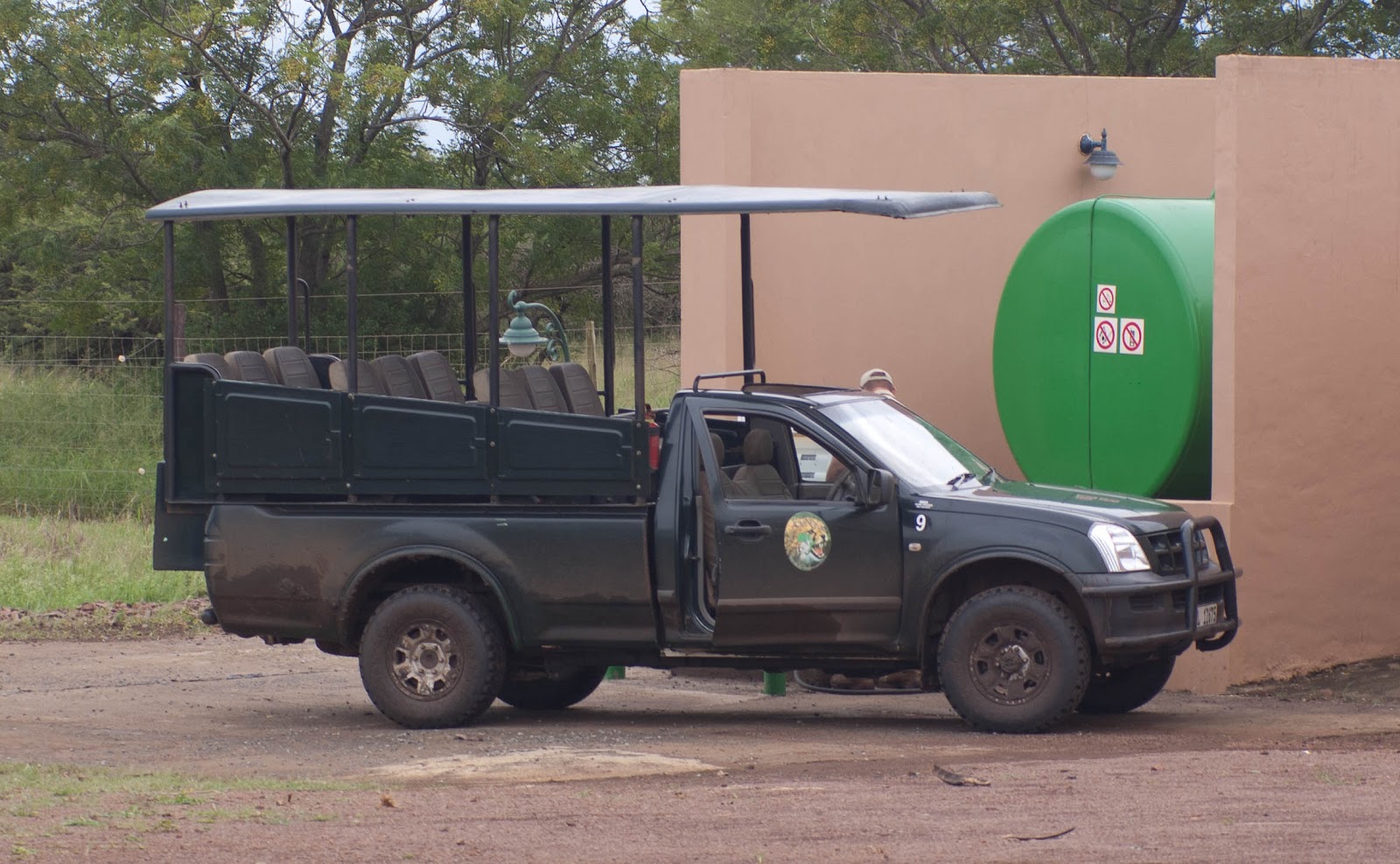
We walk about ¼ mile to the lobby and eating area. The brick path is torn up a bit as they are building some additional tents, but it has been a good walk for the exercise. We don’t get much as we ride around in our Land Rover where we are not even allowed to stand as that would change the profile of the vehicle and perhaps then interest the animals enough to think we are a threat or food. 
Our Chariot Awaits
Food has been good and more than plentiful. Breakfast is similar to most buffets with cereal, yogurt, eggs, meats, cheese, cold cuts, various breads, fruits, juices and coffee. For lunch we can order just about anything with specials depending on the day. Today it was prawns tempura. Salads become special when tuna or cheese or something else is added to the standard lettuce, tomato, and cucumber. Dinner is usually also a buffet although tonight because of the rain we ate inside and had a choice or steak or dorado (a whitefish).  Last night we ate in the Boma. That is a series of round huts built together with a large open area in the center. This provides some privacy for groups with a large area for entertainment, not that we had any last night.
Old Train Station; Now Our Restaurant
Normally we eat on the veranda thinking about how easy it would be to get used to this lifestyle and understandable that Europeans who came to Africa often decided to stay rather than return home at the end of their tour of duty. The building is an old train station built when this was a cotton-growing area. Today the train is mainly used to transport coal to the port at Durban to be used for electricity generation. The old station now is the restaurant and bar with a few hotel-style rooms on the second floor. 
Pool
Other attractions include the bar and a Zulu cultural center that we have not yet visited. Two crocodiles inhabit a double-fenced pond where they are joined by a variety of birds nesting in the reeds and moorhens and crakes of an indeterminate number. 

Entrance to Boma
It appears that most of the people who are staying here came by the same route we did. They purchased the package at an auction. Tonight, Linda talked to Robert, the manager who immigrated from France in the 1980s, about the process. He said that this is how they have built up the clientele. The charity gets 50% of the auction price which on average is enough to make them happy. So far we have met people from Alaska, Massachusetts, and Burns, Oregon, among others. The rest of the guests come on tour buses. This appears to be a regular tour stop. The group comes in for one night and one safari before moving on to their next stop. In the three days we have been here, we have seen eight of the big tour buses with people from England, France, and Germany. A couple of the groups have had an evening’s entertainment by Zulu dancers and singers. I overheard it from the bar one evening. 

Folks who stay here get the choice between the tents or real cabins. Zulu Nyala also has a lodge not far away on a hillside overlooking the reserve. We got to visit is for a short time the first evening as we picked up a couple there for our first safari. We did not see a lot, but it looks like it has a nice view and probably nice rooms. Some of the people have opted to split their time between here and there. Personally, I’d rather not have the inconvenience of moving any more than necessary.
Air-Conditioned Rooms - Our Tents Are Not

Our First View

Finally, the servers include locals and six students from Toronto who will be here four weeks after spending four weeks in Johannesburg. They are all majoring in tourism and this is their internship. Not a bad gig. Interns come twice a year. 

Because the heavy rain made the clay roads in the refuge too slick even for the 4-wheel drive Land Rovers, we are just hanging out today. Hopefully, the rain is over and we will be able to get out tomorrow, our last day. Other than the dampening effect (pun intended) effect of the storm, we would easily recommend this as a good place to experience Africa.

Friday, March 2, 2012

Nompondo School


Today we took a break from the twice-daily safaris to visit Nompondo village and school. The elementary school is just up the road from the center of the village. We met the administrator (school secretary) who answered our questions before visiting a classroom and the kitchen.  K-12 school is free and includes a lunch. Today they were having a fish stew and cabbage. One nutritious meal in a village with 70% unemployment and where some of the employed are self-employed street vendors.  The kitchen was designed to allow cooking in two large pots – large enough to feed all the students, about 300.
Marcia Rinta with our Guide for the Day
The student day begins with math in every classroom. They begin learning English in first grade. While there are eleven official languages, English is the language of business and government so everyone must learn it to get ahead. Our guides have all spoken at least five languages and will switch between languages mid-sentence. Rohan, our guide here at Zulu Nyala, provided an example of a simple sentence in which he used three different languages. 

Class sizes are a problem. The first grade class had 71 students. The smallest class still had 34 students. We visited the sixth grade class with 43 students. They were doing a literature lesson which stopped for us while they sang us a song that used to be sung by the miners on their three-day semi-annual trip home from the mines. “Shosholoza” which is asking the train to go faster is now the national sports song. It is the song they sang after winning the Rugby World Cup made famous in the movie, Invictus.

The school year is slightly longer than ours in the US and uses the exam system to move ahead. Unfortunately, most of these children will not go on to college or university, but that is something the government is working to improve. They have come a long way since 1994. The school we visited is the oldest school in the village. Prior to its construction in the 1970s, the school met in a field at the top of the hill overlooking the village. 
No Students - They Are All In Class
In the picture, you can see the two classroom buildings. The bathrooms are to the left in a separate building. The kitchen and administration buildings are also separate. Notice the large green catch basins to store the rainfall. Nothing goes to waste.

Thursday, March 1, 2012

Our First Safari


After lunch we prepared for our first safari. 
Female Nyala
Male Nyala
 I had always thought of safaris as those treks across the savanna lasting days if not weeks. The term actually simply means a trip that might only last a couple of hours. We get two a day, one in the very early morning and another late in the afternoon. We start as the sun is rising and end after it has disappeared for the night.
Elephant Scratching Post
The Young One is 9 Years
We saw almost everything we are supposed to see here on this first safari. Three elephants had just emerged from their late afternoon bath looking dark and dirty, not the gray we are more familiar with. Nyala seemed to be around every corner. 
One of the few warthogs that would look at us long enough for a picture.

Hippos
Hippos
Impala and warthogs were almost as prevalent. One impala had a day old baby.  We saw hippos wallowing in a pond. One square-lip (white) rhino posed for us. Giraffes and wildebeest showed up, too before we were done. Finally, we came upon a cheetah walking along the fence line. Unfortunately, picture-wise it was on the wrong side of the fence.
Giraffe
Giraffe

Rhino
Cheetah

Cheetah
We saw a lot of birds, too. Our guide has a subtle sense of humor. When I asked him if he could identify some of the birds for us, he said he knows which ones are birds. Later he identified one as inflightus flybyus. He does know most of them by sight. He would bring a book and binoculars the next day. Among those we saw were Egyptian Goose, wood sandpiper, red-winged starling, three-banded plover, crowned lapwing, white-backed vulture, Cape turtle dove, and Wahlberg’s eagle.
White-Backed Vultures

A good first day while we are still recovering from jet lag.

Zulu Nyala Tent Camp


The flight from Joburg to Richards Bay was uneventful. On a prop plane, like flying Horizon. We were going to rent a phone there for emergencies, but the only retail at that tiny airport was the 10 rental car companies.  So the phone will wait for later. We rode for an hour and a half to get to Nyala passing mile after mile of eucalyptus grove. The driver said they use it to make paper, poles, and soap. Then it was mile after mile of sugar. Finally we arrived about 1:00.

As we walked to our ‘tents’ we saw our first wildlife. Zebras feeding, female nyalas prancing around, Vervit monkeys frolicking, and several birds flying around greeted us. The zebras are so tame they practically come up on the deck, but not tame enough to touch or feed. Of course feeding any wild thing is absolutely forbidden here. 
Tent Interior

Outside View of Our Tent
The View From Our Deck
Our ‘tent’ has foot-thick plaster walls interspersed with floor-to-ceiling screens for windows. The bathroom has both a large triangular tub and glass shower. They are in drought conditions here so we were asked not to use the tub, but the shower is fine since they do have a nice pool. The main room has a large sitting area separated from the bed by a short wall. We can sit on the deck and watch the animals and birds wander in the field in front of us. 

Mom and the Kids (Nyala)


It has been a hot day
A short walk takes us to the dining area and curio shop. At times we have to walk through the zebras to get anywhere, but they are too tame to mind. They  just mosey out of the way. Several trees have weaver colonies. These are the birds that weave their nests into a ball which they enter from the side or bottom. Perhaps 100 pair will populate one tree. Another route takes us past the crocodile pond. Filled with cat-tails (or something similar), the pond is home for over a dozen strikingly beautiful southern red bishops. They seem to like the reeds as much as our red-winged blackbirds. Swallows are a continuous presence over the fields. That probably helps account for the lack of mosquitoes. Lots of other bugs of various sizes and persuasions, but no mosquitoes.