Showing posts with label Bergen. Show all posts

Sunday, September 2, 2018

Hurtigruten - Day 1 - Bergen to Molde

Our first of many sunsets in the land of the midnight sun
We walked the six blocks from our hotel to the Hurtigruten dock. A slight uphill climb of three blocks and one steep block downhill were the highlights. We will be spending the next six nights aboard this ferry that is more of a cruise ship than a ferry. The service began 125 years ago with a few stops. Today the Hurtigruten is a twice daily experience for more than 25 towns and villages along the Norwegian Coast between Bergen and Kirkenes, the last stop before the Russian border. Fifteen ships assure that each of these often isolated towns have service from the north and the south every day. While freight, cars, and passengers are important, the service makes more money from tourists like us during the summer months. During the winter, they promote trips to see the Northern Lights and dog sled trips.

The first white-tailed eagle
Our trip to Kirkenes would take six nights, seven days with stops varying from five minutes to 3.5 hours. Stops at smaller towns are just long enough to load and unload passengers and freight. We linger at the larger cities and tourist sites so we tourists can be escorted on a variety of excursions (at additional cost, or course).

Alesund Church
Alesund. The Art Deco City
The food is excellent with a strong emphasis on Norwegian cuisine and locally sourced food. Buffets for breakfast and lunch make it hard to keep the pounds off. Sit-down three-course dinners are sumptuous and beautifully presented. Special presentations of particular foods and drink highlight some afternoons. Smoked lamb and aqavit were one of the highlights. Lectures and cultural presentations round out the days.

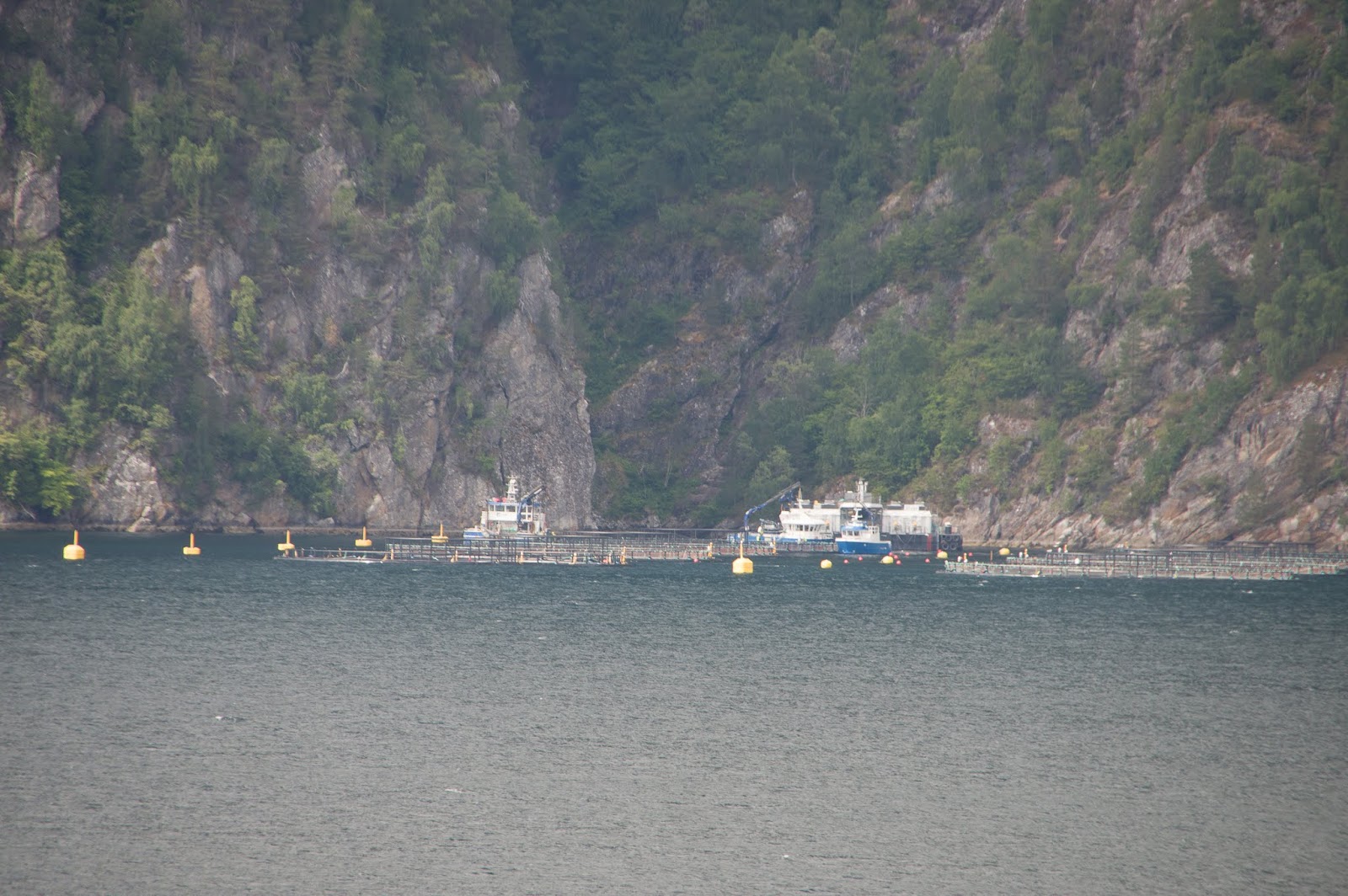
A fish farm. We would see many of these.

Imagine dragging the building materials up here

We checked in and boarded the boat about 4:00. A Norwegian gin and tonic eased the wait until our rooms were ready at 6:00. Bergen had dawned with sun and no clouds, but by the time we headed out at 8:00 pm it was raining. It would continue to rain until the next morning. We did however get a break in the clouds about midnight for a lovely sunset. It was still raining as we awoke the next morning and we were in one of the few short sections of open sea. But soon we were again inside the protective islands and calmer waters.

Most of these fjord homes do have a boat house for transportation


We stopped at Alesund where I had hoped we would have time for a short stroll because Alesund is full of art deco architecture. Downtown burned in 1904. Because it was rebuilt so quickly, most of the downtown buildings were completed in art deco style and that look has been preserved to this day. Unfortunately we were a bit late and there wasn’t time to do more than just get off and quickly back on. I chose to simply remain aboard and see what I could from the deck. We stopped at Alesund again in the evening, but that was during dinner, so we did not have time for a stroll then either.

Seven sisters who refused to marry the young man from the opposite side.
It's a good story
In the meantime, we had a great trip through a series of fjords to Geiranger fjord, one of Norway’s most spectacular. It is one of the narrowest and steepest with a large number or waterfalls. Along the way we were treated to views of some of the fjord’s farms. It’s hard to imagine the work it would have taken to build a home up these steep hillsides and the fortitude it still takes to live and work in these isolated spots. Interestingly, one of the farms is a favorite of the royal family and they visit it frequently with guests during the summer. One of the jokes is that Norway’s best soccer players come from here because they have to be precise with their kicks or the ball will disappear down the fjord-side. Rumor also has it that parents leash their young children so they don’t roll down the hillsides.

Geiranger town
The start of the Troll Highway
The shuttle craft
By the time we reached Geiranger, the sun was fully out so we had an even more beautiful return trip to Alesund. Most of the passengers left the ship at Geiranger to take advantage of one of the world’s best road trips over the Troll Highway (Trollsteigen). This road begins with a dozen switchbacks out of the fjord, crosses the high country and descends again on the Troll’s Highway before rejoining the Hurtigruten at Molde at 9:45. Linda and I chose to stay on the ship for the return trip as we had done this excursion a few years ago as part of our Norwegian Fjord Tour. Our friends John and Cherie Briggs and Jim and Marcia Rinta did take the ride and loved it. They were especially impressed with the fine dinner they were served in Molde before returning to the ship. You can read about our trip on an earlier blog post here.

A mine along the fjord
A little entertainment as we learn about smoked lamb
And Aquavit
The ride from Alesund to Molde was blissful as we passed numerous islands, their beauty enhanced by the low evening sun. The highlight of Molde is the wing-shaped hotel that overlooks the harbor. We stayed there as part of our previous tour. It has a bar on the top floor that I wanted to visit for a quick gin and tonic, but the stop is one of the short ones with no time to leave the ship.

Arrival in Molde

Saturday, September 1, 2018

Ancestry Search

The remains of an old farm
Looking across to the Rodland Peninsula from our deck.
Our goal for this day before we headed back to Bergen and the Hurtigruten was to check out an area we know is home of one of Linda’s great-grandparents, Lars Carlson Rodland. Lars was born on a farm near Bergen and came to America in 1883. We had done some searching in the area a couple of years ago when we found the church they would have attended and drove through the countryside, but really didn’t have enough information to find any specific property where he lived. You can see some pictures from that trip in this previous blog entry. Since then we learned much more with the help of Ancestry.com and the efforts of cousin Jerry and his wife Joni Smith in Everett. We visited Joni and Jerry last spring and they shared a lot of information Joni gathered on the family. We learned the approximate location of the farm and linda managed to find an Airbnb host one peninsula over from where the Rodlands had lived.The area is still called Rodland on the map..


Until recently water was the only practical way to travel.
Our drive from our beautiful lakeside hotel in Oppheim to the Myking area really showed off the Norwegian road system. A trip of 90 miles took a bit over 2 and a half hours. That wasn’t bad considering that over over half of those miles are on curvy one lane roads along lakes, rivers, and fjords, and through 42 tunnels, most of which were also one-way. That’s an average of about one tunnel per kilometer. With one exception, the longer ones have been widened so two cars can at least squeeze by each other. That exception did have a number of pullouts making it possible to pass other cars. Fortunately, we did not meet anyone in that particular tunnel. The amazing thing is that the Norwegians managed to build roads in this area at all. Many of them are literally carved out of steep hillside. Making them any wider would have necessitated cutting out hundreds off feet of rock on those steep cliffs. Obviously, one does not drive with speed on these roads and everyone slows down even more when approaching the many blind curves. We never felt in danger, but were always aware of the possibilities. Part of the fun of driving these roads is the ever-present possibility that one car (or truck or bus) might have to back up to make room for passing. Over the course of the day, we had to back up seven times. Fortunately, our rental car had a backup camera and beeps when it gets close to danger.

Narrow roads are the norm

As we checked in with our hosts we chatted about our plans for the afternoon. Laila pointed across the bay to the Rodland peninsula where we were headed and said she would talk to her dad about meeting with us in the evening. She said he has lived there his whole life and knew just about everybody on both peninsulas. These are two narrow peninsulas with only one access road each. They are slightly wider than those we traveled earlier in the day in that one can generally squeeze past another car without having to back up.

We neglected to ask why these buildings have only one wall of stone.

It took us about 45 minutes to get around onto the other peninsula and reach its end where Lars had lived. As we drove around the area, we kept thinking about how difficult farming would be on these rocky hillsides. There is hardly any flat ground anywhere. Today, almost no farms exist on this are at all. What used to be farmland is now overgrown with forest so it is even harder to imagine the farms that used to be there. The area we were told belong to Lars looked impossible to farm even with the best of our imaginations as it is even rockier than most of the land and we could find no place where even a trail used to enter that section. We drove around it without any hint of a former farm.

Most of the old farmland has reverted to forest.
Before we left the peninsula, we found one side road that took us about 20 gravel switchbacks up the hillside. As we rose above the fjord, we saw some actual farms for the first time basically a few sheep scattered amidst the rocks and grasses of the hillside. At one point we saw a small orchard of about 20 trees, probably either apples or plums. Not many fruit trees can succeed in this cold, damp climate even with the long summer days. These few farms really showed how hard it would be to make a living from the land. It’s no wonder that so many Norwegians emigrated to the United States and Canada where the land was cheap and productive and you didn’t have to clear it of trees and boulders.

Sheep are the main crop we found today.
Stones cleared from the land were used to build terraces.


After an early dinner at a truck stop cafeteria where we also purchased a couple of large breakfast rolls for the morning, we returned to our home for the evening. Laila took us to meet her father. Over a couple of beers he pointed out several places on the map where farms were owned by families named on Linda’s family tree. The location he showed us for Lars’s farm was much more conducive to farming as it included some flatter land and was closer to the fjord.

We were told one can find more of these broken homes
and fences when tramping through today's forests.
Some harvested wheat drying before gathering.


We also learned that about 80% of the population farmed at that time and they all had to have a second income. Most of them fished for cod in the winter and mackerel in the spring and fall. Crops included apples, plums, gooseberries, and redcurrants. They also raised cattle, sheep, goats, pigs, horses, and some grain to feed them. Goat’s milk was prized for the excellent cheese that they made from it. He surprised us when he said that roads out these peninsulas are very recent. The road to their home was built in 1979 and another six years later. Before that all travel was by boat.

The Myking Parish church
An old schoolhouse now a museum.
The name of this location is Lindås.
Two of the many Nævdal tombstones we found.


He also told us that Nævdal, one of the names in Linda’s tree, is close to the Myking church and only two farms. We decided to visit it on our way to Bergen the next morning. First, we stopped at the church again to really examine the gravestones in its cemetery. We were rewarded by about a dozen Nævdal stones although no other names were present. We should have asked Laila’s father about other burial sites. We did leave our information and he said he would talk to friends to see if he could gather any more details for us. Obviously, we will be returning.

The owners of this farm may be related to Linda.

The road to Nævdal ended at the farms. As I got out to take a couple of pictures, a car from the last farm stopped and the driver got out. I expected he wanted to know what we were doing, but when he learned that we only speak English, he said, “Ah, tourists.” and explained that he was just getting some water for his sheep, necessary because of the hot, dry spring they have had here in western Norway. When I shared why we were there, he introduced himself and we had a nice conversation about the families. He said he is from a different Nævdal line, but the other house might be more closely related to Linda. He tried calling his mother about the family tree book they have that goes back 300 years. She did not answer, but he asked for our email so he could check with her later. We thanked him profusely and headed off for Bergen as he began filling his canisters with water for the sheep.

Thursday, August 30, 2018

Bergen


Sign at the airport. It is supposed to get you to think
what Bergen is to you since the city has many facets.
My thought was that the artist isn't sure where they are.
Looking at Bergen today, it’s not hard to imagine that from 1217 when King Håkon moved the capital of the Kingdom of Norway here from Trondheim until sometime in the 1600s, Bergen was the most important city in Norway and for part of that time the most important city of the North Atlantic. Even after the capital was moved to Oslo in 1299, the city continued to flourish as the leading port of the Hanseatic League established in 1350. The League, headquartered in Germany, held a trade monopoly over northern Europe for the next 200 years. Trade continued to flourish in Bergen even after that time. Its reach stretched from Ireland and Scotland all the way to Greenland. The city acquired a cosmopolitan character and some impressive architecture. As with most cities of the time, most of the wooden buildings were destroyed by fire, but the essence of the period remains in the Bryggen harbor district honored as one of UNESCO’s 89 international historic monuments.


The old warehouses of the Bryggen district are the historical and tourist highlight of Bergen. The old buildings are protected and being restored to their original state even as they house street level shops and restaurants. Tourists are invited to visit the museum and wander the narrow back alleys even as the traders did 700 years ago. Two hotels also grace the area.

The view from Floien

One of the goats earning his keep.
Another highlight, especially on a sunny day, is the trip up Fløien, one of the seven mountains surrounding Bergen, on the Fløibanen funicular. Those hardier than us can hike up Fløien on a gently-sloped paved trail. A more common activity is to take the funicular up the mountain, have lunch while enjoying the magnificent view, play with the goats there to keep vegetation under control, and take the trail down.

Fisketorget is a popular place.
That is dried cod from Lofoten hanging over the prepared meals.

Paella maker
Cherie purchased some berries for us to enjoy.
We also spent some time at Fisketorget (Fish Market) where one can buy all sorts of fresh fish or a meal to enjoy while watching the harbor activity. When I first visited it 50 years ago it was primarily a market where local people purchased fish for dinner. I remember buying a sack full of shrimp to peel and eat sitting on the edge of the harbor tossing the shells into the harbor at my feet. Even two years ago that part of the market made up about half the vendors. Today, most of those vendors have been replaced by those selling prepared food to eat on site. One vendor makes paella.

Enjoying a beer after a day or touristing
Other highlights we did not have time to visit on this trip include Troldhaugen, the home of Edvard Grieg, Norway’s preeminent composer. There, one can tour his home, the small building overlooking the fjord where he composed his music, and a beautiful concert hall for performances throughout the year. Bergen’s wide variety of museums include an art museum, a couple of historical museums, a fishery museum and an aquarium. Gamle Bergen (Old Bergen) is a collection of 30 old houses just outside the city limits. Any visitor to Norway misses out if they don’t spend a few days in this beautiful coastal city.

A bird overlooks the fact that we are leaving town, our bags in tow.
You can see an earlier post about Bergen here.