Showing posts with label Fjord. Show all posts

Wednesday, September 5, 2018

Hurtigruten Day 3 - On to Lofoten

Beautiful scenery all the way north

The weather held as we entered Day 3. While there were a few clouds on the horizon, they were accompanied by plenty of sunshine. We seem to be bringing good weather to the Nordland. The ride continued to be smooth with blue skies and sunshine.

As we cross the Arctic Circle

Our first point of interest was crossing the Arctic Circle which happened early in the morning. We all entered the contest to pick the exact moment of crossing. At midmorning we passed Fugleøya, the bird island. Some 30,000 puffins and razorbills nest on the west side of this island. Unfortunately, we passed on the east side, so all I saw was three puffins flying past the ship and about 100 gulls following a fishing trawler sharing its harvest. An unusual geological phenomenon of the island is a sand river. About a third of the way up, sand makes its way out of the hillside. According to our guide, geologists are not sure the origin of the sand.

Fugleøya

The white spot is the river of sand
At about 10:30 Jim and Marcia left us on a boat to visit one of the largest glaciers in Norway. During their ride to the glacier they were treated to some good views of sea eagles. They disembarked at the glacier for a short bus ride where they had some excellent views. Then it was a long ride over the water to rejoin us in Bodø where they found Finnish friends waiting to greet them. The friends has come from Finland to do some fishing near Saltstreumen.


Cherie and John opted for the RIB tour to Saltstraumen. RIBs are special Zodiak-type boats that carried them up the channel to Saltstraumen, perhaps the largest whirlpool in the world. This is an amazing site which we viewed from the bridge on our previous visit. The previous blog entry is here. The whirlpools are created by the tides rushing through the channel at millions of gallons per minute reaching speeds of seven knots per hour. The whirlpools can be ten meters across and five meters deep. They are exciting enough that Jules Verne used it as a model in one of his books.

A lot of planes
While the others were off on their adventures, Linda and I took a shuttle to the Aircraft Museum. Bodø has a long aviation history and one of the longest runways this far north. The airfield was important during the Cold War as protection in the Arctic. Those of us old enough to remember when Francis Gary Powers was shot down flying his U-2 spy plane over Russia in 1960 probably don’t remember that he intended to land in Bodø. The museum is excellent divided into military and civilian sections. The military section begins with a graphic showing the world’s first aerial bombing over Venice in the 1850s. The display included about 20 planes of various ages and interesting display panels. One diorama used peepholes of varying heights to show the view of a battlefield as you would see it from ground level a balloon and an airplane.

Diorama of Bodø harbor during the war
In the civilian section, we saw several early flying attempts, both failed and successful. Several panels and planes showed the development of air transportation including one mockup of an early passenger cabin. It was a good way to spend the afternoon even though the hour and forty minutes we had to spend there was way too short.

Probably Stamsund
 

Our first stop after Bodø was Stamsund on Lofoten Island. Three groups left the ship there to do one of the Viking tours A couple of decades ago, a farmer discovered the remains of a Viking longhouse atop one of the hills of his farm. Since then the house has been recreated and tourists can visit the replica and enjoy a Viking meal. Those who took one of the tours enjoyed one of those options along with a lovely bus ride on these beautiful islands. The ship headed on to Svolvær where we would spend a couple hours while the Viking tours caught up. Linda and I had spent three days on Lofoten six years ago, so it was fun to wander the streets a while enjoying the small town atmosphere.

A sailor's wife waving goodbye

Entrance to Svolvær harbor
Svolvær
A small market
Just to prove we were there
The hotel we stayed in on our first trip
Racks drying cod for sale down soutn
After leaving Svolvær, our ship took a short ‘detour’ to visit Trollfjord. Barely a two kilometers in length and less than 100 meters wide, Trollfjord is perhaps the narrowest of Norway’s fjords, barely wide enough to accommodate our ship, the Kong Harald. The other big cruise ships we see from time to time certainly don’t fit and would be much too long to turn around even if they did. A bit of evening sun on the mountaintops above us highlighted the stark beauty of the sheer walls rising over 1000 meters above our heads.

The crowd at Troll Fjord


This is it
Close to the edge
The end of the fjord. It is less than two kilometers.
After two late nights we headed to bed earlier to try to catch up on our sleep as we truly reached the land of the midnight sun.

Sunday, September 2, 2018

Hurtigruten - Day 1 - Bergen to Molde

Our first of many sunsets in the land of the midnight sun
We walked the six blocks from our hotel to the Hurtigruten dock. A slight uphill climb of three blocks and one steep block downhill were the highlights. We will be spending the next six nights aboard this ferry that is more of a cruise ship than a ferry. The service began 125 years ago with a few stops. Today the Hurtigruten is a twice daily experience for more than 25 towns and villages along the Norwegian Coast between Bergen and Kirkenes, the last stop before the Russian border. Fifteen ships assure that each of these often isolated towns have service from the north and the south every day. While freight, cars, and passengers are important, the service makes more money from tourists like us during the summer months. During the winter, they promote trips to see the Northern Lights and dog sled trips.

The first white-tailed eagle
Our trip to Kirkenes would take six nights, seven days with stops varying from five minutes to 3.5 hours. Stops at smaller towns are just long enough to load and unload passengers and freight. We linger at the larger cities and tourist sites so we tourists can be escorted on a variety of excursions (at additional cost, or course).

Alesund Church
Alesund. The Art Deco City
The food is excellent with a strong emphasis on Norwegian cuisine and locally sourced food. Buffets for breakfast and lunch make it hard to keep the pounds off. Sit-down three-course dinners are sumptuous and beautifully presented. Special presentations of particular foods and drink highlight some afternoons. Smoked lamb and aqavit were one of the highlights. Lectures and cultural presentations round out the days.

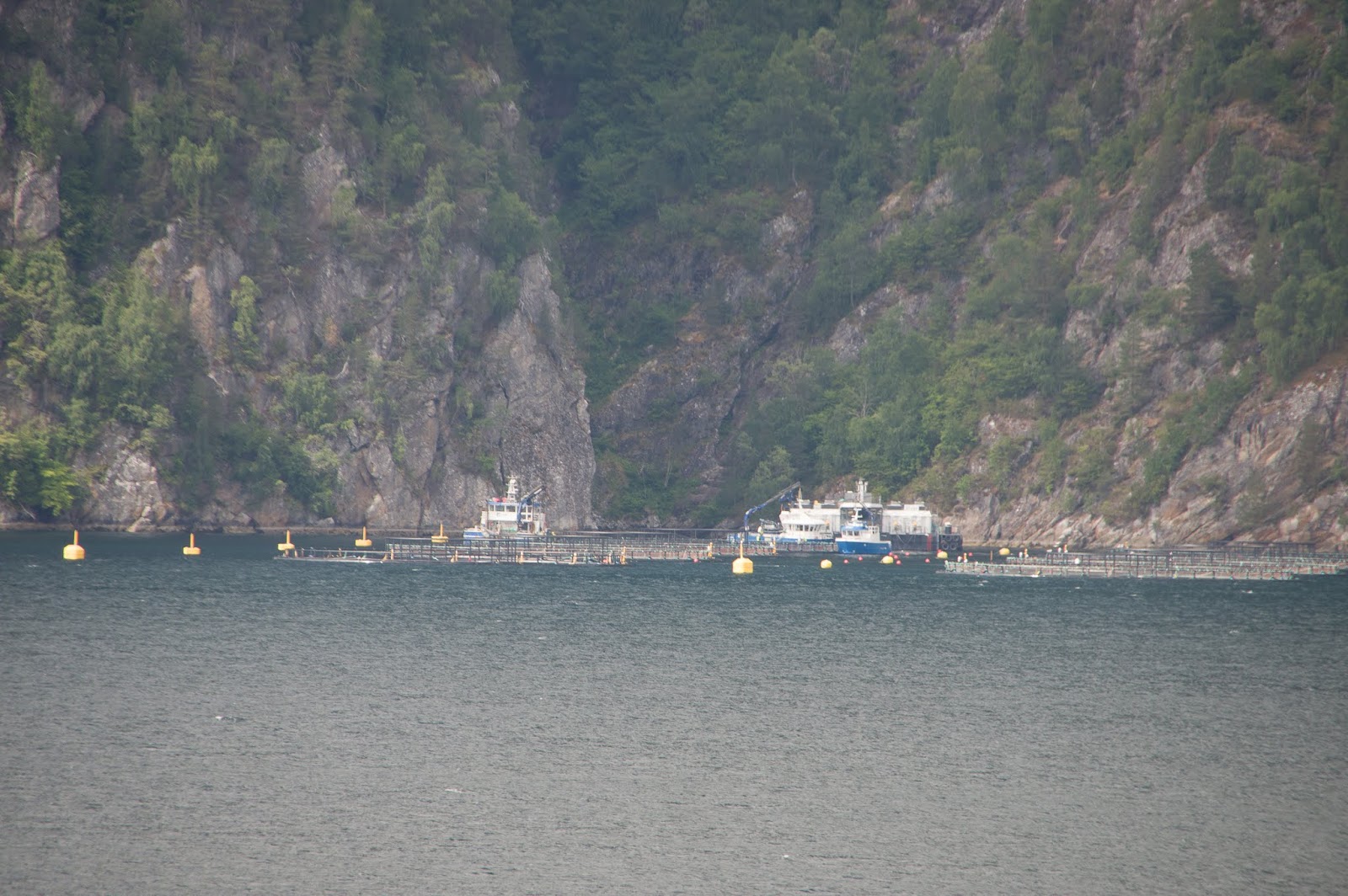
A fish farm. We would see many of these.

Imagine dragging the building materials up here

We checked in and boarded the boat about 4:00. A Norwegian gin and tonic eased the wait until our rooms were ready at 6:00. Bergen had dawned with sun and no clouds, but by the time we headed out at 8:00 pm it was raining. It would continue to rain until the next morning. We did however get a break in the clouds about midnight for a lovely sunset. It was still raining as we awoke the next morning and we were in one of the few short sections of open sea. But soon we were again inside the protective islands and calmer waters.

Most of these fjord homes do have a boat house for transportation


We stopped at Alesund where I had hoped we would have time for a short stroll because Alesund is full of art deco architecture. Downtown burned in 1904. Because it was rebuilt so quickly, most of the downtown buildings were completed in art deco style and that look has been preserved to this day. Unfortunately we were a bit late and there wasn’t time to do more than just get off and quickly back on. I chose to simply remain aboard and see what I could from the deck. We stopped at Alesund again in the evening, but that was during dinner, so we did not have time for a stroll then either.

Seven sisters who refused to marry the young man from the opposite side.
It's a good story
In the meantime, we had a great trip through a series of fjords to Geiranger fjord, one of Norway’s most spectacular. It is one of the narrowest and steepest with a large number or waterfalls. Along the way we were treated to views of some of the fjord’s farms. It’s hard to imagine the work it would have taken to build a home up these steep hillsides and the fortitude it still takes to live and work in these isolated spots. Interestingly, one of the farms is a favorite of the royal family and they visit it frequently with guests during the summer. One of the jokes is that Norway’s best soccer players come from here because they have to be precise with their kicks or the ball will disappear down the fjord-side. Rumor also has it that parents leash their young children so they don’t roll down the hillsides.

Geiranger town
The start of the Troll Highway
The shuttle craft
By the time we reached Geiranger, the sun was fully out so we had an even more beautiful return trip to Alesund. Most of the passengers left the ship at Geiranger to take advantage of one of the world’s best road trips over the Troll Highway (Trollsteigen). This road begins with a dozen switchbacks out of the fjord, crosses the high country and descends again on the Troll’s Highway before rejoining the Hurtigruten at Molde at 9:45. Linda and I chose to stay on the ship for the return trip as we had done this excursion a few years ago as part of our Norwegian Fjord Tour. Our friends John and Cherie Briggs and Jim and Marcia Rinta did take the ride and loved it. They were especially impressed with the fine dinner they were served in Molde before returning to the ship. You can read about our trip on an earlier blog post here.

A mine along the fjord
A little entertainment as we learn about smoked lamb
And Aquavit
The ride from Alesund to Molde was blissful as we passed numerous islands, their beauty enhanced by the low evening sun. The highlight of Molde is the wing-shaped hotel that overlooks the harbor. We stayed there as part of our previous tour. It has a bar on the top floor that I wanted to visit for a quick gin and tonic, but the stop is one of the short ones with no time to leave the ship.

Arrival in Molde

Wednesday, August 29, 2018

Vik Medieval Churches, Part II


Our visit to the Hove Stone Church was just as interesting. This church was built in 1170 as a private church so the wealthy need not worship together with the regular citizens. When the Reformation came to Norway in 1537, all things Catholic were removed and/or destroyed.


As beautiful as the restoration work is, perhaps the most interesting thing about the Hove Church is that Peter Blix is buried there. The Norwegian government outlawed burials within church walls in 1850. Because he owned the church, Blix chose to be buried there when he died in 1901. Quite possibly, the burial took place before the authorities were informed and they decided to let it be.


This altar is made of marble


Thick walls for protection from attack, a realistic possibility.

Beautiful tapestries, too.

Blix was a strict preservationist believing that buildings should be restored to their original condition and intent. This means that a crucifix adorns the interior and the decorations were restored as much as possible.


The tiled floors represent Matthew, Mark, Luke, and John. The stained glass windows depict Jesus, Moses, and David.


Typical slate roof on this small canopy.