Showing posts with label Church. Show all posts

Tuesday, October 23, 2018

Searching for an Ancestral Past

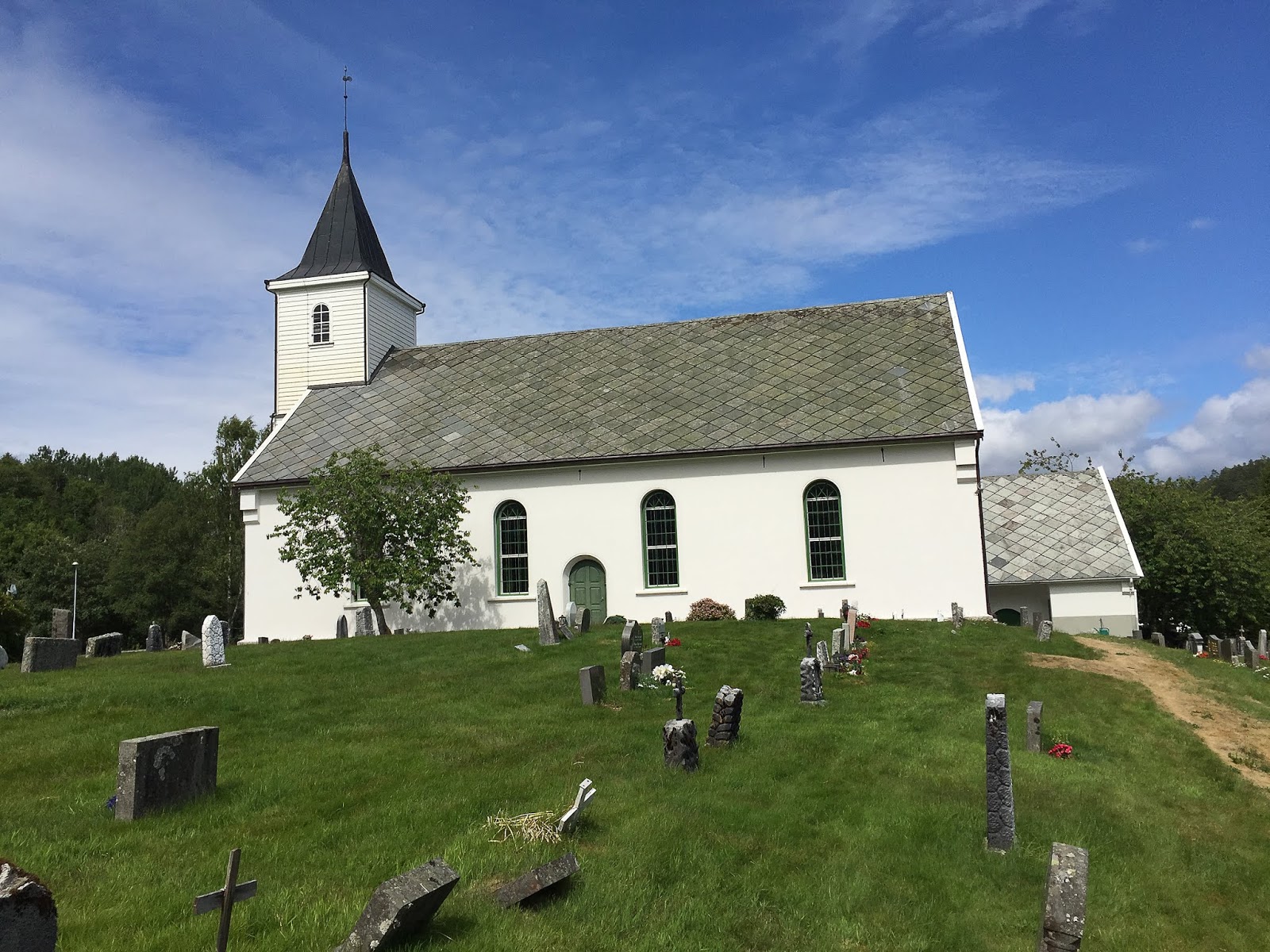
The Myking Church
While the Hurtigruten Ferry was the catalyst for this trip, it has been much more about finding ancestral roots. Linda and I started in Norway before the ferry ride looking for places her family had lived in the wilds around Bergen. We were fairly successful with some help from Ancestry.com, Linda’s cousin Jerry and his wife Joni, and the kindness of our Airbnb host who set us up with her father who remembered the names of places where people lived. With that we were able to get a good look at a few of those locations before heading off to our ferry cruise on the Hurtigruten. We left information with him and another stranger we met nearby with hopes that they will get back to us with more information.

The extent of farmland in Fjordland
Naevda Farm
A water world
The land is good for sheep
We also took a drive to Vik where we had tours of two churches connected to Cherie’s family. We took some pictures and hope to join them when they head that way in the next few years.

The Hove Stone Church
Hove Gravestones
Then after some time exploring southern Finland, we took the ferry to Åland Island. Cherie had made contact with someone living on property that her aunt had corresponded with. Fortunately, the woman living there today responded to Cherie’s letter and invited us to visit her. Cherie learned a lot about her family and left documents with Carlita who promised to translate them. Her husband also set us up to meet relatives of my brother-in-law Roy through an address he still had. That was the most exciting part of the trip. When we arrived at that address, we were met by two families anxious to meet us and although they were disappointed we were not the actual relatives. Even so, they entertained us with pictures and memories. We left with promises to continue the communication and visit again. We finished our stay in Åland with a visit to the Emigrant Institute where we spent a lively afternoon with the two women in charge. Among other things we learned that many of the papers Cherie had saved when her sister passed are rare and have real historical value beyond what they will teach her about her family. We also learned a lot about the context of emigration from Åland Islands which helped us understand more about the emigration of our ancestors.

Fun with paper at Carita's winter home
Roy's family
At the Åland Emigrant Institute
Then after a few days in Stockholm, Linda and I headed off to Vetlanda, a small city of about 10,000 where my grandmother was born. We already had a lot of details about the family here because she and a few others of her generation had written about the family as their contribution to the American Bicentennial in 1976. We don’t have any names or addresses of current relatives living in Sweden, so we did not expect any kind of a reunion as we had experienced on Åland Island, but we did want to explore the area and see what we could of the land where they had lived. With one possible exception, the only buildings remaining from that time are churches and even some of the have been replaced in the intervening years. The possible exception is a root cellar. The pictures look like it could be the same, but there isn’t a lot of difference among root cellars, so we can’t be sure. We did have a good time driving around the area, visiting two marvelous Emigrant Museums in Göteborg and Växjö, and looking at the amazing variety of churches the Swedes have built. There have been times on previous trips to Europe when we did tire of visiting churches and cathedrals, but on this trip, the only times a church disappointed us was when they were closed and we could not get inside. Outside and in, the amazing variety and beauty of even the smallest of these churches continues to amaze as the number we have visited approaches 20.

Vetlanda Lutheran Church
The stone fence
Root cellar - perhaps used by my ancestors
Linda pointed out that it is a bit ironic that on this trip, the person who learned the most about their past and was able to make actual personal connections is the person who wasn’t even there. Nevertheless, we were all excited with what we did learn and we all are leaving Scandinavia with the promise to return and spend more time in this stunningly beautiful region of the world.

Monday, October 22, 2018

Our last day in Sweden


Gardserum Church
From Vetlanta, we had to make the long drive back to Stockholm's Arlanda airport where we would spend the night before heading home. We added a couple of hours to the trip to see the town where my great-grandfather John Peter Thorngren was born and the church where he recorded his leaving Sweden in the 1830s. John Peter was born in Gamleby. We drove through part of this hilly town, but took no pictures. Today, it is just a modern town with little to set it apart from other Swedish towns of a similar size. At least, that was our impression. We really didn’t search the city for anything beyond what we saw in the few minutes we spent there.


The white addition is the mausoleum

Shortly after leaving Gamleby we stopped to look at some church ruins. After what we learned yesterday about churches being left in disrepair when new ones were built to replace them we weren’t really surprised to see this one across the street from the new, larger church even though the setting for the older one is quite a bit nicer. What was surprising was that the actually blew this one up once the new church was finished. Built at the beginning of the 12th century, it is another example of a medieval church. Västra Ed Church was reduced to rubble about 1870 after the new church was consecrated. The artifacts from the old church either went to museums or the new church, so at least they were saved. The other interesting item about this ruin is that a crypt is attached to the back side away from the road is still in use.


Our final stop before heading to the airport was Gardserum Kyrka. This is where Johannes Peter Törngren registered the fact that he was leaving Sweden for America. We were amazed to find this large beautiful church almost isolated in the country. Only a few houses are even in the neighborhood. The present church was built on the site of a smaller church in the 1850s and consecrated in 1857. It was built to hold the 2500 people then living in the parish. Its 20 small towers make it unique. According to the church’s website they offer tours during the summer. Perhaps not on Sunday’s however as it was closed during the time we visited.


It turns out I was technically wrong to think that would be our last stop before reaching the airport. As we reached southern Stockholm we entered the worst traffic jam we have ever encountered. No exaggeration! It took us over an hour to travel less than two miles. Then, as traffic jams do, it completely opened up and we were again driving the speed limit of 110 km/hr (about 65 mph). Pleased that our hotel was literally next door to the car rental agencies, we dropped off luggage so Linda could check in while I returned the car only to discover that our hotel was actually in the airport. When Linda expressed surprise that there are two Radisson Blus at the airport, the clerk said he had only learned that when he reported for his first day of work. Fortunately, there is a shuttle bus to take us to the airport where we had a pleasant evening and morning waiting for our plane.

Thus ends our trip

This is ALL snoose for sale in the airport.


Friday, October 19, 2018

Medieval Swedish Churches, Part II

Hylletofta Kyrka
Shortly after we entered the Hylletofta Kyrka, we were joined by the early-arriving guests for the wedding soon to take place. We felt a bit (a lot, really) underdressed, but still took our time looking at the interior before removing ourselves from the premises. An ironclad door stored near the entrance to the church includes a crow that has become the symbol of the church. One story tells us that the crow’s feet were bound together and then released. Where it landed would be the site of the new church. Modern scholars believe the bird represents ravens who brought the bread of life in communion to Elia during a time of drought in Palestine. Also of interest is the 12th century christening font. Originally, there were no windows on the north side of the chancel which represented evil. The lone window originally on the south side is now bricked over. The brochure suggests that today it is a resting place for angel’s as they gather new strength at the altar.


Like the other medieval churches, Hylletofta Kyrka has been changed and restored over the centuries. It was enlarged at least twice adding a new entrance and a vestry. In the 18th century, the old campanile was torn down and replaced by a steeple. At the same time the nave was extended by 7 meters and the triumphal arch widened. Larger windows were added and old wall paintings covered with limewash. In 1832 a crypt in front of the altar was found to be in disrepair. These were uncovered during another restoration in 1956. Since the family was not interested in preserving the grave new flooring was put in over it. The most recent restoration took place in 2010 when the exterior was finished with a new coat of plaster.


Wall carving of St. George in Hylletofta Kyrka
Next on our agenda was the church at North Lunga. The campanile has been in place since at least the early 17th century. It has been rebuilt at least three times since 1899. An electric ringing system was installed in the 1930s requiring a stronger tower to contain the two bells. The final renovation in 1955-57 removed a hood added in 1899 that gave the tower a rather strange look for a medieval building. This old church has some of the most recent major decorative items because a 1977 fire that destroyed old paintings by Pehr Hörberg on the breast of the gallery, the pulpit, and the bench doors. Pontus Ljungberg, a local artist, painted the replacements.The church was re-consecrated in 1979.

North Lunga


North Lunga Baptismal Font
From North Lunga we moved on to Nävelsjö Kyrka. Built in the 12th century, one of the beams has been dated to 1181-82. The christening font, also from the 12th century, standing in the original apse has a motif typical of the time. The sides are carved in a swarm of beasts, demons, and angels but the beasts are kept from the edge of the font unable to touch the holy water by the angels proving that while evil is always present, God is always strong enough to protect us. Because stone masons often carved their own name into their work, we know this one was carved by Bestiarius, a name that literally means “wild animals master”.

Nävelsjö Kyrka


Nävelsjö Kyrka Altar
The 1669 pulpit shows the four evangelists. The organ was built in 1937 by Olof Hammarberg using the same facade as the previous organ built by Johannes Magnusson in 1852. The 1682 clock tower originally had an open skirt-like appearance. It was clad at the beginning of the 20th century. A 1992 renovation adorned the tower with a cockerel, a symbol of vigilance.

Näsby Kyrka


Unfortunately, our last church of the day, Näsby Kyrka, was closed so we were unable to see the interior including three magnificent coats of arms and the beautiful ceiling and altar paintings dating to the 1740s. Situated beautifully overlooking Lake Flögen, the size of the church was influenced by the fact that it is in the parish of the county seat. An open air cross graces the front lawn.

Each church has a panel like this one.
Unfortunately, this was just a tease at Näsby Kyrka

By this time it was nearly 4:00 so we headed back to the hotel having completed a fascinating day learning more about Swedish churches from medieval times.