Showing posts with label Italy. Show all posts

Sunday, December 20, 2015

Birds


Mute Swan
I had hoped to see a few birds on this trip and that is what I saw – a few. Winter is not the best time for birding in the northern climes and birding was not the focus of this trip anyway. There were no specifically birding expeditions. We left the good binoculars and longest camera lens at home. I hoped that if necessary the 250mm on the small zoom lens we did bring would be good enough for identification pictures. What I managed to see were birds that happened to be in the same places we were. There were entire days when we would see no birds at all. Other days only the very common birds showed up: rock pigeons were everywhere; house sparrows were everywhere except Italy; gulls on the water of course; and several types of crows were also common. So in three months I am satisfied with the 31 total species and quite pleased with the fact that 12 of them are lifers. 


Black-headed Gull in winter plumage so no black head
I was a bit disappointed that we only saw one seabird on our cruise, the Yelkouan shearwater. The Mediterranean does not have a lot of seabirds, but I was hoping for more than one. The only other birds I saw on the cruise were a few on the island of Delos, but I was unable to identify any of the small, quick-moving little brown jobbies (LBJs in birder talk).
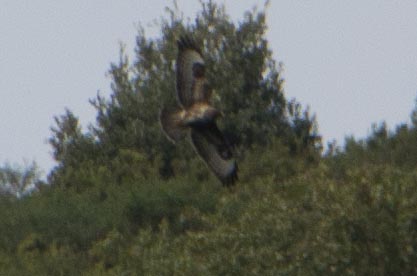

Common Buzzard. He was quite far away, but the camera did see this.
The second lifer showed up in Vernazza flying far above us. The common buzzard actually was quite common as we would see them in a couple more places. The only other bird we saw there was another common bird in the US: the Eurasian collared-dove. This bird has expanded all over the US in just a few years after first finding its way to southern Florida in 1982. 


Chaffinch
Montepulciano was no better even though we spent several days driving around the countryside. We saw many pigeons and jackdaws (a kind of crow). Then as I was walking through town one day, I spied a new bird which sat for several minutes on a wire giving me good looks and a picture. I was able to identify him finally as a Chaffinch. 

Wallcreeper in flight. The camera caught the id marks.

The best birding was in Orvieto where we saw five new birds. The first was the most exciting. I have read on some blogs about the wallcreeper being a nemesis for some birders. As we walked out of the museum behind the cathedral, I saw this bird creeping high on the wall of the cathedral. No binoculars so we observed from a distance and took a bunch of pictures. I even managed to get a couple of shots of him flying a few feet across the wall. Since he was creeping on the wall, I had hopes that he might be this elusive wallcreeper and was excited to confirm that in the bird book that evening. 


European Goldfinch
Italian Sparrow
I had been hearing birds every morning in the farmyard of the house we were staying in, but the birds refused to stop within sight as I walked through the garden. Then a couple of days before we left, I looked out our second floor bedroom window and was delighted to have very good views of three different birds. All turned out to be lifers. The European Goldfinch and Sardinian Warbler were easily identified. The goldfinch has a distinctive face and the warbler is one of the few birds with dominant red eyes. The third bird I had assumed to be a common house sparrow like we have all over the US and Europe until I looked in the bird book and discovered that in Italy, the house sparrow is replaced by the similar, but different Italian Sparrow. 

Yellow-legged Gull
In Sorrento, I spent a couple of afternoons at the beach while Linda rested so I could focus on the gulls we had there. Gulls can be difficult not only because there are several similar species, but also because they change looks as they age. Some of the larger gulls take four years to get their adult look and each year they sport a different look. I was sure that I was seeing Black-headed and Yellow-legged Gulls, but had hopes that there were more. All my closer inspection showed was those two gulls in different plumages. I was disappointed, but the effort was worth the time, especially since I had one of the best meals on the trip at a little beach restaurant while I was studying the gulls. An appetizer of seven different marinated fishes with bread was more than enough for lunch. The half carafe of wine only helped make the long afternoon more pleasant. 

Black Redstart

Robin

The other surprisingly good birding spot turned out to be Herculaneum, one of the sites destroyed by Vesuvius and now an excavation open for visitors. The Black Redstart and Chiffchaff joined the small list of new birds there. Again, it was the ability to get good pictures that confirmed the identifications. 

Mute Swan - a beautiful bird on shimmering Lake Lucerne
Red-crested Pochard

Linda spotted the final lifer while we cruised on Lake Lucerne in Switzerland. She was looking out the other side of the boat and noticed a small group that looked different. Indeed they were. Red-crested Pochards are not uncommon, but the five we saw that afternoon on the lake are the only ones we  have seen. 

Perhaps another Redstart, but I don't think so.
For anyone interested here is the entire list, lifers in bold
Greek Isles: Yelkouan shearwater
Italy: Common Buzzard, Eurasian Collared-dove, Black-headed Gull, Yellow-legged Gull, Rock Pigeon, Italian Sparrow, Magpie, Robin, Jackdaw, Hooded Crow, Chaffinch, European Starling, Eurasian Blackbird, Wallcreeper, Sardinian Warbler, European Goldfinch, Gray Wagtail, Black Redstart, Chiffchaff, Red Kite, Great Tit
Switzerland: Mute Swan, Tufted Duck, Great-crested Grebe, Red-crested Pochard, Mallard, Great Cormorant
Holland: Eurasian Coot, Gray Heron


Saturday, December 12, 2015

Rome

Rather than a writing as usual about Rome, this post is mostly just pictures showing the places we saw. Rome is, after all, the "Eternal City" and well known everywhere. So, here goes.

Our apartment was on this square with a turtle fountain
A kitchen fire in this restaurant two doors down from our apartment
we had to drag our luggage completely around the block.
No terrorist involved, just a careless chef or a loose wire.

On our first night we visited three of the biggies, the Victor Emanuel II Monument, built to memorialize the unification of Italy in the late 19th century. Built on an ancient Roman scale it honors the first king of a united Italy. From there we walked to the Trevi Fountain and threw in our coins to assure our return. A short walk further took us to the Pantheon, the only Roman structure still standing as it was in Roman times. The dome was unequaled until the Renaissance when the Duomo in Florence and St. Peter's in Rome were built.


I took this picture from St. Peters.
From there you can see its epic scale.
Easily one of the most beautiful fountains in the world.
I had just reopened for us after an 18 month repair job.
The Pantheon is not particularly interesting from the outside.
Inside the pantheon
The dome
These men are guarding the tomb of the last king.
They hope his descendants may return to rule one day.
Day two was devoted to the Vatican Museum and St. Peter's Cathedral.

The Laocoon Group, an ancient Roman statue unearthed in 1506
is one of the highlights of the Vatican Museum
As are the many tapestries
I expected the Map Room to be maps, but not like this.
These are maps Italy painted on the walls. This one is of the Cinque Terre area.
Michaelangelo's Pieta sits behind a glass wall
after being attacked in 1972 by a man claiming to be Jesus
The alter is about six stories tall
Raphael's School of Athens
A modern crucifix
St. Peter. Note the hand on his foot. I'm not sure why
but this is a traditional thing to do
Michelangelo's Done
View from the dome of the plaza
These doors are only opened for Holy Years which come every 25
Unless the Pope declares a special one
Our new Pope has declared next year to the a Holy Year of Mercy

Day three was devoted to Ancient Rome


Three huge arches dominate the landscape
One of the Vestal Virgins who had to stay pure and keep the fire lit
Failure to keep the fire lit meant the end of Rome.
Failure to remain a virgin meant an ugly death
Success meant a life of luxury and happy marriage in their thirties.

Forty Christians waiting to be executed.
One recanted to save his life so a guard claimed he was Christian
This kept the number at the auspicious 40.
One of the Forty

These ruins are near the Pantheon.
Julius Caesar was killed here.
The Coloseum


Rooms under the floor of the arena for the gladiators and the animals
Other sites of interest

The Spanish Steps under repair
The church, St. Peter in Chains has the chains used to shackle Peter before he was crucified.
For me this is the real reason to visit St. Peter in Chains
Michelangelo planned a massive tomb for Pope Julius II
Then Julius died and other priorities took over
What was to include 18 statues was reduced to this.
Only Moses was completed by Michelangelo
Although the statues on either side were done by his students. 
Moses
Santa Maria Maggiore
A rather imposing facade
The Pope in prayer
Ceiling in the crypt


Wednesday, December 2, 2015

Monte Cassino


On our drive from Sorrento to Rome, we decided to take a side trip to Monte Cassino. About halfway between the two cities, the Abbey of Monte Cassino sits high above its surroundings offering commanding views of the countryside after a long and winding road to the top of the mount. This was our second visit to a World War II battle site; this one has a more difficult story than the easy landing at Pasteum and Salerno several months earlier.

St. Benedict
The monastery was founded by St. Benedict in 529 on the remains of an ancient Roman fortification as were so many Christian churches and holy sites. In fact, the Temple of Apollo was still in use as a religious site when Benedict arrived. Over the following years the abbey would be destroyed several times both through wars and natural events. First it was the Longebords in 577, then the Saracens in 883, then an earthquake in 1349. The final destruction was by Allied bombers in 1944. Each time it was rebuilt to its former glory although not all the art works would be saved.

The entrance cloister

Benedict had already founded 12 communities for monks before he moved to Monte Cassino, but he would spend the rest of his life atop this hill. He would die and be buried at this beautiful spot and the abbey would prosper as the years passed. Today the abbey features two cloisters. The entrance cloister is a grassy park-like square with a statue of Benedict donated by West German Chancellor Adenaur in 1952. The second cloister is the entrance to the basilica cathedral. It is a more traditional cathedral courtyard surrounded by Corinthian columns and statues.

The grand staircase leading up to the Basilica


Bronze doors open into the ornate cathedral space. The white and gold motif give the the building an open feeling that surpasses any church we have visited. Built in a typical style with three naves and several chapels on each side, the building is most impressive. 


Bronze Doors
The crypt is almost completely covered with mosaics and completes the beautiful building.

The Crypt


Outside we were provided with great views of the countryside and a Polish War Cemetery  where over 1000 Polish soldiers are buried. Monte Cassino was the site of one of the most important battles of the Italian campaign. The Allies had landed at Salerno and Pasteum and expected to move north rather quickly. However, the rugged Italian terrain and the great efforts by the German army slowed the effort considerably. Eventually the Allies made another landing at Anzio – another difficult landing where the Germans fought a bitter albeit unsuccessful battle to stop the Allied advance.
Monte Cassino was the last major obstacle on the way to Rome. The hills gave the Germans a decided advantage in their defensive efforts. The separate armies had agreed to keep the Abbey off limits and fortunately they sent many of the most valuable art words to Rome for safe-keeping.

Grapes grown by the Abbey
The first snow we have seen. There will be more.


However, a misread memo led the Allies to believe that the Germans were, in fact, using the Abbey as a base and in three short hours on February 15, 1944, they reduced the Abbey to a pile of rubble. The only people kills there were locals and monks who were using the Abbey as a place to be safe from the war. It was only a few years ago that the US military finally admitted the truth in their documentation of the battle. The irony of the bombing was that by reducing the Abbey to rubble, they provided the German army with an even better defensive position well protected by the elevation and the rocky remains of the Abbey.

Photos of the destruction

By the mid-1950s, the Abbey had been rebuilt according to the old plans and we were able to visit it in its glory. While the museum was not open we were able to see most of what it had to offer. We have found it interesting that there is little memorializing of the war in Italy. Here the big effort is the Polish War Cemetery. At Salerno and Pasteum we found no memorials at all. This is a huge contrast to what is at the beaches of Normandy, which we have not visited.

More than 1000 Polish soldiers buried here