Showing posts with label Birds. Show all posts

Sunday, September 9, 2018

Hurtigruten Day 5 - Honningsvåg

Honningsvåg, Note the snow fences
We landed at Honningsvåg about 11:15 for our next excursion, just before our normal lunch time. I had an early breakfast, made a sandwich to take on the excursion, and a small bit for an early lunch. The others decided they would travel to North Cape, the northernmost point in Europe. They had a good bus ride and short walk to the site. It was a bit foggy, but they beat the main crowds of the day to enjoy the views and the experience. Four large cruise ships arrived at Honningsvåg on this day including the world’s fourth largest making it the busiest day of the year for Honningsvåg.

Reindeer swim this channel twice a year

One of the lakes as we crossed the island
The world's fourth largest cruise ship
Honningsvåg is on the island of Mageroya which is now connected to the mainland by a 6.8 km tunnel. Norwegians do love their tunnels. Fishing and whaling used to be the mainstays of the economy. Fishing is still important, but tourism is now the mainstay. The airport welcomes 19,000 passengers per year and multiple cruise ships enter the harbor daily during the summer. An exciting thing to see here would be when the caribou herds swim to the island, a distance of some 1.8 kilometers.


A few cod on the drying rack
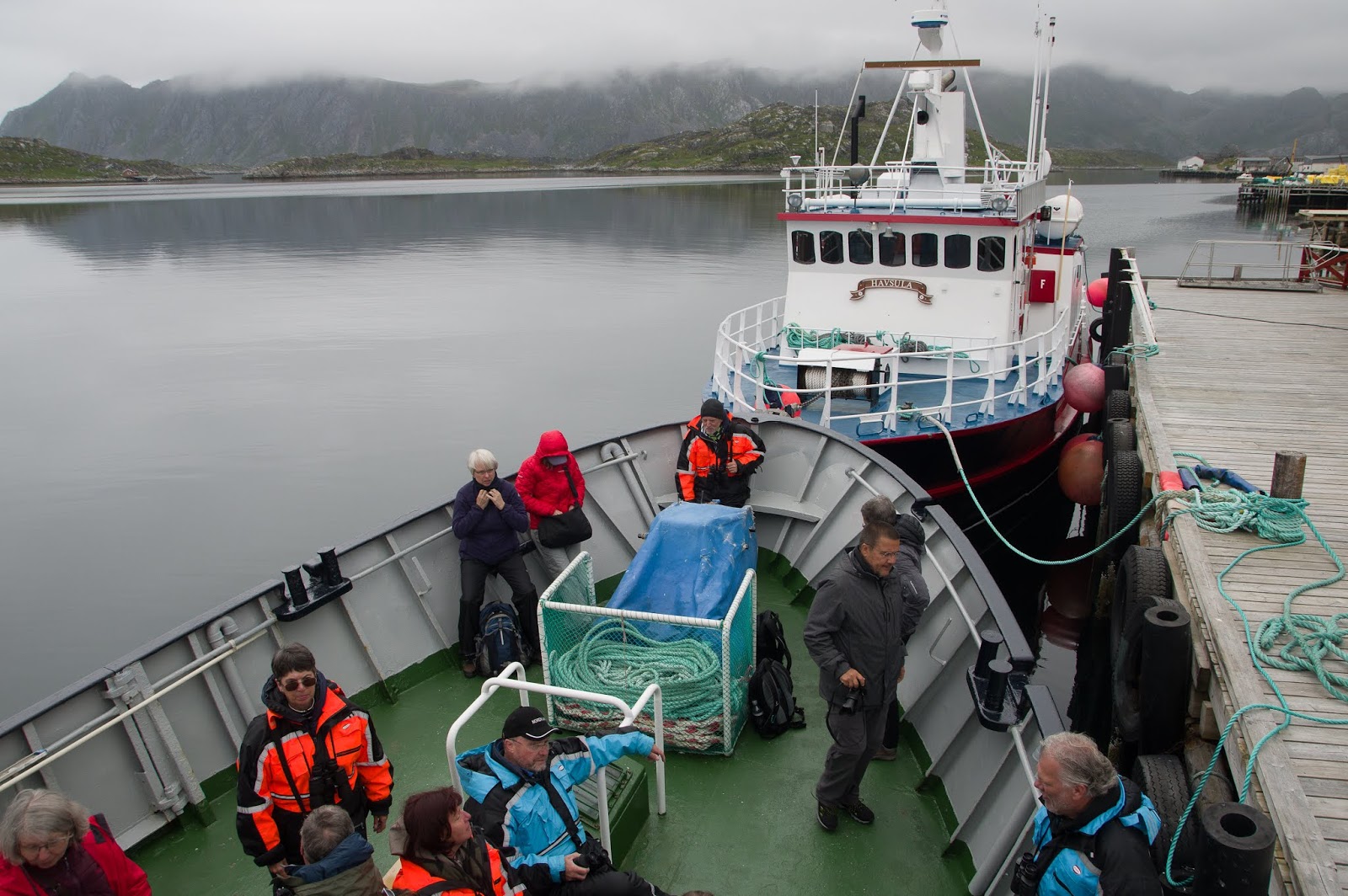
Preparing to leave the dock
I opted for the bird safari and was not disappointed. We drove across the island to the small fishing village of Gjesvær where we boarded our safari boat out to the bird colonies on the small island of Gjesværstappan. As we left the harbor and crossed the channel, the number of birds increased until we were literally surrounded by thousands of swimming and flying puffins and guillemots. Nearly 1 million puffins nest here. Since raiding the nests for eggs and killing the birds for eating was outlawed about 50 years ago, the population has increased. Puffin eggs and meat were so popular, the locals bred a special dog for the purposes. These puffin hounds were small enough to enter the deep holes the puffins dig for their burrows. They also had an extra claw to help them climb the steep cliffs. Finally, they were short of teeth to they did not harm the meat of the birds as they pulled them out of the nests.

Mostly Atlantic puffins
Puffin taking off

One would think they are out of danger now. Unfortunately, the capelin and herring they eat and feed their chicks are decreasing to overfishing and a warming climate. Without enough of these small fish to feed the young, the babies die before they can care for themselves threatening the future of the species.

Razorbills


Mostly razorbills
After some time amongst the puffins and razorbills and watching the gulls and eagles fly around looking for easy pickings, we sailed just a short distance to see other bird colonies. The northern gannet colony of 3000 began with a single pair about 20 years ago. I’m not sure why they came here, but they do seem to have found a good spot. These are beautiful white and gold birds who dive into the water in search of fish. Puffins and guillemots, on the other hand dive from a floating position. They are built for swimming and can reach a depth of 80 meters. Unlike the gannets, the puffins and guillemots are not elegant flyers.

Puffins are ungainly in the air
Northern Gannets
A bit further on we would pass nesting sites of black-legged kittiwakes, shags, cormorants, and razorbills. Along the way we saw at least 15 white-tailed eagles either flying or perching on the cliffs. Eagles will eat just about anything they can find, but there are so many birds here they subsist just fine on a bird diet. The big excitement for me however, was seeing the Great Skua, my first, chasing a puffin. Skuas are thieves. This one wasn’t chasing the puffin to eat her, but to get her to drop her to drop her catch so the Skua could eat it. I think it was successful because it dropped quickly down to the water after the puffin left the scene.

Common Murres

Black-legged Kittiwakes

Great Cormorants
We learned that we had actually reached the most northerly point in Europe rather than those who were driven to North Cape. The problem is that there is not easy access to this true north point, so North Cape gets the distinction for touristic purposes.

Gjesvær: The Bird Safari Harbor


Unfortunately, we had to leave all too soon to get back to our ship. Alas, it was not to be. While we were gone, something went wrong with the air system on the bus. Since everything on the bus, including the brakes, depends on air pressure, we had to wait for a replacement. Fortunately, because this was a Hurtigruten tour, the ship had to wait for us. That is one advantage of ship-sponsored tours. When something goes wrong, they will wait for you. If you are on your own, you could be left on your own to reach the next port or whatever at your own expense. We were so close to the end of our voyage that we never did catch up, arriving at Kirkenes, our final port, 30 minutes late.

Sami and reindeer in traditional dresss
John and Cherie at North Cape

I need Linda to write about these discs.


Sunday, December 20, 2015

Birds


Mute Swan
I had hoped to see a few birds on this trip and that is what I saw – a few. Winter is not the best time for birding in the northern climes and birding was not the focus of this trip anyway. There were no specifically birding expeditions. We left the good binoculars and longest camera lens at home. I hoped that if necessary the 250mm on the small zoom lens we did bring would be good enough for identification pictures. What I managed to see were birds that happened to be in the same places we were. There were entire days when we would see no birds at all. Other days only the very common birds showed up: rock pigeons were everywhere; house sparrows were everywhere except Italy; gulls on the water of course; and several types of crows were also common. So in three months I am satisfied with the 31 total species and quite pleased with the fact that 12 of them are lifers. 


Black-headed Gull in winter plumage so no black head
I was a bit disappointed that we only saw one seabird on our cruise, the Yelkouan shearwater. The Mediterranean does not have a lot of seabirds, but I was hoping for more than one. The only other birds I saw on the cruise were a few on the island of Delos, but I was unable to identify any of the small, quick-moving little brown jobbies (LBJs in birder talk).


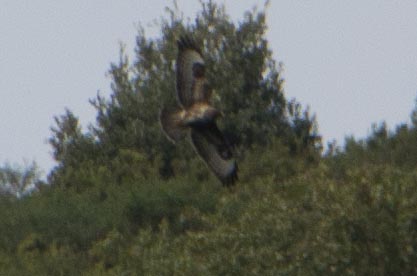
Common Buzzard. He was quite far away, but the camera did see this.
The second lifer showed up in Vernazza flying far above us. The common buzzard actually was quite common as we would see them in a couple more places. The only other bird we saw there was another common bird in the US: the Eurasian collared-dove. This bird has expanded all over the US in just a few years after first finding its way to southern Florida in 1982. 


Chaffinch
Montepulciano was no better even though we spent several days driving around the countryside. We saw many pigeons and jackdaws (a kind of crow). Then as I was walking through town one day, I spied a new bird which sat for several minutes on a wire giving me good looks and a picture. I was able to identify him finally as a Chaffinch. 

Wallcreeper in flight. The camera caught the id marks.

The best birding was in Orvieto where we saw five new birds. The first was the most exciting. I have read on some blogs about the wallcreeper being a nemesis for some birders. As we walked out of the museum behind the cathedral, I saw this bird creeping high on the wall of the cathedral. No binoculars so we observed from a distance and took a bunch of pictures. I even managed to get a couple of shots of him flying a few feet across the wall. Since he was creeping on the wall, I had hopes that he might be this elusive wallcreeper and was excited to confirm that in the bird book that evening. 


European Goldfinch
Italian Sparrow
I had been hearing birds every morning in the farmyard of the house we were staying in, but the birds refused to stop within sight as I walked through the garden. Then a couple of days before we left, I looked out our second floor bedroom window and was delighted to have very good views of three different birds. All turned out to be lifers. The European Goldfinch and Sardinian Warbler were easily identified. The goldfinch has a distinctive face and the warbler is one of the few birds with dominant red eyes. The third bird I had assumed to be a common house sparrow like we have all over the US and Europe until I looked in the bird book and discovered that in Italy, the house sparrow is replaced by the similar, but different Italian Sparrow. 

Yellow-legged Gull
In Sorrento, I spent a couple of afternoons at the beach while Linda rested so I could focus on the gulls we had there. Gulls can be difficult not only because there are several similar species, but also because they change looks as they age. Some of the larger gulls take four years to get their adult look and each year they sport a different look. I was sure that I was seeing Black-headed and Yellow-legged Gulls, but had hopes that there were more. All my closer inspection showed was those two gulls in different plumages. I was disappointed, but the effort was worth the time, especially since I had one of the best meals on the trip at a little beach restaurant while I was studying the gulls. An appetizer of seven different marinated fishes with bread was more than enough for lunch. The half carafe of wine only helped make the long afternoon more pleasant. 
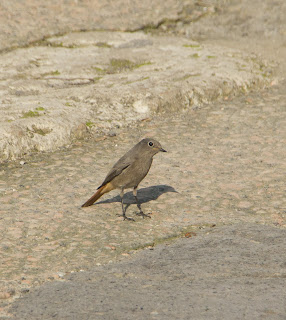
Black Redstart

Robin

The other surprisingly good birding spot turned out to be Herculaneum, one of the sites destroyed by Vesuvius and now an excavation open for visitors. The Black Redstart and Chiffchaff joined the small list of new birds there. Again, it was the ability to get good pictures that confirmed the identifications. 

Mute Swan - a beautiful bird on shimmering Lake Lucerne
Red-crested Pochard

Linda spotted the final lifer while we cruised on Lake Lucerne in Switzerland. She was looking out the other side of the boat and noticed a small group that looked different. Indeed they were. Red-crested Pochards are not uncommon, but the five we saw that afternoon on the lake are the only ones we  have seen. 

Perhaps another Redstart, but I don't think so.
For anyone interested here is the entire list, lifers in bold
Greek Isles: Yelkouan shearwater
Italy: Common Buzzard, Eurasian Collared-dove, Black-headed Gull, Yellow-legged Gull, Rock Pigeon, Italian Sparrow, Magpie, Robin, Jackdaw, Hooded Crow, Chaffinch, European Starling, Eurasian Blackbird, Wallcreeper, Sardinian Warbler, European Goldfinch, Gray Wagtail, Black Redstart, Chiffchaff, Red Kite, Great Tit
Switzerland: Mute Swan, Tufted Duck, Great-crested Grebe, Red-crested Pochard, Mallard, Great Cormorant
Holland: Eurasian Coot, Gray Heron


Monday, April 21, 2014

The Silvies River Flood Plain

Irrigation Canal with a flooded field in the background
The Silvies River provides the irrigation water for the Burns area as it flows into Malheur Lake. Most of the fields are flooded providing great habitat for ducks, geese, and shorebirds. When I first saw all the flooded fields, I assume it was just a high water table after the spring rains. I was wrong. Their preferred method of irrigation here is to flood the fields in the spring which will hopefully provide enough moisture to last the season. A few farmers have put in pivot irrigation systems, but the wildlife experts are hoping that this does not become the norm as pivot systems do not provide habitat for water fowl.
No one was sure, but we assume the large size means goose eggs. This was right next to the highway.
This tour took us around the neighborhood, so to speak. We drove in all four directions from Burns never more than about ten miles from the city center. We saw many of the flooded fields, some for the second or third time. But since the birds move around every view is different.


We started the day with spectacular views of thousands of Ross’s geese along with a few late-leaving snow geese. While most of the snow geese had already headed for northern Alaska, the Ross’s geese were all headed to northern Canada. Those snow geese remaining may stay here all summer. At least two were injured and probably unable to make the flight. For them, the summer months will be difficult as they must evade the coyotes and raptors without the flock as protection.


Today, we did stop to see the owl and had some good looks at both Mom and Dad. Mom was lying across the nest while Dad was just sitting in the tree a few feet below waiting. Both were waiting for the night hours when the hunting would be better.

Look close to see Mom lying across the nest.
Today was the best day for shorebirds as we saw everything we expected to see including long-billed curlews, black-necked stilts, willets, white-faced ibis, long-billed dowitchers and even a few killdeer. Most of the good birds were too far away for good pictures, but I did get a few. The long-billed curlew is an amazing bird with a bill about 1/3 of its body length. Some of them reach ten inches as this is one of the larger shorebirds anyway.
Long-billed Dowitcher
Black-necked stilts in flight
We ended the day driving along some desert landscape where we were able to our first sage thrasher and a loggerhead shrike. Shrikes have a hooked beak giving them a sinister look. They are best known for storing their insect kills on thorns. We did not see any of this today, but I have seen it other places. It is a bit disconcerting to see this and think about the bird’s mind that came up with such a gruesome storage plan.

The tour ended at noon so I ventured back downtown for one last meal before heading on the back roads to Sun River where I would spend the night before returning home and getting Linda at the airport as she returned from her San Diego girls’ weekend. 
Fort Rock
I made one stop at Fort Rock to see what raptors might be visible there. I had passed a golden eagle nest a few miles earlier and managed to add three bald eagles and a pair of prairie falcons to my list for the day. I was surprised to see rock pigeons there too. These are the same birds that populate our city streets and were the subject of one beautiful song from Mary Poppins. London no longer allows their feeding in Trafalgar Square. Fort Rock looks like a huge fort from a distance but is really an extinct volcano that rises 325 feet above the plain. Prehistoric artifacts over 9000 years old have been found in some of the caves that were inhabited on the interior of the ‘fort’.