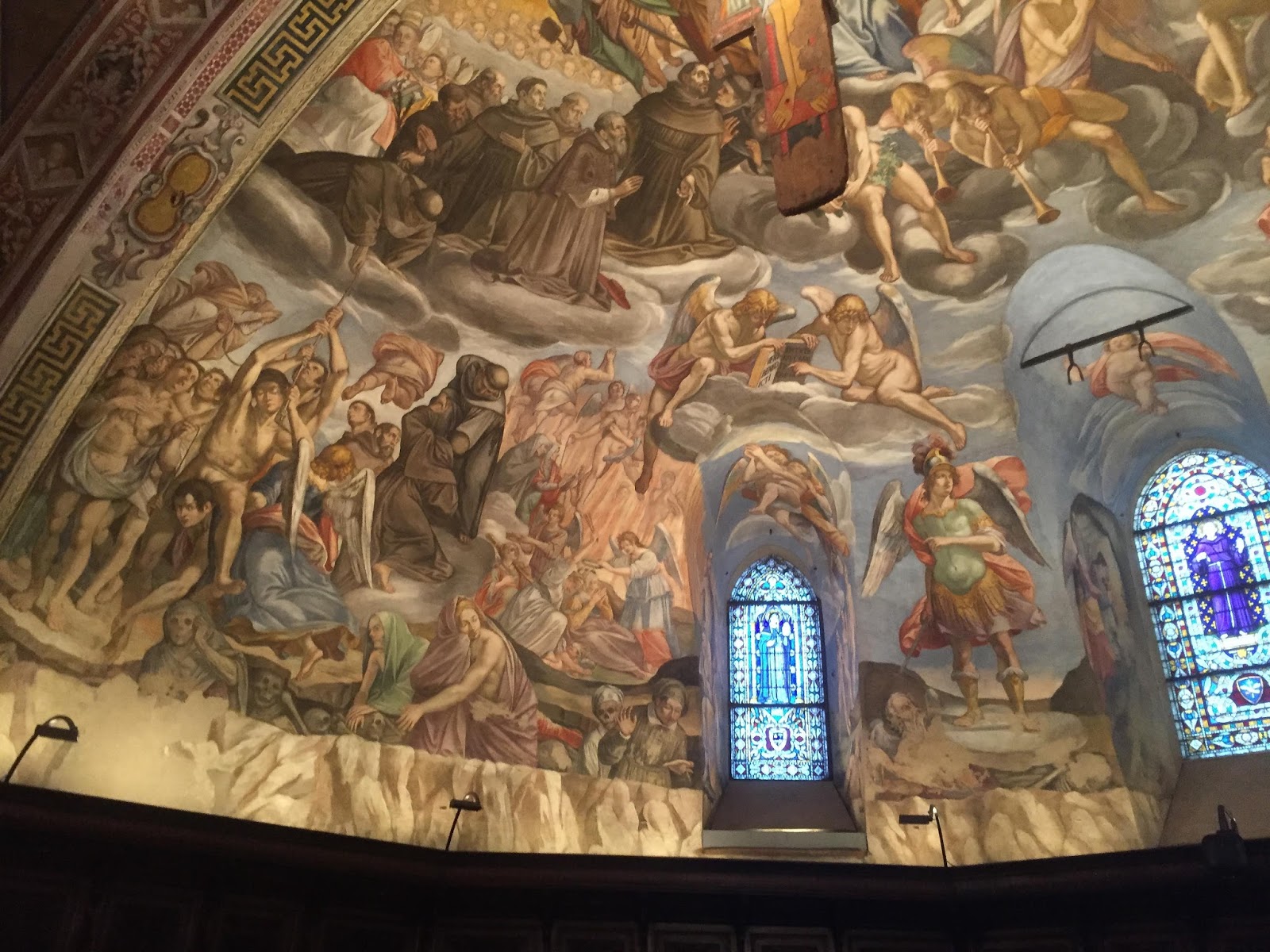
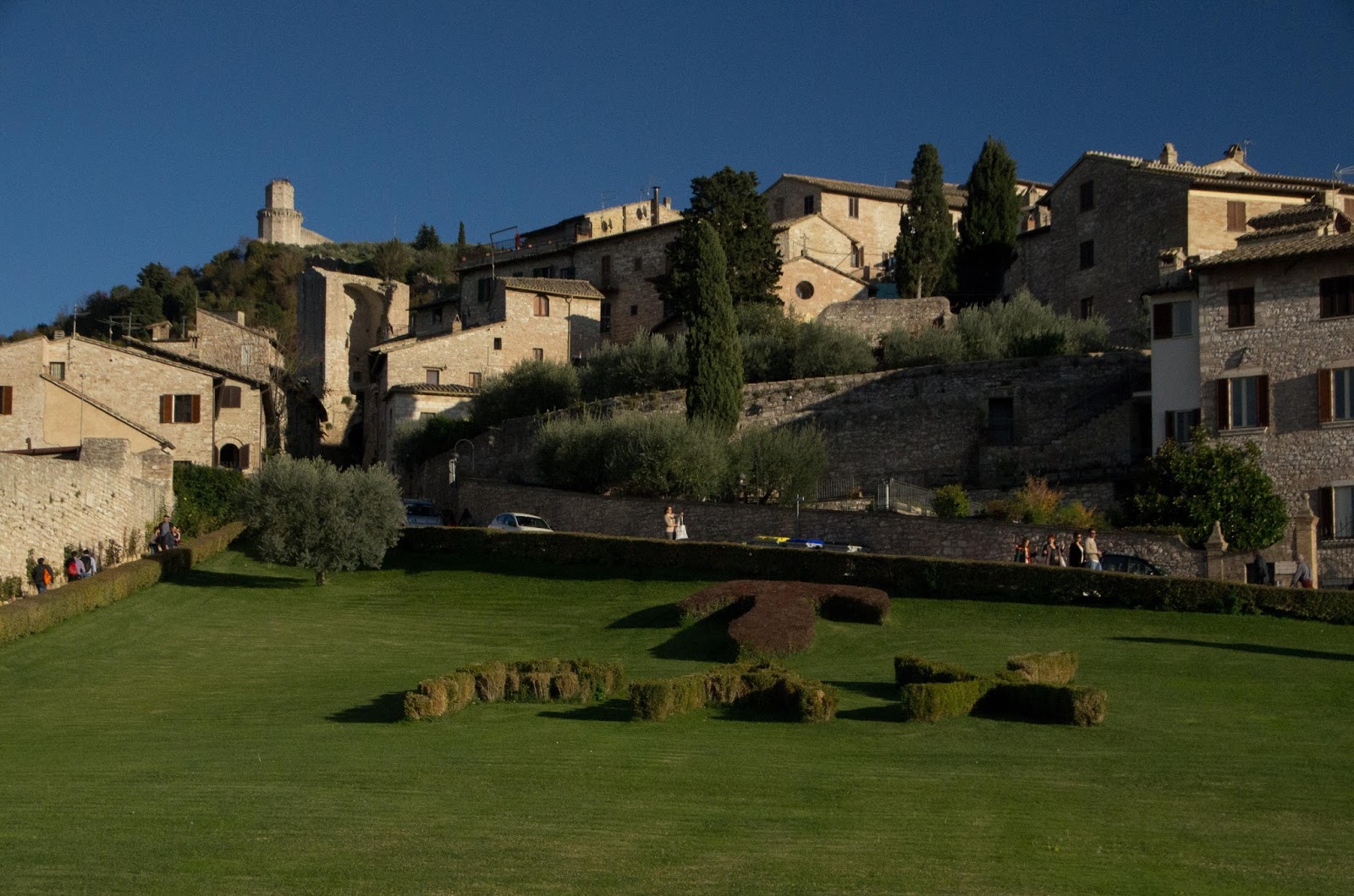
As in St. Francis of, Assisi is an Umbrian hill town that
justifies the number of pilgrims and tourists it attracts each year. Francis
grew up in Assisi, the son of a rich merchant. In 1202 he was captured in a
battle against Perugia, Umbria’s capital city, and held prisoner for a year. He
came home a changed man in search of something different than the life he had
led. In 1206, after three years of fasting and praying, he had a vision,
returned to town where he stripped naked and threw his clothes at his fathers.
Turning his back on the comfortable material life, he declared his loyalty to
God alone.


Francis became a sort of cult figure preaching out of doors in the
Italian language to huge crowds. In 1223, his order was blessed by the Pope. He
died young at age 45 leaving a legacy of humanism, equality, and love of
nature. Clare, the young Assisi woman who became one of his followers was
joined by other women who became known as the Poor Clares. Both Clare and
Francis were canonized almost immediately after their deaths and have churches
in Assisi built in their honor.
 |
| Roman wash basins still work |
 |
| Roman Theatre |
Like most of the tourist cities in Italy, it is easy to walk
from one end of Assisi to the other in less than an hour. Of course, actually
seeing the sights can take days if not weeks in many of these towns and that is
certainly true of Assisi. When we remember that the history of these towns and
cities goes back to at least Roman and often Etruscan times hundreds of years
before Jesus, it is easy to understand why a complete exploration of the towns
will take more than a day or two. Nevertheless, we do what we can in the time
that we have and always leave some reasons to return. Our walk through Assisi
took about seven hours including a stop for lunch.
 |
| Rocca Maggiore |
 |
She is contemplating the fact that this aqueduct still provides fresh water after 2000 years.
Providing fresh water stops seems to be a requirement in Italian towns, probably a legacy of Roman times. |
We began at the upper end which of course meant that the
last part of the day would be walking uphill to return to our car. Somehow that
seems to be the easier route. Our first view from this end of town is of the
two castles (Rocca Minore and Rocca Magiore) the provided protection for the city
when Italy was a system of city-states. We walked around the walls of the Roman
Amphitheater passing by the town laundry basin that still holds water although
I doubt anyone does laundry there today.
 |
| This arch crosses a street to create another home in an area where space is limited. |
 |
| Another ancient set of faucets still in use. |
After wandering through the old city streets past a still-functioning
section of the Roman aqueduct, we reached the Cathedral of San Rufino. Rufino,
not Francis, is Assisi’s patron saint. Francis is one of the two patron saints
of Italy. The other being St. Catherine of Siena. The main door of this
exquisite Romanesque façade is guarded by two lions eating Christians, a
reminder of those difficult days or early Christianity. Statues of Saints
Francis and Clare by Giovanni Dupre created in 1888 share the spotlight with
the baptismal font where they were baptized and glass panels in the floor
showing the ancient Roman temple beneath.
 |
| Lion eating a Christian at the front door |
 |
| St. Francis is everywhere |
 |
This hallway is just paintings of Pope John Paul II.
Each pose represents a different Christian attitude. |
 |
| The baptismal font where Francis and Clare were baptized. |
 |
| Roman ruins under the floor |
More narrow city streets lead us to the Basilica of St.
Clare. Along the way we see some of the homes that were built over the streets
when everyone wanted to live inside the city walls for the protection they
provided. The basilica, built after her death, was closed for lunch when we
passed so we did not get to enter so we missed seeing the whitewash covering
the original frescoes. The whitewash was applied during Baroque times to provide
more light in the churches. We also missed seeing Clare’s crypt and the
blood-stained stocking Francis wore when he received the stigmata of Jesus.
Reasons to return one day to Assisi.
 |
| The arches to the left were added later. |
We followed the shopping street from the Basilica to the
city’s main square where we had lunch and visited the Temple of Minerva built
by the Romans and now a Catholic church. On the side of the alter in the front
of the church we could see the drains that the Romans built to drain the blood
of the sacrifices held there.
 |
| Note the drains for the sacrificial blood. |
In a market arcade off the main square, the arches above are
decorated with fun paintings. Apparently, the artists were told to have fun.
Note the playful monkeys and the musicians at the tables. Turkeys indicate that
the art was created after 1492 because turkeys were one of the new finds from
the new world along with tomatoes and potatoes.
One more small church awaited our visit before we reached
the Basilica of St. Francis at the lower end of town. This is the Church of
Santo Stefano built by simple stonemasons in the most basic design. The church
is famous because the bells began miraculously ringing at the moment of St.
Francis’s death.
 |
| A very simple confession booth |
It would have been easy to spend a full day visiting just
the Basilica of St. Francis. Actually, it is two churches, one built on top of
the other. From town we arrive on the upper level with a huge plaza allowing a
great view of the front of the basilica. The lawn adds to the ambiance which in
earlier times would have been filled with pilgrim services and medieval souvenir
shops. Even in those times, people wanted a souvenir to take home with them
from their pilgrimage.

We began our visit in the lower basilica and a slow walk
around the tomb of St. Francis below this level. He is surrounded by four of
his closest friends and early followers and his rich Roman patron, Jacopa dei
Settesoli who traveled from Rome to be at his side at his deathbed. Turned away
because she was a woman, Francis allowed her to enter and be with him.
Francis’s remains were hidden while the tomb was being built. Like the remains
of St. Mark at the basilica in Venice, people then forgot their location. In
this case, it took a month to find them.
The nave of the lower basilica is decorated with frescoes of
the lives of Jesus and of Francis. Side chapels were added after the
decorations were in place to provide mausoleums for rich families that
patronized the Franciscan order. These new chapels cut into some of the
frescoes, but it is important to honor those whose money makes things possible.
The most visible part of the domed ceiling shows Francis on a heavenly throne
in a golden robe reaping his heavenly reward for a life of simplicity for the
glory of God.
The upper basilica is considered to be the first Italian
Gothic church. The stained glass windows are among the oldest and most precious
in Italy, but the highlight of this level is the 28 frescoes of scenes from the
life of St. Francis. These include his first visitation from God, the pope
having a dream and confirming the Franciscan order, Francis exorcising demons
in Arezzo, his sermon to the birds and finally his death, funeral, and miracles
associated with him even after his death.
A fitting farewell to Assisi.
 |
| Peace |
Finished with our quickie tour of Assisi and the basilica,
we girded ourselves for the mile long walk back up to the parking lot and our
drive home. Fittingly, as we drove past
Lago di Corbara just outside of
Orvieto, we were treated to a beautiful sunset over the lake waters.