Sunday, September 27, 2015

Corfu - First stop on our cruise

Corfu's two summits
The weather forecast was for thunder storms just like we watched at dinner the night previous. Fortunately, the day dawned clear giving us a great opportunity to enjoy this lovely island. Corfiots are proud of the fact that they were never conquered by Turkey like much of the rest of Greece. This fact shows in an unusual way because you don’t see blue and white buildings like you do on most of the other islands. Those conquered islands were not allowed to fly the Greek flag so they used paint instead. Since they were never conquered, Corfiots never resorted to the painting subterfuge.
The name comes from the two summits of the island so it was called the Island of the Korifus (summits). It has long been a favorite summer home and vacation spot for Europeans, particularly the British. Today many of those tourists are from Eastern Europe. The local population numbers about 120,000 with four million olive trees. Because the Viennese paid the Corfiots to plant the trees, they are too close together so the harvest only takes place every other year. The main economic resource is those tourists. 


We began our day with a walking tour of the old town. Partly because Corfu was part of the Venetian empire for centuries, the Old Town has a strong Venetian character with its narrow streets, small vendors, and laundry drying from the balconies. No canals mean no bridges so getting around is much easier. 

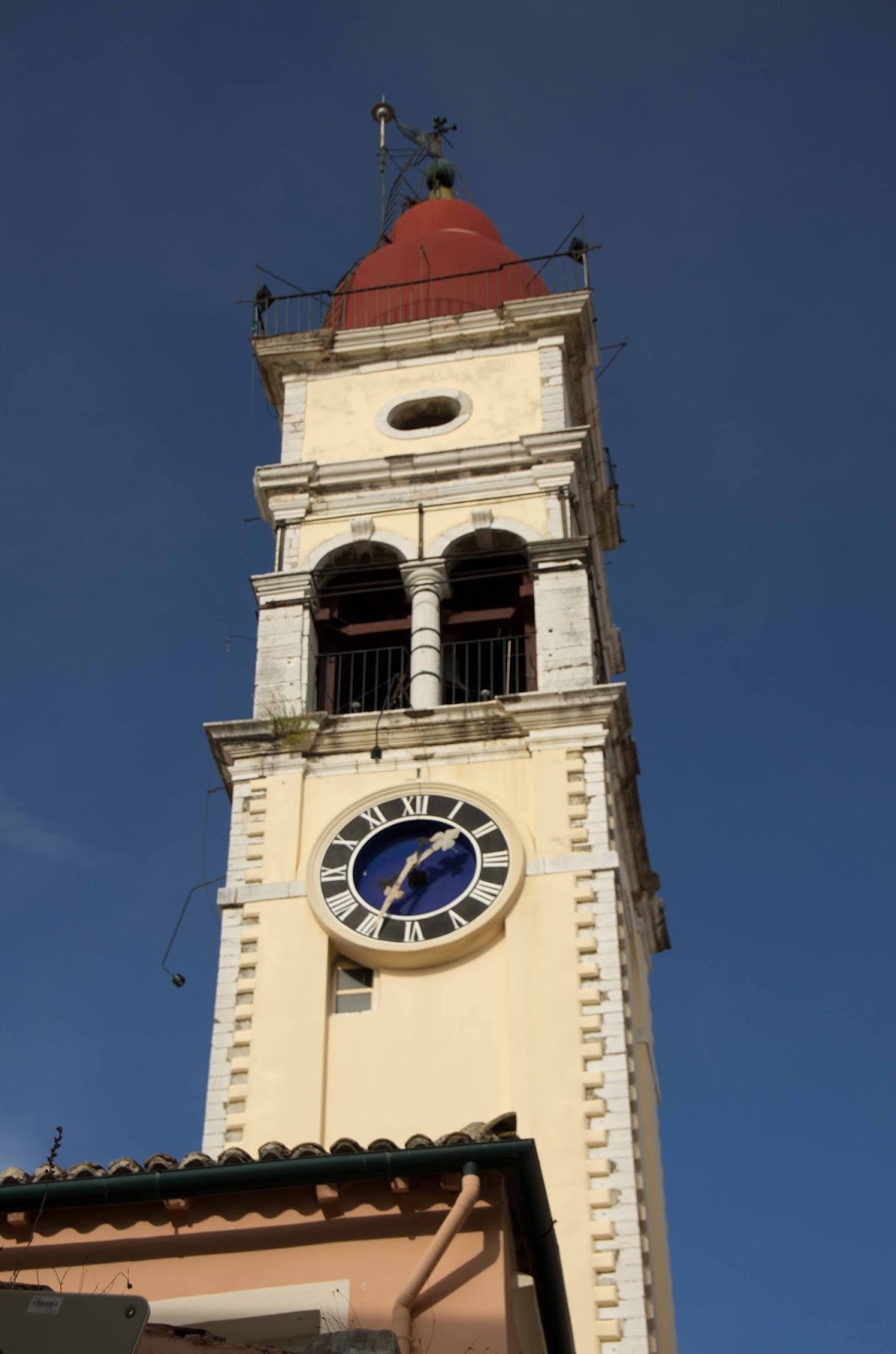
Church of Saint Spyridon
One of many outdoor chapels attached to a church
We saw several churches, the largest being the Church of Saint Spyridon, Patron Saint of Corfu built in 1596. Even with a service going on, our guide sent us inside to see the artwork which adorns every available space from floor to ceiling. According to her, people enter and leave services all the time, so we would not be any disruption at all. The church was packed to the gills already, so we had to take turns and only got a quick look to verify our guide’s words of praise for the artwork. Nearly half of the shops sold religious icons and knickknacks. We bought a couple of things before sitting down to a coffee and a milkshake with a WC and free internet. Stanford 41 – USC 31. Big smiles.

The new fortress - a new use for the moat 
A view of the old fortress from our ship
Our bus stopped next to the New Fortress built by the Venetians in 1577-78. To get to the Old Town we crossed what may be the largest city square in Europe. When the British took over the town, they fired a cannon from the fortress. No buildings would be allowed between the Fortress and the cannon ball’s landing site. The square is large enough for Greece’s only cricket matches.


Our other tour stop was the Achilleion. Built by the young Empress of Austria/Queen of Hungary in 1880-91 as a summer palace, it is magnificent structure atop a wooded hill in the village of Gastouri. She and her husband Emperor Ferdinand visited twice a year until she was assassinated by a fame-hungry Italian anarchist in 1889. It was sold by her heirs to German Kaiser Wilhelm II in 1907. 

The young empress
A sample of the fine works of art in the building
Wilhelm made several additions to the building over the years mostly to house his large staff. Perhaps the most significant change was to move the fabulous marble statue of the dying Achilles from its place of prominence overlooking the sea and replacing it with a larger than life bronze of a victorious Achilles. Achilles spear was topped with a gold tip that could be seen from his yacht. Legend has it that the first sailor to spy the spear on each trip was given a monetary reward.

Triumphant Achilles dragging Hector's body around the city of Troy
Achilles overlooking the harbor
Achilles removing the arrow from his vulnerable heel
Achilles dying pose
After World War I, the Greek government took control of the Achilleion. It was leased to a private company as a casino from 1962-1983 during which time it was used for the casino scene in For Your Eyes Only. It was restored in 1994 for a European Summit and today is a major tourist attraction. 

A common sight - Men talking over their morning coffee

Saturday, September 26, 2015

Venice: Part II


We stayed at Residenza degli Angeli, a small B&B two bridges from the Grand Canal. I wonder if Venetians think in terms of bridges to cross instead of distance between places. After carrying luggage between our Vaporetto stop and the B&B, that certainly is the way I would think, especially as we would be carrying groceries and other things from the store to our home. It’s hard to get most anywhere without crossing at least a couple of bridges.

Fortunately for us, Mario, our innkeeper, greeted us at the Vaporetto stop and helped us with our luggage. He also helped when we left. He said he wanted to be the complete innkeeper. He also got on the Vaporetto with us. I thought that was really nice, but he was just riding two stops to the fish market to get something for dinner and to have coffee with whatever friends he found there. The B&B was perfect. Mario gave us a hand-drawn map with directions to the B&B and major landmarks and, most importantly, to four recommended restaurants. The one we chose, Muro, was two bridges away. We ate outside where we could people watch while we ate the wonderful meal. We would definitely stay there again and will probably have another meal at that restaurant when we return for our week in Venice.
One of the dinosaurs
We also had a bit of a problem upon our arrival because of phones. We expected to be able to purchase a sim card for our phones there and make the necessary call to Mario so he could meet us. Unfortunately, unlike other airports, there are no sim cards available at the airport. They did have pay phones which I tried to use, but got no answer and then I had no idea what the recorded message said to do. It was, not surprisingly, in Italian. We decided to worry about that when we got to our Vaporetto stop.  Once there we simply asked someone for help and they called Mario who came a few minutes later to help. Stupid tourists can always get help if you just are not afraid to ask.

Some say that the only way to properly enter Venice is by boat. We got a good sense of how that is  when we left on our cruise. Cruises ships enter and leave port passing by the main part of the city providing fabulous views. We left at sunset so the views were even more spectacular.


Friday, September 18, 2015

Venice - First Impressions


The Grand Canal
We just  got back from dinner, so let’s start there. At the recommendation of our B&B host, we ate at a nearby place that was packed as soon as we arrived. We are still tired from two full days of flying so appetites were not huge, but we started with their daily bruschetta group. The tomatoes were rich and full of flavor, Linda liked the pizza-like topping, and I really enjoyed the anchovy paste mixed with Kalamata olives and tomato sauce. Linda opted for an artichoke penne pasta which she loved. 

I had a lobster spaghetti which was again flavorful and rich once I finished wrestling it out of its shell. A white truffle gelato followed by a couple of glasses of the house white finished off the evening.
The airport is small and easy to navigate. We quickly found our bus for the 13 km ride to the vaporetto which would take us down the Grand Canal to our stop. Unfortunately, we weren’t able to purchase a sim card in the airport so we had to ask a stranger to call our B&B to meet us at the vaporetto stop. We also had the pleasure of following one of the local “helpers” to the stop which was not well marked.  For some reason he led us to the second stop meaning we crossed the canal three times. Still, now we know where the train station is and how to get to our cruise ship tomorrow.


Our B&B is three bridges from our stop, but very easy to find. I think that people (at least the tourists) think of distances in terms of bridges because each means and up and down. After our orientation, we both showered. Linda chose to rest while I went exploring. Since it was 1:00 pm, my first exploration was a local bar for a beer and sandwich. I quickly discovered that it is hard to walk 50 yds without passing multiple shops and bars/restaurants.

The gondolas are beautifully outfitted.
One of the many delivery 'trucks'

This traffic jam included six gondolas, three delivery boats and two private boats.
It took about 15 minutes to clear. 
Fueled up, I took off for St. Marks Square. This took longer than expected, partly because of stops at the Hard Rock CafĂ© to buy a pin and Vodaphone to get a sim card so we can communicate online here like normal people. I also hit several blind alleys. Actually they are ‘blind’ only in the sense that you have to backtrack unless you want to swim or try to break the world long jump records.

This 'street' is quite wide.
Many small squares. Venetians used to get their water from collected rain out of wells like this one.

I wandered streets barely wide enough for two people and watched the gondolas fight with the delivery and personal boats for primacy on the canals, even the smallest ones. When I finally reached St. Marks, it took me a while to get oriented. It’s bigger than I expected and the main part of it is further from the water. We will learn more about that in a week as we spend more time in this beautiful city.

St. Mark's
Referring to something as ‘one of a kind’ today has lost its meaning, but this city fits. Because it was built on water, it has missed the programs other cities followed in turning their downtowns over to the car. Cars require much wider roads and straighter streets that actually go somewhere other than having to stop at the water. People dominate here as do small shops. The narrow streets and no cars make it hard to carry lots of purchases home if the home is more than a few blocks away. It is easy to see why people fall in love with Venice. Limiting the core area to boats and people creates and ambiance that is truly human in scope.
This black-headed gull is the only interesting bird so far.

Friday, February 20, 2015

Manatee


Yesterday, we drove about one hour north of Orlando to see the manatees that spend time at Blue Spring State Park for the winter. Because the water is a constant 73˚ they spend a good deal of time here during the winter when the temperature of the Johns River drops. Manatees get cold shock and die if the water temperature drops below 60˚ for any length of time. Blue Spring is about 1/3 mile from the river. The lagoon and the 104 million gallons of water it discharges daily provides enough for as many as 300 manatees at any one time.
Lots of young manatee. They stay with momma for up to two years. 
The park built a boardwalk the entire length of the lagoon providing great viewing of the manatees as they slowly make their way to the springs and back. The huge mammals can swim up to 13 miles per hour, but in the lagoon they seldom move more than one or two mph propelled by their huge tail which is strong enough to break the leg of a swimmer who gets too close. The front flippers are only used for direction.

The sad story for these amazing animals is that while they have no natural predators – the only such animal in the world – they are endangered because of humans. Most are killed when they are hit by the propeller of a speeding boat in the open water. Every manatee we saw had scars. The scars are easy to identify as they heal with a white scab that never goes away. The scars are therefore unique and used to identify individuals.
Injured manatees are given a tracking device when they are returned to the water.

They are also harmed by fertilizer runoff and plastic. Plastic is a problem because they are unable to digest it and it will block their intestines. There is a bill in the Florida legislature right now that would allow local jurisdictions to ban plastic bags. Unfortunately, the retailers and bag makers are fighting this quite reasonable idea. I was somewhat ambivalent about the paper/plastic choice until a few  years ago when we spent a week in Corpus Christie, TX. I was appalled at the number of plastic bags we saw littering the landscape, something one would never say about paper bags. Paper bags do of course end up as litter also, but they don’t blow around in the wind and cause the death of many birds and animals. When I visited Texas two years ago, I saw that several of the coastal towns now do prohibit their use which has made a huge visual change to the region. I hope Florida will follow suit. I also have hopes that Vancouver and Clark County will do the same although I have doubts that our current set of county councilors will do so since they are more focused on levying a litter tax on the local newspaper. They claim this has nothing to do with the fact that the Columbian keeps pointing out their myriad foibles or as they editor says, “They keep doing stupid stuff.”
Notice the tiny mouth
Meanwhile, we had a great time walking the boardwalk watching the manatees. We probably saw 200 of them as we wandered the park for about two hours. During the summer months they allow swimming and scuba diving in the lagoon, but not during the winter when the manatees are there.


We also spent some time examining the historic Louis Thursby house built in the 1870s atop an Indian midden. A midden is really a garbage pile of mostly shells left behind over the centuries by the local Indians. For the first several decades the Thursbys was a major stop for steamboats plying the Johns River which is navigable from Jacksonville to Orlando. The advent of the railroad eventually put an end to steamboat traffic and the state purchased the land as a park to protect the area for the manatees.
The Thursby House
 The 2400 acres is also home to many other endangered species including the Florida scrub jay, gopher tortoise, and Okeechobee gourds. One may also see black bears in the area. We did not see many birds, but were lucky enough to get some good views of the Florida scrub jay which is Florida’s only endemic bird. We had tried to find them on earlier trips to the state, but came up empty. Yesterday we were more fortunate.
The elusive Florida Scrub Jay
Before heading home, we drove through the small town of Cassadaga which claims to be the home of more psychics and mediums than any other town in the US. It did seem like every third house had a sign advertising the availability of the one or the other. We saw more black cats than we have ever seen in one place. You can’t drive through the town without having at least one cross your path. I hope that doesn’t lead to bad luck. The one hotel in town includes a store selling mystical ware and its own resident medium. They even have the Cassadaga Spiritualist Camp which takes up several acres with its buildings. We did not stop, but did enjoy seeing the sites. 


Saturday, December 27, 2014

Battlefields

Blood River

During our stay at the Spion Kop Lodge, we took advantage of our host Raymond Heron, an expert on South Africa’s wars, and asked him to take us on a tour of a couple of the battle sites. When we were here in 2012, he took us to the site of the Battle of Spion Kop which you can read about here. Spion Kop was one of the battles during the South African War which is better known as the Boer War.
This time we visited three battle sites from earlier wars between the Europeans and the Zulus which ended the Zulu threat to European efforts to take over the Zulu land. Coincidentally, these battles took place during the same period Americans were moving westward and doing the same thing to the Indians. In an even stronger coincidence perhaps, the Russians were expanding eastward to the Pacific Ocean at the same time.
The 1947 monument. This wagon is larger than life.
The Battle of Blood River was fought between 470 Voortrekkers led by Andries Pretorius, and 15,000–21,000 Zulu attackers on the bank of the Ncome River on 16 December 1838, in what is today KwaZulu-Natal, South Africa. The Zulu had developed a powerful attacking style emulating the horns of the cape buffalo. While the horns flanked the sides, the main body of the army attacked the front. with the enemy encircled one more portion of the army would sit with its back to the enemy until it was needed.

This and the next two photos show the 1971 monument with its 48 life-size bronze wagons.
At Blood River, the Boers negated the Zulu strategy by circling the 48 wagons where they were protected on one rear by the Ncome River and another by a dry riverbed. The front offered no cover for the attacking army. Before the battle, the Boers vowed that if God helped them win, they would build a church and honor the day forever as a holy day of God.

When the Zulus attacked, they were decimated by the Boers. As many as 3000 Zulus were killed while only three Boers suffered wounds. The Boers built their church in Pietermaritzburg and the holiday became known first as the Day of the Vow and then the Day of the Covenant. Today, December 16 is the Day of Reconciliation as the new South Africa tries to reconcile its racist, apartheid past with its non-racial future.


In 1947, the Afrikaners built a monument consisting of a larger than life granite wagon. Then in 1971, the monument was expanded to a life-size set of 48 bronze wagons staged in the laager formation including the three cannons deployed by the Boers. Then in 1998, the new government added a new monument and museum across the river. Ideally, the two monuments across the river from each other can provide symbols for reconciliation.

A Painting of the Reconciliation Ceremony
Our experience was ‘enhanced’ by a discussion by a young Afrikaner still living in the past. He made sure we understood he is not a racist, but he seemed mostly interested in making sure we understood that the Afrikaner is the superior race and was right to take the land. Change can be slow in coming. He was especially critical of the large mural in the new museum that he said misrepresented the battle. He would have been correct except for the fact that it is really showing the Reconciliation Ceremony that he should have attended. In the actual battle, the Zulus attacked from the field, not across the river and the Boers never left their kraal.

Isandlwana

The Battle of Isandlwana on January 22, 1879, was the first major encounter in the Anglo–Zulu War that the British instigated in its effort to unite South Africa under one rule. After creating a confederation in Canada in 1867, Britain decided to implement the same plan in South Africa. This would require defeating the independent Kingdom of Zululand. The British did not see this as a major obstacle given their overwhelming firepower and superior military training. Such was not to be the case however.

Isandlwana Peak
The war began when the Zulu rejected an ultimatum that would have destroyed the kingdom anyway. Among other things, it required a disbanding of the army and allowing missionaries total freedom within the kingdom. In early January, 1879, Lord Chelmsford began moving his troops in preparation for battle.
Upon reaching Isandlwana, Chelmsford divided his troops, taking the larger group and leaving a garrison at Isandlwana. The poorly led garrison neglected to create any defensive lines leaving itself open to attack as Chelmsford chased what turned out to be a feint by the Zulu.


On January 22, the Zulu army attacked using its buffalo formation easily surrounding the British force. The result was the worst defeat ever in a colonial war for the British. They lost approximately 1300 men of their force of 1800 including 52 officers.

Two of the British monuments. Many divisions have erected their own.
The Zulu memorial. This is a replica of the Zulu necklace.

The battlefield today includes four different monuments to the British dead and dozens of rock cairns painted white to mark the burial sites of British soldiers. A small museum and Zulu memorial are located nearby.

Rorke’s Drift

Isandlwana was immediately followed by a battle at Rorke’s Drift where 150 British soldiers held off an intense assault by 3000-4000 Zulu warriors while losing only 17 dead and 15 wounded. Rorke’s Drift had been designated for munitions storage. By the end of the battle, most of the ammunition the British had for the war had been depleted. Eleven Victoria’s Crosses were awarded, the most even awarded for a single battle in British history.

The hospital
 A drift is a river crossing. This one was named for its first owner James Rorke. At the time of the attack it was both a weapons depot and a hospital for wounded and sick soldiers. The awarding of the eleven Victoria’s Crosses has been criticized as an overreaction to the defeat at Isandlwana, but it is impossible to ignore the fact that this small group of soldiers, many of whom were sick and wounded managed to hold off the much larger Zulu force for over ten hours.


The two battles secured British public opinion in favor of the war. While the British would retreat for a time because of the losses inflicted here, they would invade Zululand a second time within weeks and finally secure victory in early July.