Thursday, August 22, 2019

Ol Pejeta: The Camp


 The camp at Ol Pejeta is more rustic than any others we have seen. The tents are really tents although they do have cement floors, king-size beds and full bathrooms. We do have to schedule our showers so the staff can bring a bucket of hot water. The water is raised above and released into the shower. It does provide plenty of pressure, more than we had in some hotels. One load was enough for both Linda and I to finish our showers. The lodge is a larger tent raised on a platform overlooking a pond. The tent is large enough to house the kitchen, bathrooms and two offices in addition to dining and lounging. 


The Shower Stall
Click to make larger
They fill the bucket with hot water
Then raise it so the water flows through the hose

Another view of the shower setup
On our afternoon drive duma took us by the ranch area of the Conservancy where they raise cattle. The ranch helps support the Conservancy and the cattle complement the wild animals that also graze on the land. These are brahma-like cattle with massive horns. They are controlled with an electric fence. Elephants are kept out with a unique set of electric wires at chest level. About two feet long they poke the elephants as they approach the fence which otherwise would offer no resistance to the huge elephants. Because the chest of the elephant is sensitive, these seemingly innocuous wires keep the elephants in their place. 

Nubian Woodpecker outside our tent

We made one interesting stop so Duma could show us some black rhino poo. Black rhinos have a narrow mouth which they use to pick fruits and leaves from trees and shrubs. As vegetarians, they have no incisors, only sharp molars that make 45 degree cuts as they chew on the branches. Duma found some example twigs in the poo for us. 


In addition to the cattle and poo, we had some good looks at hartebeest, warthogs, and waterbucks. We also spent some time at a waterhole where we saw a few shorebirds. Duma told us that the waterhole had some catfish even though it looked much too small to have any fish. Once it starts to rain the waterhole will fill  up and even overrun the banks. Last year it had flooded so much that it left fish behind as it receded to its current level. The predators and birds had a field day. 

Two pictures of waterbucks
A somewhat rare sighting.
Waterbucks usually keep the young ones hidden.
Warthog - He is not praying, just getting closer to his food

We are the only guests. The staff is attentive beyond measure and they make sure we always have someone to share the meal time. We had interesting conversations with the manager. Peter was a welder from Australia who met his Kenyan wife and moved to Kenya after they were married. He became interested in the birds and went to work for the company. He had to get a special work permit which took several months. The fact that married a Kenyan was no help and he said it would probably be impossible for someone to get a similar permit today. He also shared that his wife has trouble entering South Africa. Because she is a white person with a Kenyan passport, they pulled her aside for special interviews. 
 
Dining Table
Lounge
By the time we were ready for bed it was already cold. The camp gave us two hot water bottles to warm up the bed. The next morning they still had enough warmth to use to warm our clothes before getting dressed. They also gave us bottles to help take off the chill for the morning ride.

Wednesday, August 21, 2019

Ol Pejeta: Arrival

Cessna 208B Caravan, the plane of choice in this part of Africa
We arrived at the Nanyuki airport about noon where we were met by Duma, our guide. Duma means cheetah in Swahili. He was given the nickname because he is good a finding cheetahs on game drives. It turned out that he was good at finding all kinds of birds and animals, so we were happy. The Conservancy is about 30 minutes from the airport so we had to wear seat belts for the first part of our journey. We drove past the typical roadside restaurants, bars, and shops on our way. These are the strip malls of East Africa with several joined together in a row alongside the highway. Some are obviously open while others are more difficult to discern. They might be open or they might even be closed for good. We always saw people around them passing the time. Occasionally, they would have food or drink, but most of the time they seemed to be chatting or resting.


We crossed the equator twice before we reached the conservancy. The weather here is pleasant and not too hot, but still very dry. We are over one mile in elevation. We stopped at one of the equator crossings to take a couple of pictures. When we reached the entrance to the Conservancy, Duma registered our arrival. While he did that I talked to a young couple traveling on their own. They were from Spain and planned to spend a couple of days at the public campground.
Gazelle - the side stripe will disappear as males age
Conservancies are private concessions on land owned by one of the indigenous tribes. Tribes are paid a fee for their use so they won’t be developed as towns or farms. The leases are only temporary however, so there is often concern that when the lease expires, the tribe will end the conservancy arrangement to meet the needs of the growing population. This is one of the many pressures on African wildlife we learned about while on our travels.

Baby elephants are so cute


African Kingfishers are much more beautiful than ours.
This is a Brown-hooded Kingfisher
When we got back in our vehicle to head to camp, Duma told us we no longer needed seat belts. We would not be driving fast enough to need our seat belts and we were now off the main roads so we would not be stopped by any police looking for a chance to earn some money.

Elands are the largest of the antelope-type animals
Dry landscape
Another gazelle
On the way to the camp we saw a number of gazelles. These beautiful animals are similar to impala. They are the dominant antelope-type animal in this part of Africa in the same way impalas dominated the landscape in southern Africa. They are a more striking animal because most have a black stripe along the flank. On males this stripe disappears as they mature. This part of Africa has two different gazelles: Thompson (the smaller of the two) and the Grant. Other than size, they are difficult to tell apart.

Superb Starling
These birds are everywhere
We also saw elephants, reticulated giraffes, impala, and buffalo. And of course, we saw a number of birds. The most beautiful of these is the superb starling. Just like the European starling we have in the US, they are ubiquitous and a bit obnoxious, but at least they are native. The birds of Africa are generally more beautiful and interesting than those we have at home.

Yellow-necked Francolin

Tuesday, August 20, 2019

Nairobi - Karen Blixen House and David Sheldrick Wildlife Trust


After about half an hour we took a quick look in the gift shop and headed off to Karen Blixen’s house. Blixen, who was Danish, lived in Kenya from 1913-1931. She left Denmark to marry her first husband who wanted to establish a coffee plantation on land that he purchased. The marriage did not go well and they divorced in 1925. In the meantime she had met Denys Finch Hatton, big game hunter, with whom she had an affair that lasted until he was killed in plane crash while on safari in 1931. The coffee plantation had failed by then due to some mismanagement, a fire, world recession, and the fact that the land is really too high to grow coffee. Her book about her experience under the pen name Isak Dinesen became a best-seller and movie starring Meryl Streep and Robert Redford.


The grounds and house are now a museum providing guests a reasonably accurate picture of life during those years. The house is filled with artifacts and pictures and the grounds include some of the machines used to produce the coffee. The house is rather small by modern American standards, but well-appointed for tours.

Old machinery used for roasting coffee
We finished our house tour a bit earlier than expected so our guide suggested a visit to the Kazuri Bead Factory. The factory opened some 20 years ago to provide an income for unwed mothers. Today, it employs over 100 women and a few men making beads and jewelry. They have a gift shop on-site and sell all over the world through stores such as 10,000 villages. We purchased several items as Christmas presents and a couple of things for Linda’s personal collection.


Our final stop for the day was at the David Sheldrick Wildlife Trust: Haven for Elephants and Rhinos. We had read books by Diane Sheldrick about their work in Africa so we were anxious to visit here. We had also donated $50 to this trust as part of the cost of our trip thanks to Mango Safaris, our travel agent for this trip. With this money we became “parents” of Luggard, one of the orphaned elephants at the haven. We arrived at 5:00 pm in time to watch the animals return to their pens for the night after spending the day in the wilderness of Nairobi National Park which abuts the Trust land. The youngsters arrived right on time trotting past the line of proud parents. The head keeper named each animal as it passed by, but did not name Luggard. Nor did he name the elephant John and Cherie Briggs had adopted.


Of course, we asked what had happened. Lugard had been shot in the hind leg by poachers and was permanently injured. Because of that, he is slower than the others and would be pushed and shoved as they rush back for the night. He gets to come in to the pens earlier by himself to avoid that. Briggs’s elephant had already been released into the wild at Tsavo East, one of Kenya’s national parks. Each of the elephants is released after four years. We were surprised to learn that the trust doesn’t do anything special to prepare the animals for life in the wild. They release them in the vicinity of an elephant family that will eventually take them in and care for them - a real adoption. Even though Luggard will always be a bit slow, they expect that he will do fine once he is adopted. He will be released next year.


They also provide homes for rhinoceros although we only saw two. Maxwell is a blind rhino who is about 13 years old. He won’t be released into the wild and can expect to live the next 25 years or so in his pen. The other rhino we saw was only a few days old and seemed to be progressing nicely. Unfortunately, she died a few days after our visit. He had appeared to be healthy, but succumbed to some ailment in only a few hours and even with the veterinarian’s work, they were unable to save her. Rhinos are solitary creatures, so they are released into an area where they will have plenty of room or where they are strong enough compared to other rhinos in the area to protect themselves.


It is sad that this kind of effort is necessary, but with the continued presence of poachers and the unwillingness of nations like China and Vietnam to crack down on the smuggling, the animals need this kind of support to preserve the species.


We finished the evening with dinner at Tamarind, a very nice restaurant in one of the warehouses used by the Blixen coffee plantation. Looking around the restaurant, we noted that about 80% of the patrons were white. We were told that the Karen neighborhood is one of the nicer areas of Nairobi and very popular with diplomats and government officials.


The next morning we left early for the airport and our flight to Ol Pejeta and our first safari camp. On our drive it soon became evident why tours avoid driving in the downtown area of the city. Even though this national airport was only about half the distance it would have been to the international airport, it took us twice the time as it had two nights before. And this was without any accidents. Wilson Airport is one of Africa’s busiest because it handles all the national and regional flights out of Nairobi. Each small airline has its own small terminal building. Our guide took us to the door and helped us load our bags right onto the security belt right inside the door before he had to whisk away to his next gig. We had been told that they would weigh every bag and perhaps even our bodies to make sure we were not over the weight limit. Technically, we were limited to 33 pounds including all our carry-ons. Any passenger over 220 pounds is supposed to be paying for two passengers. I had taken both cameras, lenses, and binoculars out of the camera bag hoping that would leave us close to the 33 pound limit. Then they only weighed out checked luggage. When Linda realized that, she added her back pack to the checked luggage and we entered the small waiting room to await the call to our flight.

Our plane was a 20 seat Cessna with only about 12 passengers so Linda and each got our own row. I spend part of the flight talking to a travel agent from Toronto who knows Suzanne, our agent from Mango. On the 90 minute flight, we took a few pictures of the landscape and noted the small farms that make up most of the land beneath us even as we approached the Ol Pejeta Preserve where we would spend the next three days. As long as the population keeps growing, the pressure will continue to open up more wilderness for more of these small farms, necessary to provide both jobs and food for the growing population. It’s not a promising situation for the wildlife that brings us to this beautiful and fascinating continent.

Sunday, August 18, 2019

Macushla Hotel - Nairobi


We arrived at the Nairobi airport about 7:30 pm and quickly passed through customs. We had been warned that it would be chaotic with lots of people waiting for the new arrivals and many clamoring to be the one to help you get to your destination. However, it really wasn’t much different from any other airport when you arrive from an international trip. As long as there is a space for new arrivals to stop and look around before entering the crowd, you have time to either find your ride or check out the signs and note where the help might be. We had a driver waiting so once we saw our names, we headed out for our driver and left the airport.


I had a much more chaotic arrival 20 years ago in Ghana where that separate area wasn’t available and we were immediately accosted by folks wanting to be our personal guides. Fortunately, I was part of a large group there and our leader, who was from Accra, quickly found his brother waiting for us and we were on our bus headed for the hotel. We talked to a couple of guys later who had not been so lucky. They had accepted a ride from a taxi driver who took them to Cape Coast, about three hours away. $300 later they were at their hotel. The ride should have been less than $50 even for that distance given the taxi rates in Ghana at the time.


Interesting pool fountain
No worries for us as we headed for our hotel, the Macushla House in the Karen District of Nairobi. We had an easy drive as it was well past rush hour and we bypassed the center of town. I asked our driver/guide later about tours that included central Nairobi. He said they only do those on weekends because traffic is so bad most of the tour would be sitting in traffic. Built about 20 years ago, the Macushla House has a colonial feel to it appropriate for a neighborhood named after Karen Blixen author of Out of Africa. She had lived nearby.


Dark, heavy beams and large furniture highlight the common areas. Our room was similar to the ‘tents’ we have stayed in at safari camps. A large room with a huge double bed surrounded by a mosquito net and a full bathroom make for a nice place to spend a couple of nights. The next morning was unscheduled time, so after the typically large breakfast I explored the hotel grounds. A large tiled pool with a crocodile fountain is the highlight. The grounds are small, but there is about an acre of natural area where I was able to spot a few birds. Out front I found a family of capuchin monkeys including one very young sprout feeling his oats and trying to get some distance between herself and the parents, unsuccessfully.


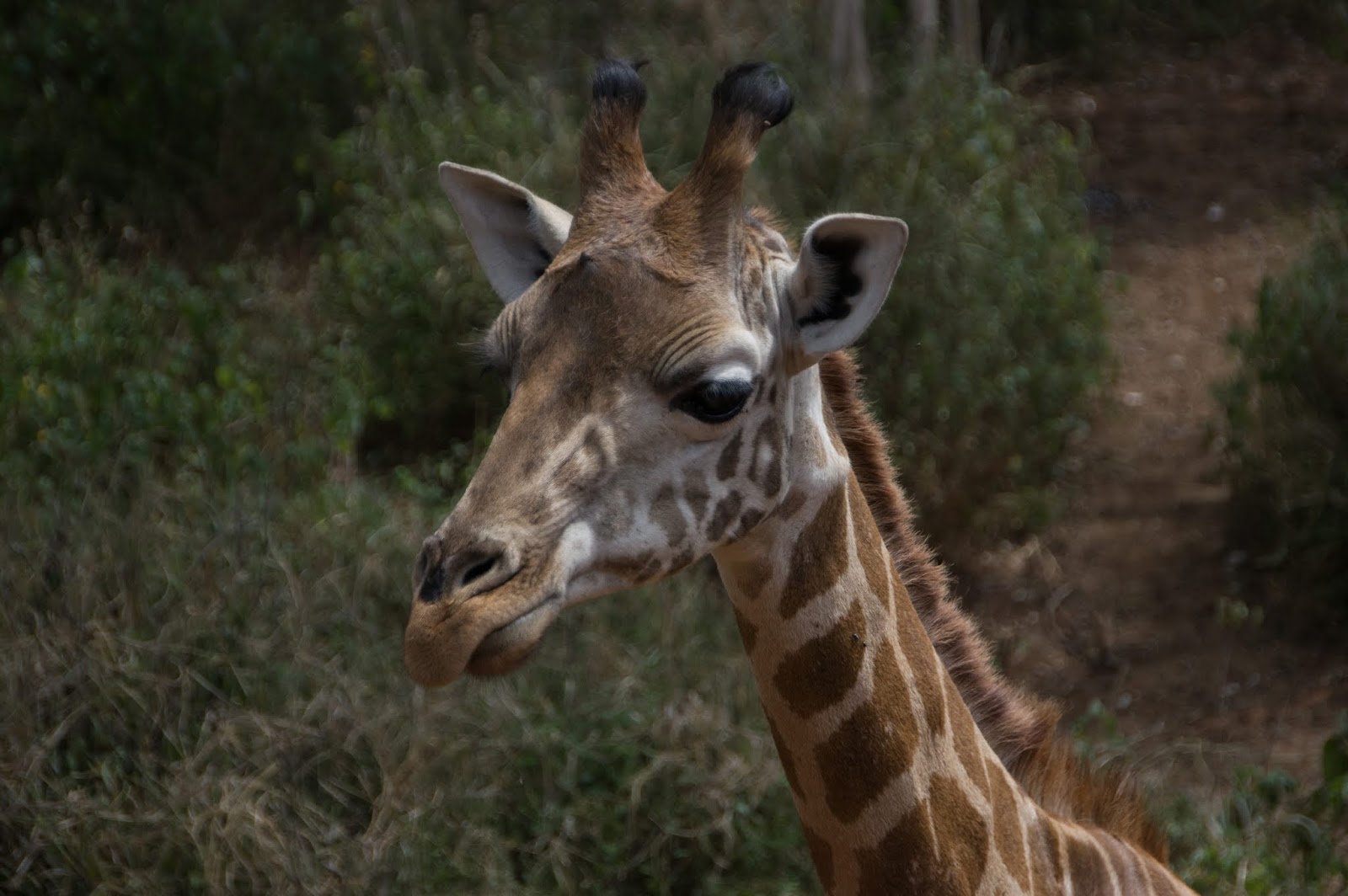
Our guide arrived about 2:00 to take us around. Our first stop was the Giraffe Centre where they are working to save the Rothschild Giraffe. Found mostly in Uganda, southern Sudan, and northeastern Kenya, there are only about 1700 left in the wild making them the most endangered of the nine giraffe subspecies. Rothschild giraffes are differentiated by the jagged edges on their spots, no spots below their knees, the five ossicones (horns) on their heads. No other giraffe has more than three ossicones. The preserve is quite small with a two story viewing building where visitors can hand-feed the giraffes from the sack of pellets given to everyone as they enter. The interior of the viewing building has displays about giraffes and the preservation efforts. The giraffes kindly stick out their tongues to take the pellets so there is no danger of being bitten although some will head butt you if you get too close.


Just let it lick or it might bite


A pair of warthogs mock fighting adds to the color

Wednesday, January 30, 2019

East Africa Itinerary - 2019

We leave for East Africa on February 28. After a stopover in New York City, we travel through Dubai on our way to Nairobi, Kenya where we arrive on Sunday, March 3. We spend our first two nights at the Macushla House about 20 miles from the city center. While there we will have a half-day tour of Nairobi. We will also be visiting the Karen Blixen Museum. Karen was the author of "Out of Africa" made into a movie starring Robert Redford and Maryl Streep. We will probably also visit the nearby Giraffe Center and will certainly make a stop at the Daphne Sheldrick elephant orphanage. We have adopted one of the orphan elephants and are anxious to see him in person.

We will be stopping at three safari camps in Kenya
Then we move on to Tanzania and two more safari camps with a private guide. Part of this time will be a visit to the Ngorongoro Crater.
Before we leave Tanzania we will spend our last few days on Zanzibar. Zanzibar is a source of some of our spices and served as both a slave port and a staging site for many of the early European explorers.
Finally, we have a couple of days in Dubai before returning home to Vancouver.

I won't promise regular postings while we are traveling, but will be posting blog entries for the entire trip once we return.